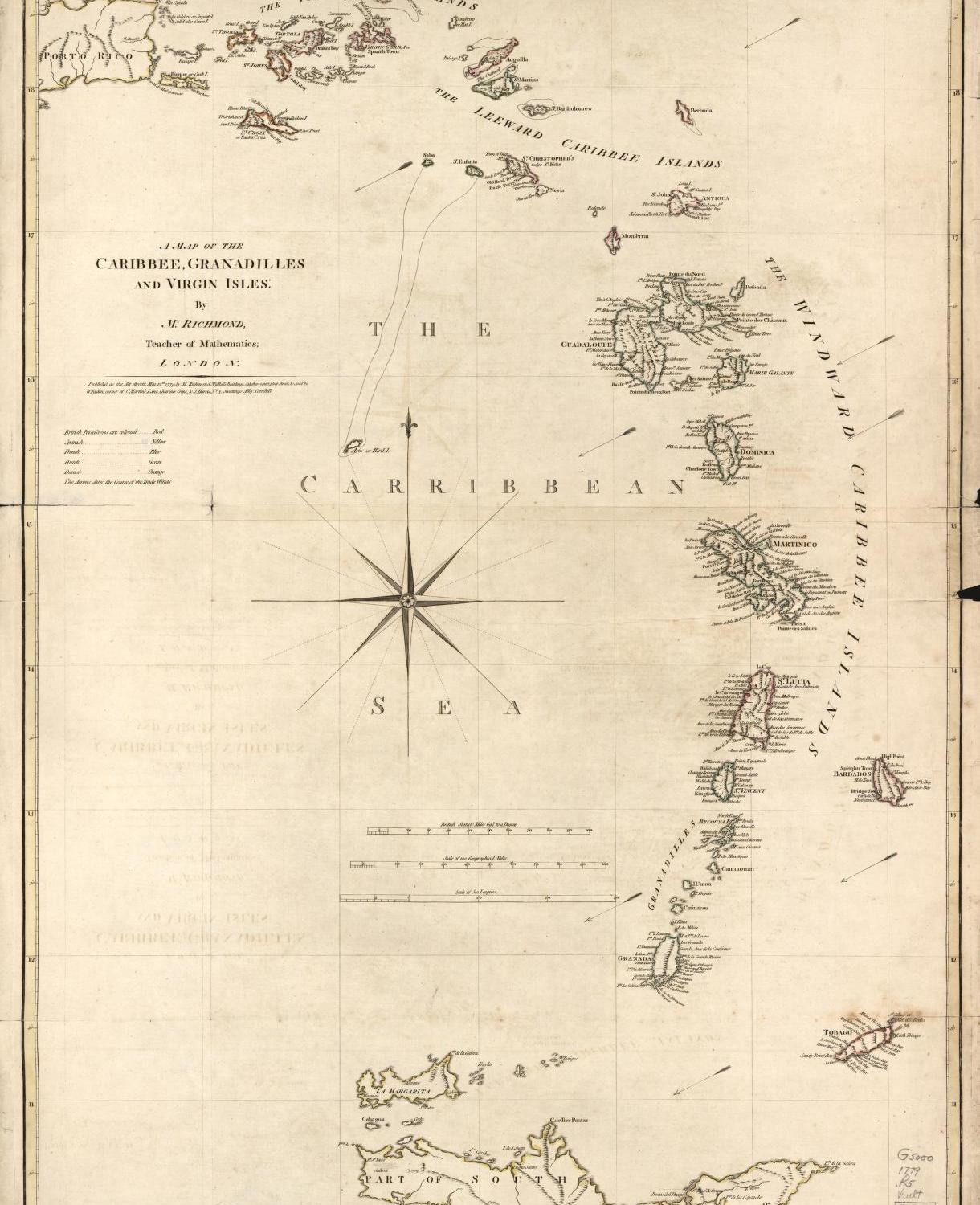
Do the Antilles belong to North America? During the American Revolutionary War, it depended on who you asked.
Historical research often turns up documents that leave you with more questions than answers. A brief note regarding a conversation between the representatives of the Hessian Landgrave and the French king in the spring of 1779 serves as a good example.
Most of the subsidy treaties Britain concluded with the six German territories specified the geographic regions where the troops could or could not be employed. Only Anhalt-Zerbst and Hessen-Hanau kept is vague, with the former mentioning the troops’ intended destination only in passing, in a clause that required Britain to reimburse the territory for losses suffered on the voyage to America, and the latter making no mention of America whatsoever. The other four territories included restrictions in their treaties with Britain. Ansbach did not permit the employment of its soldiers in South and Southeast Asia but otherwise left their use up to the king. The treaty with Braunschweig limited the employment of its troops to Europe and America, while Waldeck restricted the use of its troops to Europe and North America.
The treaty with Hessen-Kassel stipulated that “In Europe his Majesty shall make use of this body of troops by land wherever he shall judge proper; but North America is the only country of the other parts of the globe where this body of troops shall be employed. They shall not serve on the sea…”

It would appear, then, that Britain was not permitted to employ Hessians in the West Indies, for example, including the Lesser Antilles, the string of islands in the Caribbean Sea stretching from the Virgin Islands in the north to Trinidad, near the Venezuelan coast, in the south. After all, geographically, the Antilles are not part of North America.
But in the spring of 1779, this is exactly what the French suspected was happening.
In early November 1778, a large British convoy consisting of warships and transports departed Sandy Hook, New Jersey, bound for the West Indies. Carrying 5,000 soldiers under Major General James Grant, it arrived in Barbados on December 10, where it joined a British fleet already operating in the area. Three days later, the combined force launched an attack on St. Lucia, a French island in the Lesser Antilles, successfully landing troops on its shores. The next day, a large French fleet under the Comte d’Estaing arrived, and the two sides engaged in a series of fierce naval battles. However, the French were repeatedly repulsed. In late December, they sailed away, and the island surrendered to the British.
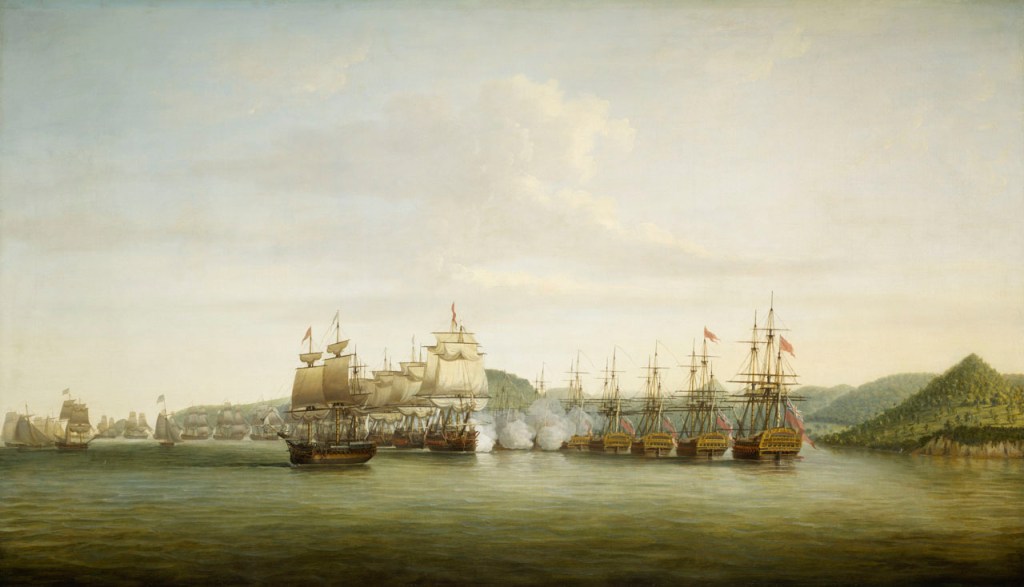
Who were the troops commanded by Major General Grant that participated in this campaign? In his “Narrative of the Occupation and Defence of the Island of St. Lucie,” Lord Colin Lindsay wrote that “Ten regiments were immediately named for this service, and by drafts from other corps were completed to five thousand men.” These ten regiments were British. No German regiment was selected for this expedition. Yet is it conceivable that individual Hessians ended up among the men chosen by draft, even without a German regiment being formally involved? Is it possible that a smaller Hessian unit was included? Or perhaps they believed that Hessians were among the reinforcements with another British fleet that reached the West Indies in early 1779? Whatever the source of the idea, the French seem to have believed Britain was employing Hessians in that theater. And they were not pleased about it.
In March 1779, the French representative, the Comte de Grais, complained to the Landgrave that Hessian soldiers were participating in the British campaign against the French in the Antilles. The document featured in this post summarizes the Hessian response. In a nutshell, the Landgrave thought that the complaint was unfounded. He neither confirmed nor denied that Hessian troops had actually been sent there, likely because he himself could not be certain. But, more importantly, he argued that Britain’s employment of Hessians on the islands did not violate the terms of the subsidy treaty at all, since the Antilles “were deemed to belong to” North America. The phrasing is important. The Landgrave did not assert that the islands were part of North America geographically; rather, he invoked a legal classification that deemed them to belong to that part of the world. It was a more expansive definition of North America that served his interests just fine.
There is no evidence that Britain employed Hessian troops in the Antilles — or, for that matter, anywhere outside the North American continent. Still, this French complaint raises the question of whether they were in fact used in the Caribbean, perhaps less formally, whether this was merely a rumor, or whether France had some other motive for lodging the objection with the Hessian Landgrave.
ENGLISH TRANSLATION
Kassel, March 26, 1779
Yesterday’s audience with the French envoy Count de Grais
Privy Councilor and Chief Chamberlain [Julius Jürgen von] Wittorf is to inform the French envoy Count de Grais in response to the remarks made yesterday during a special conversation with His Highness that:
As the tenor of the Treaty stipulated that the troops in the pay of Great Britain would be employed in North America, and that the Antilles Islands were deemed to belong to this part of the world, His Serene Highness could not depart from the terms of the Treaty.

TRANSCRIPTION
Cassel d 26t Martz 1779
Die gestrige Audientz des frantzoischen Gesandten Cte de Grais
Der Herr Geh[eim]rath und Ober Cammerherr [Julius Jürgen von] Wittorf hat dem frantzoischen Gesandten Cte De Grais auf die gestern in einer besonderen Unterredung Smo gethane euserungen, zu erkennen zu geben:
Comme la Teneur du Traitte statuoit, que les Trouppes à la Solde de la Grande Bretagne sevoient employées dans l’Amerique Septentrionale, et que les Isles Antilles etoient censées appartenir à cette partie du monde S.A.S ne pouvoit pas se Departes des Termes du Traitée.
[Translation: Da der Wortlaut des Vertrags festlegte, dass die in britischem Sold stehenden Truppen in Nordamerika eingesetzt werden sollten, und da die Antillen-Inseln als zu diesem Teil der Welt gehörig galten, konnte Seine Durchlaucht [S.A.S. = Son Altesse Sérénissime] nicht von den Bedingungen des Vertrags abweichen.]
Citation: Forderung des französischen Gesandten Comte de Grais, daß die nur für Nordamerika bestimmten hessischen Truppen von den Antillen zurückgezogen werden (1779), 4f Staatenabteilung, Frankreich, Nr. 1711, Hessian State Archives Marburg.
Featured Image: M Richmond, William Faden, and J Harris. A map of the Caribbee, Granadilles and Virgin Isles. London, Publish’d by M. Richmond; sold by W. Faden & J. Harris, 1779. Accessed at Library of Congress.


One thought on “The Antilles Belong to North America. Kassel, 1779.”