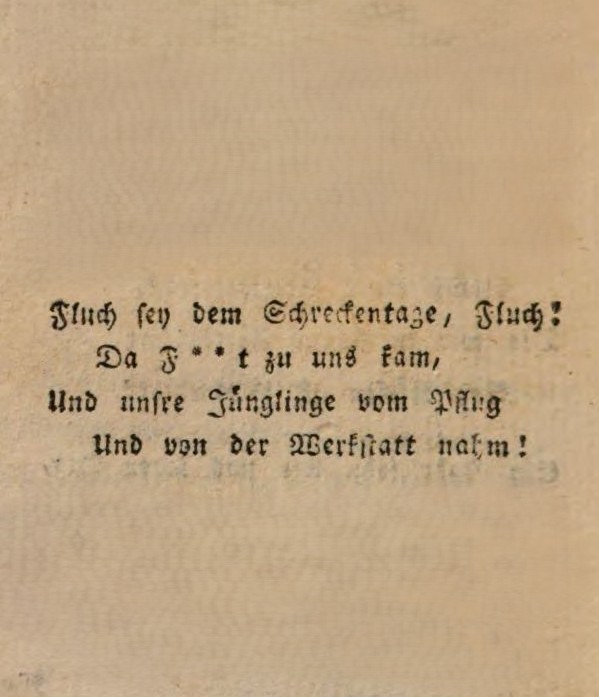
In the last quarter of the eighteenth century, dozens of poems, songs, and similar literary works about the German auxiliary troops serving in America were composed throughout German-speaking Europe. The topic was on everybody’s mind, and with censorship laws limiting direct political commentary in many German states, literary works became a popular — and safer — means of expressing opinions about it. These works represent a range of views. Some celebrated the “Hessians” as heroes marching off to glory. Others depicted America as a kind of promised land where the soldiers would find fortune. Still others expressed sympathy for the German soldiers as victims of greedy and tyrannical princes. And then there were the sad, melancholic pieces that reflected the heartbreak of families whose father, husband, son, or lover was going to war in America.
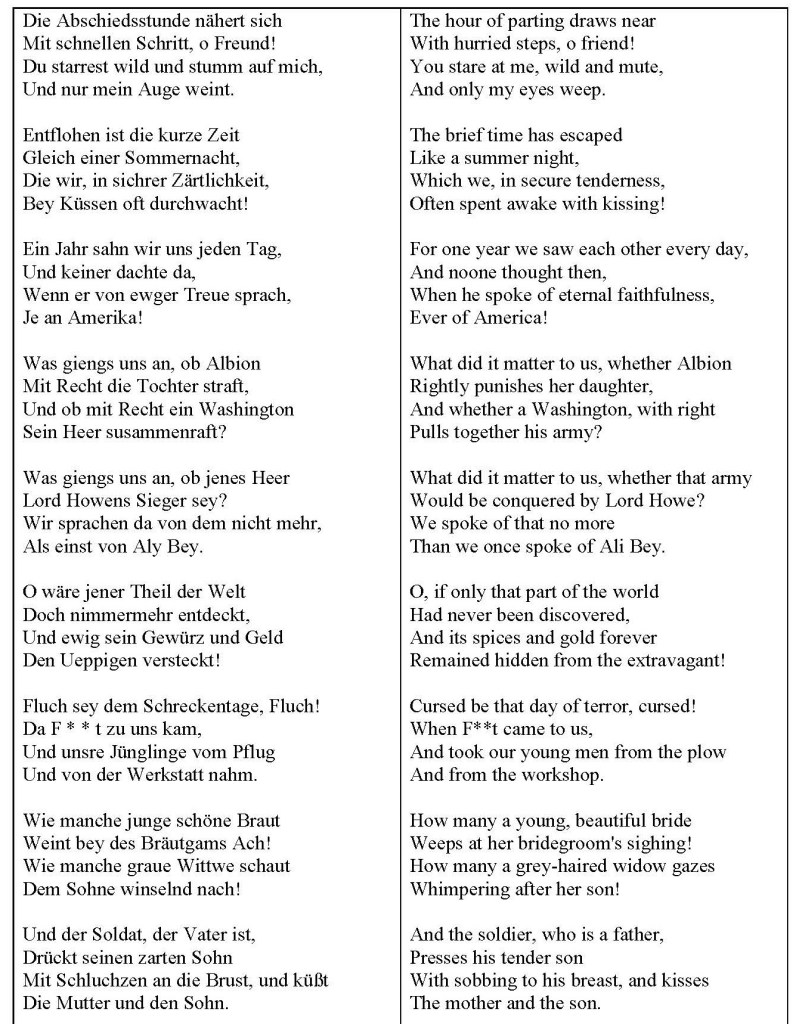
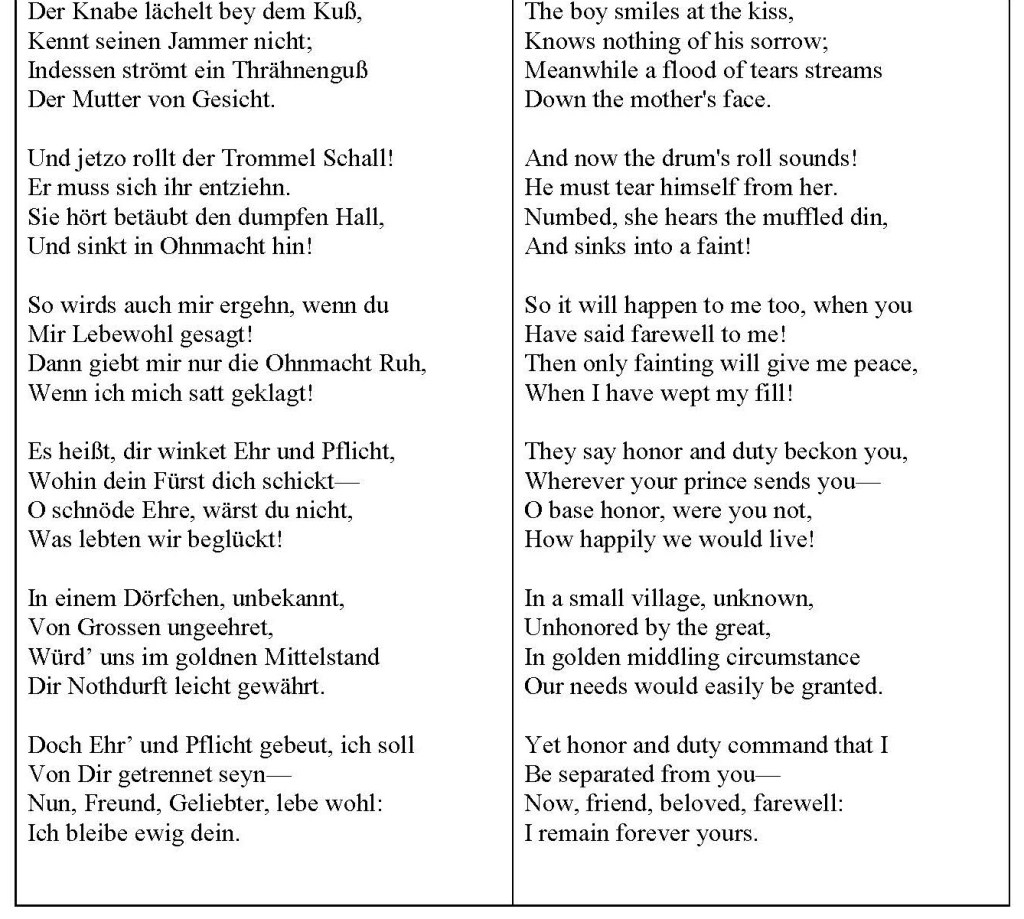
The item featured in this post belongs to this last category. It is Johann August Weppen’s poem “Klage einer Hessin bey dem Abschiede ihres Geliebten [Lament of a Hessian Woman at the Farewell of her Beloved].” The poem first appeared in 1778 in the popular periodical Musen-Almanach für 1778. Herausgegeben von Johann Heinrich Voss (pp. 189-192). It was subsequently printed in various other publications, including in the volume Gedichte von Johann August Weppen (Carlsruhe: bey Christian Gottlieb Schmieder, 1783), 352-354.
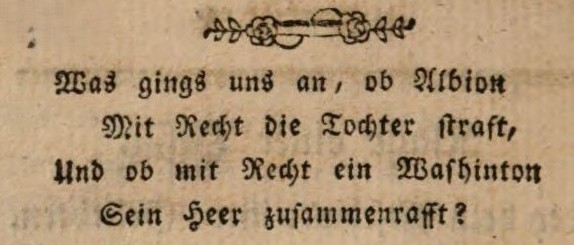
Weppen, a lawyer from Göttingen, never enjoyed much of a reputation as a poet. However, he returned to the theme of German soldiers in America a few years after writing “Klage einer Hessin,” this time in the form of a comedy (Lustspiel): Der hessische Officier in Amerika [The Hessian Officer in America], which was published in 1783.
A couple of notes on the text:
F**t refers to Colonel William Faucit (also spelled Faucitt), the British emissary who was sent to the six German territories to negotiate the subsidy treaties for Britain’s hire of German troops in the American war. The first of these visits took place in November and December of 1775, when he traveled to Braunschweig, Hessen-Kassel. and Hessen-Hanau.
Ali Bey refers to Ali Bey al-Kabir, an Egyptian Mamluk whose rebellion against Ottoman authority in the late 1760s and early 1770s was widely reported in European newspapers. Ali Bey died in Cairo in 1773.
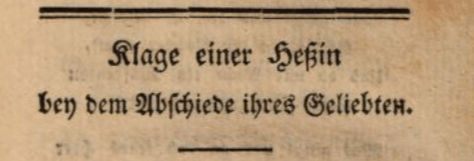
Klage einer Hessin bey dem Abschiede ihres Geliebten [Lament of a Hessian Woman at the Farewell of her Beloved].


One thought on “Lament of a Hessian Woman. Hessen, 1778”