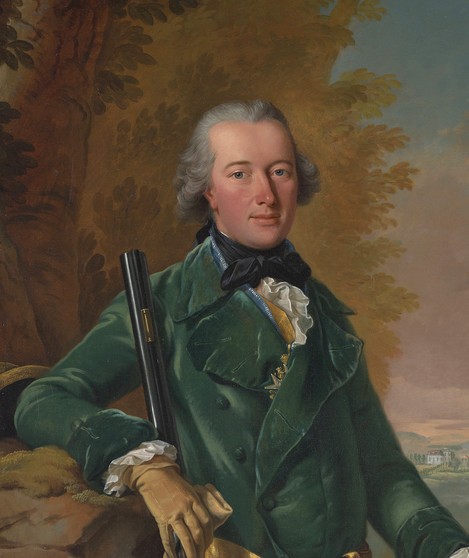
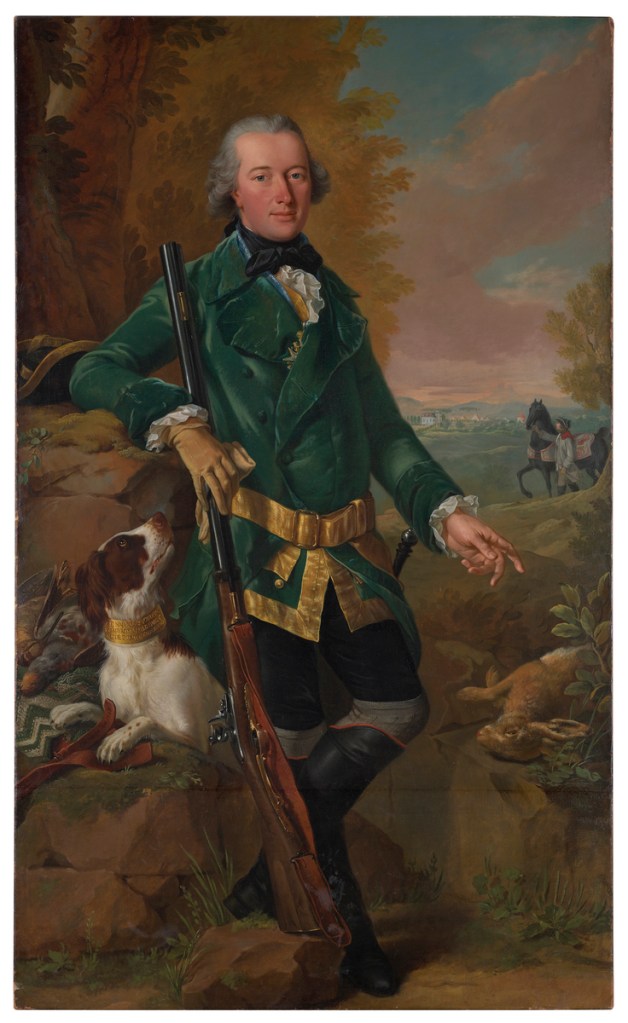
The Hessian Colonel Carl Emil Ulrich von Donop is associated with two significant events in the American Revolutionary War. The first is the Battle at Trenton in December 1776, where he failed to come to the aid of the beleaguered Hessian garrison under the command of Colonel Johann Rall, which was ultimately forced to surrender to the Americans. The second is his role in the Battle of Fort Red Bank (also known as Fort Mercer), New Jersey, on October 22, 1777. Donop commanded the corps of roughly 2,000 mostly German soldiers that undertook this disastrous attack. They suffered as many as 500 casualties, with close to 100 killed. Mortally wounded, Donop died a few days later at the Whithall House near the fort, where he had been taken.
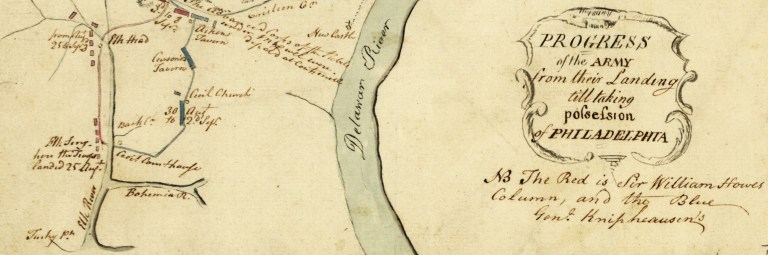
The Battle of Red Bank was part of the Philadelphia campaign. In late August, a large British force under General Howe had landed at Head of Elk, Maryland, and marched north toward Philadelphia. On September 11, the army clashed with Washington’s forces at the Battle of Brandywine, resulting in a British victory that cleared the road to the city. Two weeks later, the British marched into Philadelphia unopposed. The objective of the attack on Red Bank several weeks later was to eliminate the American position blocking British vessels from reaching Philadelphia.
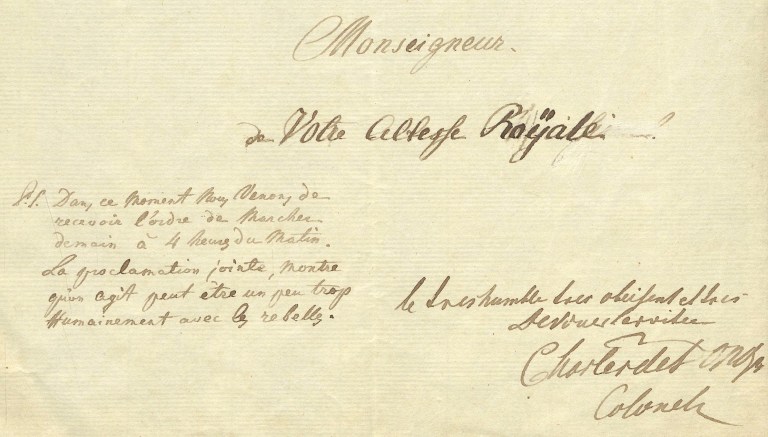
The document featured in this post was written by Donop roughly seven weeks before his untimely death at Red Bank. It is a letter to his friend, Prince Friedrich Wilhelm of Prussia, who would ascend the Prussian throne in 1786 as King Friedrich Wilhelm II, following the death of his uncle, Frederick the Great. Hoping for an appointment in Prussian service after his return to Hessen, Donop regularly informed the prince of his exploits in the war. He also freely voiced his opinions of British strategy and conduct, which were highly critical. The letter is in French, the dominant language of aristocratic correspondence, diplomacy, and court life among Germans in this period.
The letter is representative of Donop’s views on the British approach to fighting the war. In it, he describes the Philadelphia campaign as a major mistake. Had Howe’s army instead been sent north, he argues, it could have joined Burgoyne’s forces, combined with the regiments stationed in Rhode Island, taken control of New England, and then driven Washington’s army as far south as Virginia. The rebellious provinces, Donop speculated, would have been insane not to beg for peace. Instead, in early September, rather than enjoying “one of the most glorious campaigns,” Howe’s army found itself vulnerable to attack by a steadily growing and increasingly well-trained American army.
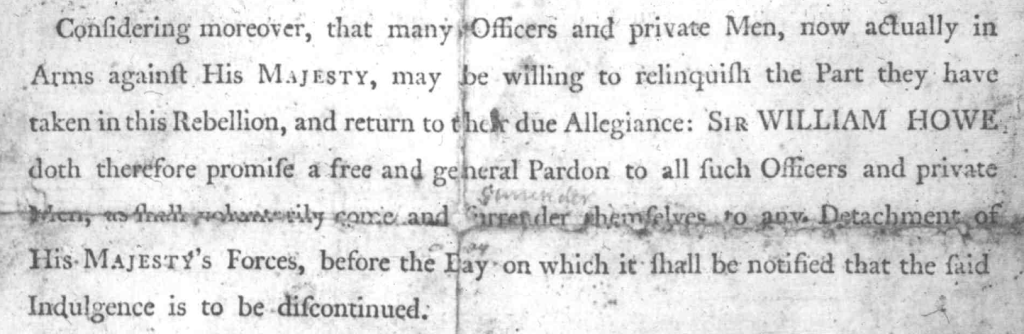
Moreover, Donop thought that the British were “perhaps acting a little too humanely with the rebels.” As evidence he enclosed a proclamation. This document, while not preserved in the prince’s archives, was undoubtedly General Howe’s declaration from only a few days before, promising “Security and Protection” to persons who “may have acted ilegally in subordinate Stations,” and issuing a “free and general Pardon to all such Officers and private man, as shall voluntarily come and surrender themselves to any Detachment of HIS MAJESTY’S FORCES.”
Donop was not wrong when he argued that the Philadelphia campaign was a mistake. With the advantage of hindsight, it seems likely that the war could have taken a very different turn had Howe’s army marched north toward Albany instead.
Note: The transcription of the French text preserves it exactly as written, including any errors in the original.
ENGLISH TRANSLATION
Head of Elk, in the Province of Maryland, September 2, 1777
Your Highness!
Your Royal Highness will have received the account which I took the liberty of sending. It was written up to July 6th, the point at which this journal begins. I am sorry, my lord, that Your Royal Highness will find nothing remarkable in it, or worthy of attention.
However, my lord, if I may dare you what I think of our present situation, I would declare that our expedition into the southern parts is not to my liking. For if, instead of coming here, we had sailed for New England and joined Burgoyne’s army, we would surely have brought this province and its capital back to their duty before the end of this month and thereby put an end to the rebellion in that northern part. Our army would have been spared the excessive heat it has had to endure and would have maneuvered in New England with 8 battalions more, for it could have joined up with the 8 battalions that are on Rhode Island. Burgoyne’s corps would not have suffered the setback that Colonel Baum [Benn] met with, along with 1,200 men of the Brunswick troops and 300 English, and our army could easily have repelled Washington’s, had he taken it into his head to follow us and cross the North River. But we could also have pursued him beyond the Delaware and driven him before winter as far as Virginia. For, in all likelihood, he would not have dared to risk a battle against an army of 35,000 men. In short, I believe we would have had one of the most glorious campaigns, and perhaps, before its end—peace.
For if all the provinces from Quebec to Virginia were cleared of rebels, the rest would have to have lost their senses if they did not beg for pardon and accept peace.
At present I can regard our army only as a flying corps, risking entry into a country entirely surrounded by enemies, who trouble themselves very little about it, knowing that we shall be obliged to abandon it again. What follows will show whether I am mistaken in my thinking. Washington has his main force on the heights of Wilmington—but he also has, at the same time, two intermediate posts: one of 700 men on the Iron Mountains [Iron Hill], and another of 4,000 men, who are said to be entrenched near Christiana Bridge. His total strength is put at 40,000 men; it may indeed be that strong, for lately the ranks of the rebels [“race des rebelles”] has increased greatly. In the meantime, I hope they stand their ground, and that we — I mean the English! — press our attack a little more closely, for without that, I still have no notion that assures me an infantry whose files stand four feet apart can scale entrenchments, or hold firm against cavalry, of which the rebels have a far greater number than we do, and which, by all appearances, is not among the worst. Besides, we have left the rebels too much time to become soldiers; they are drilled by French officers—and I do not quite know how our general would extricate himself from the affair if Washington took it into his head to advance suddenly upon us. For these past two days General von Knyphausen has been detached with 3 brigades and half of the 16th Regiment of Dragoons to the left bank of the Elk River, in the county of Delaware, and it is impossible for us to rejoin him before crossing Christiana Bridge.
Washington finds no obstacle to falling upon us, or upon Knyphausen’s corps; that is why I wish we would march as soon as possible, so as to make ourselves masters of Christiana Bridge before the enemy opens its eyes.
I wish above all, out of true attachment to the Howe brothers, that our campaign may be a fortunate one, or that our present expedition may have been undertaken by express order, so that they may bear no responsibility for it—for they are surely both persons of distinguished merit. Time has not permitted me to send Your Royal Highness any plans for the present—I shall take the liberty of doing so by the first ship. In the meantime, my lord, permit me to lay myself at the feet of Your Royal Highness, and to remain, with the most profound respect,
My Lord, Your Royal Highness’s most humble, most obedient, and most devoted servant, Charles de Donop, Colonel
P.S. At this moment we have just received the order to march tomorrow at 4 o’clock in the morning. The enclosed proclamation shows that we are perhaps acting a little too humanely with the rebels.
TRANSCRIPTION
Head of Elk, dans la Province de Maryland le 2 de Septbr: 1777
Monseigneur!
Votre Altesse Royale, aura reçu la rélation que je pris la liberté de Lui envoier. Elle étoit Ecritte jusqu’au 6. de Juillet, Epoque ou ce Journal commence. Je suis fâché Monseigneur que Votre Altesse Royale, n’i trouvera rien de remarquable, et digne de Son attention.
Cependant Monseigneur, Si j’osois vous dire, ce que je pense de notre Situation présenter, Je déclarerois que Notre Expédition dans les parties du Sud, n’est pas de mon Gout. Car Si aulieu de venir ici, nous aurions fait voila Sur la Nouvelle Angleterre, et que nous nous Soions joint à l’armée de Bourgoigne, Nous Aurions Seurement fait rentrer Cette Province, et Sa Capitale à Son devoir, avant la fin de ce Mois. et parcontre mis fin à la rébellion dans cette partie du Nord. Notre Armée auroit été dispensée de Chaleurs Excessives, qu’elle à été Obligé de Supporter, et auroit Manoeuvré dans la Nouvelle Angleterre avec 8 Bataillons de plus; Car Elle auroit pu faire joindre à Elle, les 8 Bataillons qui Sont Sur l’Isle de Rothe [Rhode Island]. Le Corps de Bourgoigne [Bourgoyne], n’auroit pas Subit l’Echec, qu’a eu le Colonel Benn [Baum], avec 1200 hommes, des Trouppes de Brunswic et 300 Anglois, et Notre Armée auroit pu facilement repousser celle de Vashington [Washington], S’il lui avoit prit Envie de Nous Suivre, et de passer la rivière du Nord, Mais aussi Nous l’aurions pu Suivre jusqu’au dela du Dèlavare, et Chasser avant l’hiver jusques dans la Virginie. Car Suivant toute Apparence, Il n’auroit pas Osé risquer une Bataille, contre une Armée qui étoit forte de 35 Mille Hommes. Enfin je crois que Nous aurions Eu une Campagne des plus Glorieuse, et peut être avant Sa fin — La Paix.
Car, Si toutes les Provinces dés Quebec, jusqu’en Virginie, étoient Nettoies de rebelles, Il faudroit que le reste ait perdu la Trémontade, S’ils ne demandoient pardon et N’acceptoient la Paix.
A prèsent je ne puis considerer notre Armée que comme un Corps Volant, qui Hazarde d’Entrer dans un Païs, qui est tout Entourré d’Ennemis, qui s’embarassent fort peu, Sachant qu’on sera Obligé de l’abandonner dérèchet. La suitte fera Voir Si je me trompe dans mon Idée. Vashington à sa force Sur les Hauteurs de Vilmington [Wilmington]— mais à aussi en même tems deux Postes intermédiaires, l’un de 700 hommes, sur les Montagnes de fer, et lautre de 4000 hommes, qui doivent être retranchés près de Christin brück [Christiana Bridge] — On fait monter toute sa force à 40000 hommes Elle peut être aussi forte, Car depuis peu la race des rebelles, s’est augmentée de beaucoup — En attendant je souhaitte qu’ils tiennent pied, et que Nous ! J’entend les Anglois ! Nous soions un peu plus serré à notre Attaque, Car sans Cela, je n’ai pas encore d’Idée qui m’assure, qu’une Infanterie dont les files sont à quatre pied de distance puisse Escalader des retranchements, ou tenir bon Contre la Cavalerie, dont les rebelles en ont un beaucoup plus grand Nombre que Nous, qui suivant toute apparence, n’est pas des plus mauvaise. D’ailleurs Nous avons trop laissé le tens aux rebelles de devenir Soldats ils sont Exercés par des Officiers François — et je ne sai pas trop comment notre Général se tireroit d’Affaire, Si Vashington s’avisoit d’avancer brusquement Sur Nous — Car depuis deux jours le General de Kniphausen à été détaché avec 3 Brigades, et la moitié du 16me Reg. de Dragons Sur le Rivage Gauche de la rivière d’Elck [Elk River]. dans la Comté du DélaVare [County of Delaware], et il est impossible que nous nous puissions rejoindre avant d’avoir passé Christinbrück.
Vashington ne trouve aucun Obstacle de tomber Sur Nous, ou sur le Corps de Kniphausen, Cest pourquoi je souhaitte que nous marchions le plustot possible, afin de nous render Maitre de la Christinbrück — avant que l’Ennemi n’ouvre les yeux. Je souhaitte surtout par un Vrai Attachement pour les frères Howe que notre Campagne soit heureuse, ou que notre Expédition présente se soit faitte par Ordre Exprès, Afin qu’ils ne soient responsables de rien Car Cè sont seurement tous deux des personnes d’un mérite distingué Le tems n’aiant pas permis de pouvoir pour le présent Envoier à Votre Altesse Royale quelques Plans — Je prendrai la liberté de le faire par le premier Vaisseau. En attendant Monseigneur permettés moi de me mettre aux pieds de Votre Altesse Royale et de me dire, avec le plus profond respect.
Monseigneur. de Votre Altesse Royale le tres humble, tres obeisent et tres Devouer Servitu Charles de Donop, Colonel
P.S. Dans ce moment nous venons de recevoir l’ordre de Marcher demain à 4 heures du Matin. La proclamation jointe, montre qu’on agit peut être un peu trop Humainement avec les rebelles.
Citation: Die Briefe des bei den hessischen Truppen in Amerika befindlichen hessischen Obristen von Donop an den Prinzen von Preußen, 1776-1777, BHP Rep 48 J Nr. 358, ff. 31-32, Geheimes Staatsarchiv Preußischer Kulturbesitz.
Featured Image: Johann Heinrich Tischbein painting of Carl Emil Ulrich von Donop (1732-1777), 1765. Accessed at LWL Musem für Kunst und Kultur Münster.


One thought on “Our Expedition Into the Southern Parts Is Not to My Liking. Maryland, 1777.”