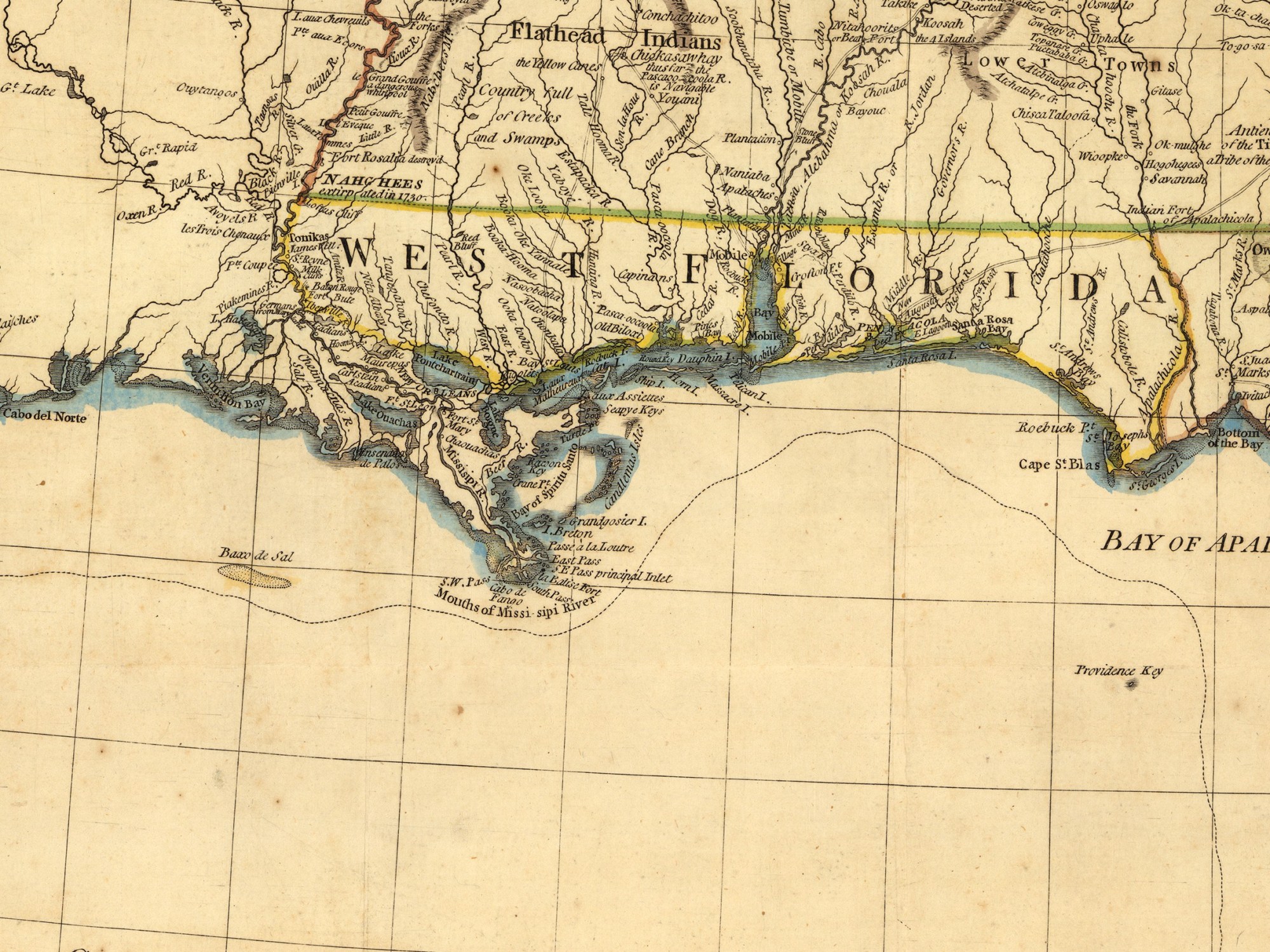
The Third Waldeck Regiment arrived in New York in October 1776 along with the Second Division of troops from Hessen-Kassel. Its commanding officer, Johann Ludwig Wilhelm von Hanxleden (c. 1736–1781), described his early experiences in New York in a letter to Waldeck authorities shortly after landing.
In the winter of 1778, the Waldeck regiment made up more than half of the 1,300 troops under General John Campbell that were dispatched from New York to defend the province of West Florida against the Spanish. After a four-week stopover in Jamaica, the fleet carrying the troops arrived in Pensacola in early 1779. Several months later, Waldeck troops were sent to reinforce the British-held Fort Bute on the Mississippi. The expedition ended in disaster, with most of the men killed or captured. Word of the defeat reached Pensacola that September. The Waldeck chaplain Philipp Waldeck described these events in his diary.
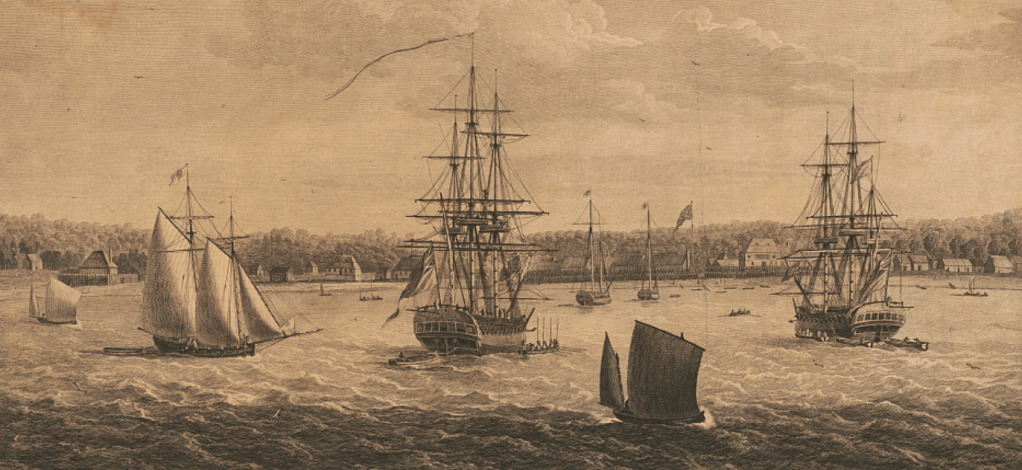
This post features a letter Hanxleden wrote in December 1779 to his ruler, Friedrich Karl August, Prince of Waldeck-Pyrmont, nearly a year after the regiment’s arrival in West Florida. In it, Hanxleden describes a miserable year, including the rampant illness, the harassment of local residents by bands of “vagabonds” and rebels that had come south from the Illinois and Ohio countries, a rebel-minded populace. Worst of all was the threat of a large Spanish force under Bernardo de Gálvez against which the British posts stood no chance. Under the circumstances, Hanxleden questioned why Britain would even want to hold onto the province at all, going so far as to suggest that it was knowingly sacrificing hundreds of men (and artillery) in what he correctly predicted would be a futile struggle against the Spanish. But this, he conceded, was simply the way war was waged in America.
He was right. Spain would gain control of West Florida in the spring of 1781. Many Waldeckers died during the more than two years the regiment spent there, whether of disease or in battle. Hanxleden himself was among the casualties, killed in early January 1781 during an attack on the Spanish fort near Mobile.
A note on the translation: Like other members of the German corps, Hanxleden refers to Native Americans as “Wilde,” a word that translates as “savages.” (He also uses the term “Indianer.”) I have retained this translation in order to preserve the language of this late eighteenth-century source.
ENGLISH TRANSLATION
Pensacola, December 22, 1779
Most Serene Prince, Most Gracious Prince and Lord!
I am informing His Most Serene Highness, most humbly that since the last report of the 7th of this month [December], nothing of significance has occurred with the rest of the regiment stationed here [in Pensacola], aside from a number of dead. However, having learned that a packet of letters dated July 12th, which were dispatched with a merchant ship called The Brothers, has been lost, and as I also do not know whether my subsequent reports, which were sent on four different occasions, have arrived or have suffered the same fate, I am hereby submitting, most humbly, a recapitulation of the reports from May 7 up to the present. As great as the losses from deaths and desertions already are, I must, based on the latest reports received from New Orleans, conclude that the number of sick men, at the time more than 100, mostly beyond any hope, must now have increased by at least 50 more.
For several weeks it has been fairly quiet here, without receiving any news from New Orleans, nor any word from our nearest savage [“wilden”] neighbors, called the Creek and Choctaw, except that several vagabonds, having been chased away from elsewhere for shameful deeds, have taken asylum among these savage [“wilden”] peoples. They have gathered together in small bands and have robbed several colonists living around Mobile, dragging them off with them. However, efforts have been made to track them down, and some have already been apprehended along with their stolen goods. However, for the past few days the situation has begun to grow more serious. They have been noticeably reinforced by rebels who have come down from the Illinois region and from the Ohio, and their number is said to already be around 800 men. According to the latest report, they were only 100 English miles from Mobile, a march of about three days for these people. The garrison there consists of around 80 men, of whom only around twenty are fit for duty, while the rest are all sick with the usual fevers, and in a dilapidated fort which, if it were in proper condition, would require at least 500 men to defend adequately, also because all the inhabitants there, as indeed in all of West Florida, are rebellious minded.
What the garrison will do will soon become clear. I hope the general will withdraw them here [to Pensacola], as he has long been advised to do. Furthermore, it is known that Don Galvez has recently had provisions brought to all ships in New Orleans in order to undertake an expedition. It can be directed to nowhere but Mobile and here [Pensacola], to finally wake us from the slumber we have been in since we arrived here until the Spanish war broke out. Even after that, we have not been able to truly awaken. In a dream, a thousand plans were made and discarded, and none were carried out, and now it may well be too late to repair the mistake. It is also said that Don Galvez, besides the beautiful regiment of 640 men that he obtained after the capture of our troops, has also received additional troops from Havana for reinforcement. However, this is not yet certain, and in my opinion, not necessary. Apart from the presumed reinforcements, Don Galvez can command at least 2,000 well-regulated and disciplined troops, excluding the assembled 800 rebels and even more Indians, and without any risk attack this generally poorly fortified and indefensible place occupied by about 500 men. However, Don Galvez seems to proceed very safely and cautiously in all his undertakings. He demonstrated this at Baton Rouge with nearly 3,000 against 124 healthy, but mostly recovering men, and, moreover, he is provided with enough time on our side to carry out his operations unhindered and at leisure.
England can no longer possibly have any interest in this province, and in this it is certainly not wrong. But why the last remaining 500 men, along with a fine, large artillery, are intentionally abandoned and sacrificed is incomprehensible and entirely unexplainable to anyone, since they could be used elsewhere and are also very much needed; but this is the manner in which war is typically waged here in America, which I have consistently observed from the beginning up to now.
With the greatest devotion, your Highness’s most humble servant JLW de Hanxleden.
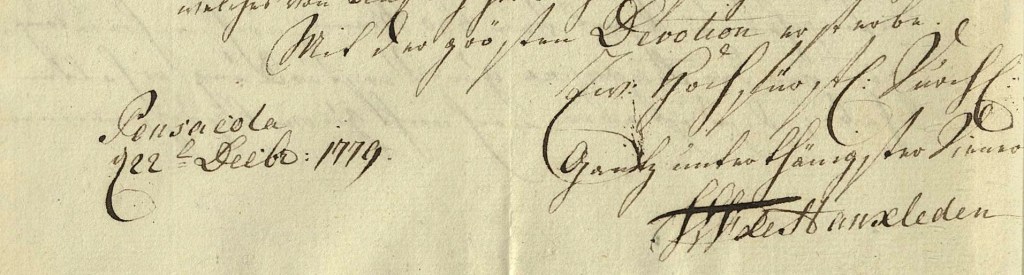
TRANSCRIPTION
Durchlauchtigster Fürst, Gnätigster Fürst und Herr!
Erw. Hochfürstl. Durchl. melte untertänigst daß seid dem lezten Rapport vom 7ten dieses bey dem hisigen rest des Regiments gar nichts verenderliches, auser verschidenen Toden, vorgefallen ist, da ich aber vernommen daß ein paquet Briefe vom 12ten July dadiert, das mit einem Kaufarthey [Kaufmann] Schiff the Brothers genannt abgeschickt hatte, verlohren gangen ist, ich auch nicht weis ob meine nachherigen zu vier verschidene mahlen wiederholten Rapporte ankommen, oder das nemliche Schicksahl wie jenes haben werden, so lege hir eine recapitulation derer Rapports seid d. 7ten May biß hir hin unterthanig mit bey. So groß der Abgang an Toden und Deserteurs jetzo schon ist, so muß aus denen lezt erhaltenen Rapports von New Orleans schlisen daß nunmehro von denen mehr als 100 Mann damahls meist ohne Hoffnung gelegenen Krancken, wenigstens die Zahl um 50 mehr sich muß vermehrt haben.
Seid einigen Wochen sind wir hir ziemlich ruhig gewesen, und ohne die geringste Nachrichten von N: Orleans zu vernehmen, wie auch etwas von unsern nägsten wilden Nachbarn die Krieks [Creek] und Chacktas [Choktaw] genannt, zu hören, auser daß sich verschidene Vagabunden, die Schandathen halber anderwerts vertriben sind, und ihr asilum bey diesen wilden Volckern genommen, in kleinen Haufen zu sammen rottirt und einige um Mobile rum wohnende Colonisten beraubt und mit sich vord geschlept haben, mann hat sie aber auf zu suchen gedeuchdet und auch einige mit ihrem Raub wieder erdapt; Seid einigen Tagen fängt es aber an ernsthafter zu werden, sie sind von Rebellen, so sich von denen Ilinois und vom Ohio her under gezogen, merckl: verstärckt worden und ihre Anzahl soll sich schon gegen 800 Mann belaufen, sie sind nach der gestrigen Nachricht nuhr noch 100 Englische Meilen von Mobile entfernt gewesen, ein Marsch vor dieses Volck von drey Tage, was die dortige Besatzung von ohngefehr 80 Mann, wovon nuhr etlich und zwanzig dienstfähig, die andern aber alle an gewöhnl. Fibern krank sind in einem verfallenen Ford, das, wenn es im Standt wehre, wenigstens, um es gehörig defentiren zu können 500 erfordert, machen werden, da ohne hin dort alle Einwohner, wie hir in gantz West Florida Rebellisch gesinnt sind, muß sich nun in kurtzem zeigen, ich hoffe der General wird sie hirher an sich ziehe, was mann Ihm schon lange gerathen, auserdem weis mann daß Don Galvez auf alle Schiffe zu N: Orleans seid kurtzem hat Provision bringen laßen, um eine Expedition vorzu nehmen, sie kann nirgens anderster als auf Mobile und hir her gerichdet seyn, um uns auch endlich aus unserm Schlummer auf zu wecken worin wir uns seid dem wir hir angekommen sind, bis der Spanische Krieg aus brach, befunden haben auch noch nach der Zeit nicht recht erwachen können, im Traume wurden 1000 proiecte gemacht, verworfen, und keins aus gefürt, und nun mögte es wohl zu spath seyn den Fehler zu repariren. Auch sagt mann daß Don Galvez seid kurtzem, auser dem nach der Gefangenschaft unserer Truppen, erhaltenen schenen Rgmt von 640 Mann, noch mehrere Truppen von der Havanna zur Verstärckung erhalten habe; diß ist aber noch nicht zu verläßig, meiner Meinung nach auch nicht nöthig, auser der praesumirten Verstärckung kan Don Galvez wenigstens 2000 Mann wohl regulaeren und guth disciplinirten Truppen, exclusive der versammleten 800 Rebellen und moch mehrern Indianer diesen weitleiftig schlecht befestigt, mit ohngefehr 500 Mann besetzen ohnhaldbahren Orth, ohne alle Gefahr angreifen, allein Don Galvez scheint in allen seinen Unternehmungen recht sicher und vorsichtig zu gehen, diß hatt Er zu Baton Rouge mit bey nah 3000 gegen 124 gesunde, doch meist reconvalescerte Leude bewiesen, und mann läst ihm auch unserer seits Zeit genug seine operations ohn gehindert und nach Gemächtlichkeit aus zu führen.
Es kan England an dieser Provintz ohnmögl: noch was gelegen seyn, wie es hirin denn gar nicht Unrecht hat, warum mann aber die noch lezten 500 Mann, nebst einer schönnen zahlreichen Artillerie, auch mit allem Vorsatz abantonnirt und aufopfert, steht nicht einzusehen und ist jedem gantz ohnbegreifl: da mann sie anderwärts recht nützl: gebrauchen könnte und auch sehr nötig hätte; diß ist aber die Ahrt wie man hir in America Krieg zu führen pflegt, welches von Anfang her bis hir hin stehts bemerckt habe.
Mit der grösten Devotion ersterbe Erw: Hochfüstl: Durchl: Gantz unterthänigster Diener JLW de Hanxleden
Citation: The letter is included in the folder “Berichte des Kommandantes des dritten englisch-waldeckischen Soldregiments in Amerika, Oberstleutnants (dann Obersten) v. Hanxleden an den Fürsten und an Frensdorff, 1776-1780,” HStAM 118a, 974, ff. 120-121v, Hessian State Archives Marburg.
Featured Image: [Detail] Bernard Romansca, Map of Southern British Colonies Including Florida, 1776. 1776. State Archives of Florida.


One thought on “This is How War is Waged in America. West Florida, 1779.”