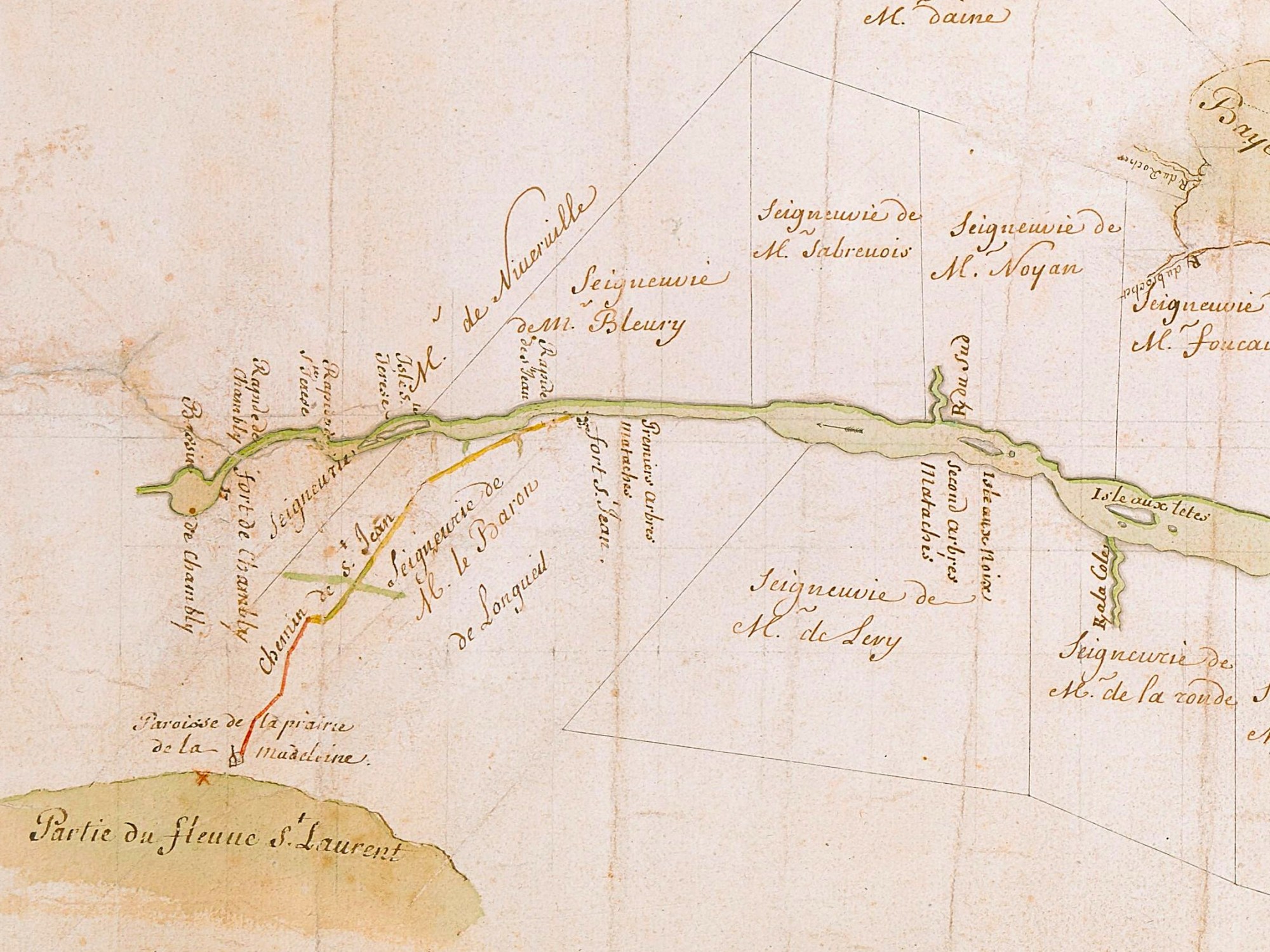
In the spring of 1777, the Braunschweig Captain Adolph Julius Thomae escorted a group of 258 recruits on their long journey from the city of Braunschweig to Canada. An unspecified number of women and children belonged to this contingent. The transports reached Quebec City around June 10, and two days later they arrived at their destination, the town of Trois-Rivières on the St. Lawrence River. On June 14, Thomae and his servant Johann (last name not recorded) traveled from there to Fort Chambly, located on the Richelieu River. Along the way, they encountered Major General Friedrich Adolph Riedesel, commander of the Braunschweig corps in North America, who instructed Thomae to proceed to General Burgoyne’s main army, then encamped near Saint-Jean on the Richelieu River at the northern tip of Lake Champlain.
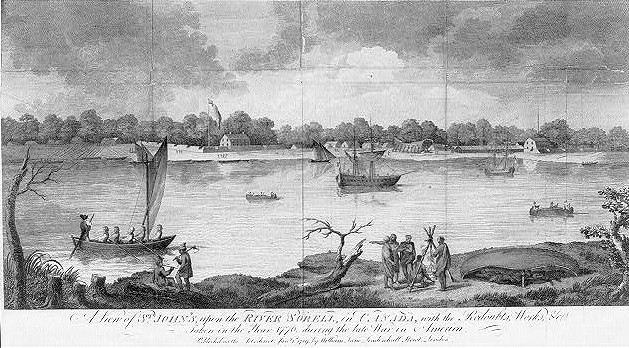
Traveling by carriage via St. Therese, Thomae and Johann reached the camp that day late at night. Despite the hour and most of the men already asleep, several officers rushed out to greet him. The joy of being reunited with Braunschweig regiments and so many dear friends was almost indescribable, he wrote in his diary. He enjoyed a hearty meal in good company, and it was two in the morning before he finally retired for the night, sleeping in Lieutenant August Wilhelm Du Roi’s bed.
This post features Thomae’s diary entries for the following two days, June 15 and 16, when he witnessed the embarkation of a large portion of Burgoyne’s army for the campaign into New York. Within weeks, it would take Fort Crown Point and Fort Ticonderoga before proceeding toward Albany.
The departure of the British armada must have been an impressive spectacle: several warships, dozens of smaller vessels, a floating battery and, by Thomae’s estimation, 3,000 Native Americans in what must have been hundreds of canoes. Never before had he seen such arms and war preparations. But it was also a solemn farewell, as Thomae himself did not join the expedition. His assignment had been to escort a transport of recruits from Braunschweig to Quebec, a task he had successfully completed. On June 17, after the main army had departed, he set out for the return journey to Chambly alongside Johann and two couriers. Unable to secure a carriage, they were forced to walk the entire way of roughly twelve miles in what Thomae described as remarkably hot weather. Back in Chambly later that day, a welcome dinner with General Riedesel and his wife Friederike helped him recover from what he called a “fatale Reise,” or disastrous journey. Thomae remained in Quebec until early August, when he embarked on his journey back home. After a stopover in England, he arrived safely in Braunschweig in late October.
A note regarding a reference in the diary: Thomae’s “La batterie Flotturt” is a misspelling of the French term Batterie Flottande, which translates as floating battery. This was the Thunderer. By the end of the month, this vessel was actually flying a Braunschweig flag. It is unlikely that it was already doing so on June 15 for Thomae would have surely noted it in his diary.
A note on the translation: Like other members of the German corps, Captain Thomae refers to Native Americans as “Wilde,” a word that translates as “savages.” I have retained this translation in order to preserve the language of this late eighteenth-century source.
ENGLISH TRANSLATION
On June 15th, in the camp where I had arrived yesterday, I encountered our Dragoon Regiment, the Regiment von Rhetz, the Regiment von Specht, the Hanau Regiment, the Hanau Artillery, and two English Regiments, namely the 22nd and 23rd Regiments. The remaining regiments had already embarked two days earlier and were encamped on Lake Champlain at Cumberland Heights, which was 22 leagues from the camp. I dined at midday at General Brigadier Specht’s with Brigadier Major Cleve; the Regimental Surgeon Bause came after dinner and expressed his joy at my arrival. I paid my respects to General Burgoyne, who shortly thereafter departed on a bateau along with his aide-de-camp, under the firing of 15 heavy cannons from the ship Carleton, to go to the camp at Cumberland Heights. Such war armaments and preparations as I encountered here, I had never seen before. Most of the ships had already departed for Lake Champlain; there remained only the following ships: La Batterie Flotturt [Flottande; i.e., floating battery], with 24 twenty-four-pound cannons; the ship Washington, with 20 twenty-four-pound cannons; the ship Carleton, with 16 twelve-pound cannons; and two schooners each with 12 twelve-pound cannons; as well as twenty large sailing longboats, each equipped with four 6-pound cannons.
On June 16th: This morning at 6 o’clock the general march was beaten in the camp; at 7 o’clock all the regiments marched off and boarded the bateaux to go to the Lake Champlain. With sorrowful eyes, as I had to remain behind, I watched our regiments depart. I accompanied General Brigadier Specht to his bateau; we took a tender leave of one another, as I had also taken from the other officers. Each company had five bateaux, and an additional bateau for the staff of each regiment; Brigadier Specht had two bateaux for himself. The river was completely covered with bateaux. 500 Canadians also went along, and the day before I had seen 3,000 savages [“Wilde”] climb into their canoes and set off onto Lake Champlain. There was terrible screaming and frightening music on that occasion. When the savages [“Wilden”] arrived, they carried their canoes, which were made of bark, three by three [e.g., three men on each side, six men total] on their backs. When all our troops had marched off, General Major Phillips remained behind with a brigade of engineers [brigade used loosely to describe a detachment or small body of men] and the hospital with one English regiment for its protection. I lodged in the tent of Lieutenant Wloterschmidt [Wolterschmidt?], who serves with the English engineering corps.

TRANSCRIPTION
Am 15 Jun: in dem Lager in welche ich gestern angekommen war, traf ich unser Dragoner Regiment, des Regiment v. Rhetz, das Regiment v. Specht, das Hanauische Regiment, die Hanauische Artillerie, und 2 Englische Regimenter wobey das 22 und 23the Regiment an, die übrigen Regimenter waren schon 2 Tage vorher embarquiert, und campirten auf dem Lac Champlain auf Cumberlarts Höhe, welches 22 Lieues vom Lager war. Ich speiste heute Mittag bey dem Hr. General Brigadier Specht, mit dem Brigadier Major Cleve, der Regiments Feldscher Bause kam nach Tische hin, und bezeigte seine Freude über meine Ankunft, dem General Bourguoine machte ich meine Aufwartung, ebenselber sich noch demnach auf 1 bateaux nebst sinem aide des Camps, unter Abfeurung von 15 schweren Canonen von dem Schiff Carleton ab, um ins Lager nach Cumberlands Hohe zu gehen. Solche Kriegs Armaturen und praeparationer als ich hier angetroffen hatte ich noch niemals gesehen. Die mehreste Schiffe waren schon weg, nach dem See Champlain abgegangen, es waren nur noch von Schiffen da La batterie Flotturt [Flottande], von 24, 24 Pfundigen Canonen, das Schiff Washington von 20, 24 Pfündigen Canonen, das Schiff Carleton von 16, 12 Pfündigen Canonen und 2 Schooners jedes von 12, 12 Pfündigen Canonen, in gleichen 20 große Chaloupen mit Seegels, jedes mit vier 6 Pfündige Canone versehen.
Am 16ten Jun: heute Morgen um 6 Uhr wurde im Lager General march geschlagen, um 7 Uhr marchierten samtl. Regimenter ab und stigen in die bataux, um nach dem See Champlain zu gehen, mit betrübten Auge, da ich zurück bleiben muste, sahe ich unsere Regimenter abfahren, dem Hr. Gen: Brigadier Specht belietete ich ins bateax, wir nahmen zärtl. Abschied von einander, welches auch von denen übrigen Officiers geschehen war. Jede Compagnie hatte 5 bateax, und noch 1 bateax a port bey jede Regiment für den Stab, der Brigadier Specht hatte 2 bateaux für sich, der fluß war gantz mit bataux bedecket, 500 Canadier gingen auch mit, und den Tage vorher sahe ich 3000 Wilde in ihre Canots steigen, und in den See Champlain stechen, es war hirbey ein entsetzliches Geschrey und eine fürchterliche Music dabey, wo wie die Wilden ankamen, so hatten sie ihre Canots bey sich welche von Borcke waren, und 3 und 3 tragen solche auf dem Rücken. Da unsere Truppen alle abmarschiert waren, der General Major Philips mit eine Brigade Ingenieurs, und dem Hospital bey welchen 1 Regiment Engländer zur Bedeckung war noch zurück blieb, so logirte ich bey dem Lieut: Wloterschmidt welcher bey die Englische Ingenieurs Dienste thut ins Zelt.
Citation: Diarium des Ingenieur Capitains Thomae über einen Rekrutentransport von Braunschweig nach Kanada und Rückreise, 26. Febr. – 29. Oktober 1777, H VI 06 – H VI 6: 24, ff. 45-46, Braunschweig City Archives.
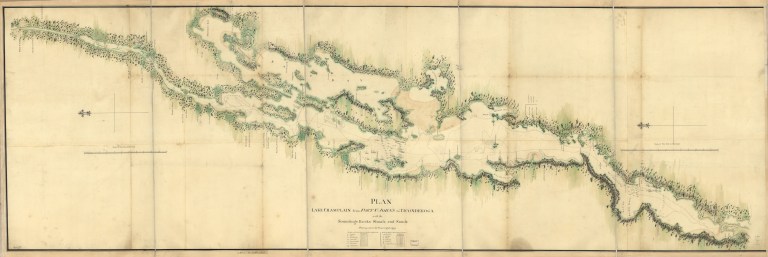
Featured Image: Detail from “Carte du Lac Champlain depuis le Fort de Chambly Jusques au desus du Fort S.t Frederic, dans la Nouvelle France,” [1739–1759]. Accessed at Norman B. Leventhal Map & Education Center at the Boston Public Library.


In my time (1947-1961) in Swanton VT, on the shores of Maquam Bay, Lake Champlain, and the Missisquoi River, St. Jean was a railroad town served by the Canadian Nation and Central Vermont Railways. In 1959 we celebrated the 350th anniversary of the discovery of Lake Champlain by Samuel de Champlain in 1609. Around that time I learned of Hessian (Hesse-Hanau) artillery and infantry coming south with Burgoyne. Many years later I learned that the artillery was commanded by a Hersfeld officer, CPT Georg Paeusch. My family comes towns (Unterweisenborn, Sorga and Rotensee) in the district where Hersfeld is the capital city. Hesse-Cassel Musketeer Regiment Prinz Carl and Garrison Regiment von Seitz /Stein/Porbeck were also recruited in these towns but served mostly in the greater NY City area or in Nova Scotia respectively.
At the time of the American Revolutionary War my countrymen were auxillary troops to the British forces fighting American patriots. In the late 1800s (1875-1885) my family emigrated to the US and in my life time has lived in areas where long ago my then countrymen served. Neighbors of my family were soldiers in America.
The many and varied experiences of Hessian (Hanau or Cassel) troops are well described in both first hand documents of the time and thankfully in more modern research by Prof. Baer. War is always arduous and this war as experienced by Hessians had unique issues: long sea voyages away from Europe, communication (German – English) problems, cultural and social class conflict, logistical (manpower and equipment) problems, tactics and strategy cncerns being the most challenging.
LikeLike
Thanks for your work. Much appreciated.
LikeLike