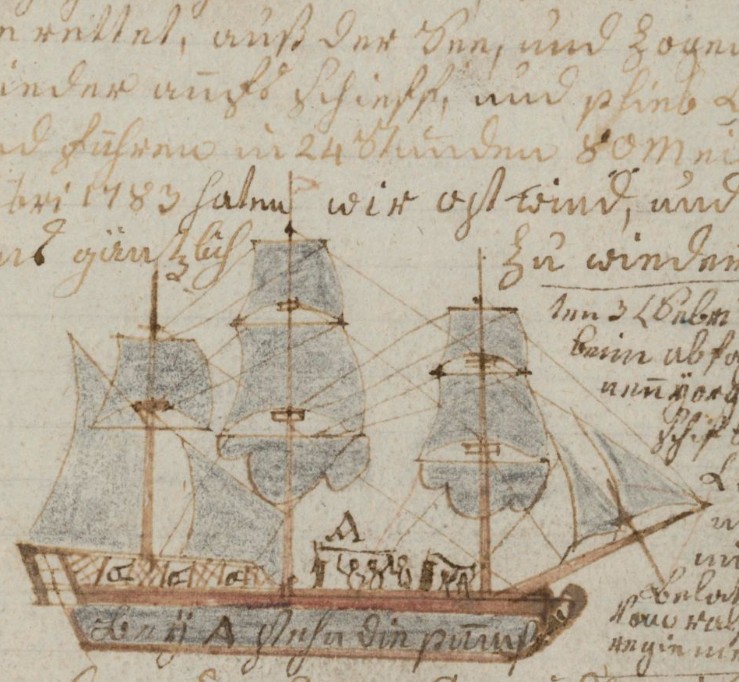
In the spring of 1783, the thousands of German troops stationed in the newly founded United States received orders to assemble in New York in preparation for their return to Europe. Evacuation commenced in July and was completed by November. Meanwhile, troops stationed in Canada departed from Quebec, with the first regiments sailing off by early August.
The transports stopped in England before continuing to the German port of Bremerlehe. Due to the lateness of their departure from North America, several hundred troops were forced to winter in England, delaying their homecoming until spring 1784. The majority of the men, women and children, however, reached the German territories in fall 1783. As an entry in the journal of the Regiment von Bose notes, the troops, “happy and healthy,” once again stepped on “German soil.”
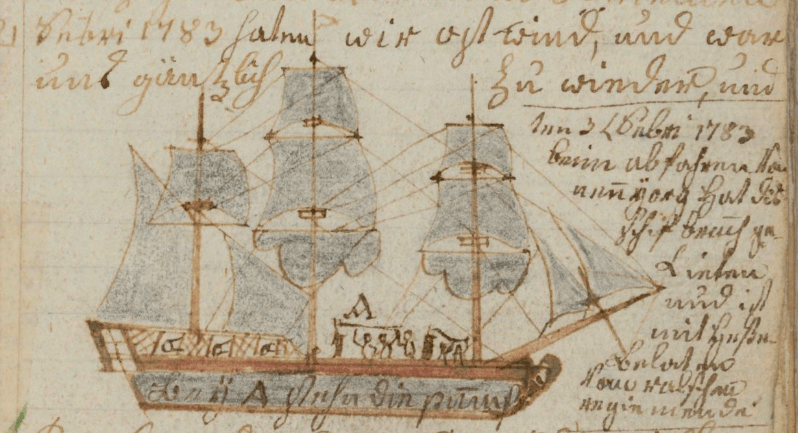
Not surprisingly, their return stirred considerable excitement. At their final destinations, the regiments were personally welcomed by their respective rulers, while throngs of people lined the streets to greet the veterans, many of whom had been overseas for six, seven, or even eight years. In the city of Kulmbach, one Ansbach soldier noted, the crowds were so dense that the troops struggled to march into town. Everywhere they went, the people greeted the “Amerikaner,” as they came to be known, with happiness and an overwhelming sense of relief.
Yet for some of the people who waited anxiously for the return of a loved one, that joy quickly turned into grief. He was not among the men marching into town. The moment a wife, parent, sibling, or child realized that their husband, son, brother, or friend might never return must have been devastating beyond words.
Friederike Riedesel, the wife of the Braunschweig major general Adolph Riedesel, described the scene of the Braunschweig troops’ arrival in Wolfenbüttel in her memoir. It was, she writes, “a beautiful and stirring scene” to see her “dear and upright husband” leading his men into town, “standing there with tears of joy in his eyes in the midst of his soldiers in the partly happy, partly pathetic bustle of fathers, mothers, wives, children, brothers and sisters, and friends, who all pressed about to see their loved ones again.” The joy of those who found, or were found by, their own, and the grief of those who searched in vain — all of this, she concludes, “cannot be described, but only felt.”
Not knowing what had become of their loved one only deepened the anguish. Families and friends scrambled to find out what had happened, and local officials found themselves fielding desperate letters from people searching for answers.
The record featured in this post shows how one small community responded to these requests for information. It is a letter by Major General Riedesel’s older brother, Johann Conrad Riedesel. It is dated December 1783. By that time, the Braunschweig corps had returned to Wolfenbüttel. Twenty-four men from the Riedesel estates had served in America. According to the letter, family and friends were seeking information about at least some of the men. Instead of responding to each request and give an account for each individual man, Johann Conrad Riedesel thought it was more efficient to compile the relevant information into a concise list that could be shared.
While Riedesel’s approach — compiling a single list rather than responding to each family personally — might seem cold-hearted, it may have been the most practical way to ensure that every family received the information they needed. What is also remarkable is that only seven of the twenty-four returned to Wolfenbüttel with the corps. The other seventeen, or around seventy percent, had not come home by December 1783. Most, perhaps all, would never be reunited with their families and friends. By that time, eight had been dead for as long as six or seven years, killed in battle, by disease, or accident. Five had deserted from captivity a long time ago, blending into American communities or perhaps enlisting in enemy forces. Three more had been left behind, including two in captivity, their fates unknown.
Here is a summary of the information included in the list:
- Six men returned with the Corps (Quartermaster Valentin Jäger, Dragoon Georg Krafft, Johann Heimel, Johann Kümpel, Conrad Roomer, Asmuss Walter)
- One man was discharged in Wolfenbüttel in October 1783 (Heinrich Bauer)
- Five men deserted out of captivity between January 1779 and October 1781 (Corporal Christian Kauck, Michael Glitsch, Johann Lange, George Müller, Conrad Eichenauer)
- Three men were left behind in captivity (Nicolaus Blume, Casper Dietz, Casper Poppe)
- Two men died in the hospital in Quebec in June 1776 (Christoph Wiesseman, Andreas Schmidt)
- One man died in Trois-Rivières in April 1777 (Heinrich Jäger)
- One man was short dead at Bennington in August 1777 (Andreas Klug)
- One man was wounded at Bennington in August and died in September 1777 (Conrad Falcke)
- One man died in the hospital at Saratoga in October 1777 (Herman Jäger)
- One man drowned in captivity in May 1778 (Heinr: Firngess)
- One man was kicked to death by a horse in Boston in July 1780 (Johan Kurtz)
- One man was left behind in Boston in January 1781 (Johan Schwartzhangst)
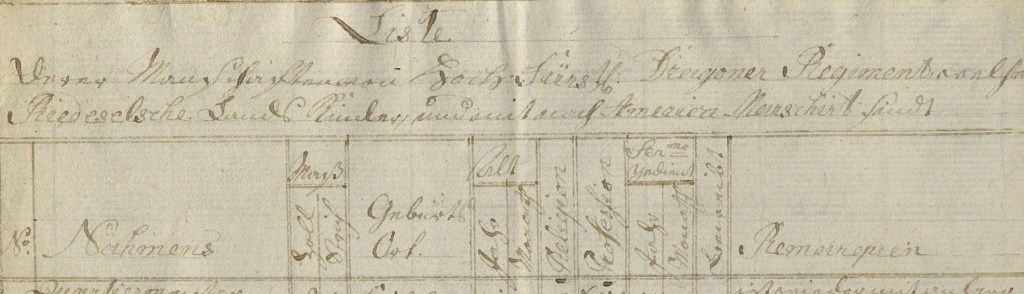
ENGLISH TRANSLATION
Braunschweig, December 12, 1783
[…] Enclosed herewith follows a list of all of the subjects of the Riedesel estate who served with the [Braunschweig] troops in America. Your high born will make arrangements so that the respective parents, relatives and friends may learn of the fates of those persons belonging to them, so that the frequent inquiries made until now may cease, and it will not be necessary to give an account for each individual man. Since this list has been carefully extracted from the regimental reports, it is authentic, and may serve in place of death certificates, and may also be used as credible evidence in any other legal matter.
I remain with the truest esteem, Your high-born most devoted servant, J. C. Riedesel
TRANSCRIPTION
Braunschweig den 12ten Xbre [Dezember] 1783
[…] Anbey folgt eine Liste aller Riedeselschen Landeskinder die mit den hiesigen Truppen in Amerika gewesen sind. Erw. Wohlgebohren werden es dahin einrichten, daß die respk: Aeltern Verwandten und Freunde, die Schiksale der Ihnen angehörigen Personen erfahren, damit die bisher häufigen Nachfragen aufhören, und nicht über ieden einzelnen Mann Rede und Antwort gegeben werden muß. Da diese Liste aus den Regiments raporten mit Fleiß ausgezogen ist, so ist sie authentisch, und kann statt der Todesscheine dienen, auch in iedem andern rechtlichen Vorfall als glaubwürdig gebraucht werden.
Ich beharre mit wahrester Werthschäzzung Erw: Wohgeborn, ganz ergebener Diener J C Riedesel
Citation: F 27 A, Nr. 29/7, Hessisches Staatsarchiv Darmstadt.
Featured Image: “Tagebuch des hessischen Soldaten Johannes Reuber über die Jahre 1775-1813,“ 8° Ms. Hass. 46[1], f. 160r, Universitätsbibliothek Kassel, Landesbibliothek und Murhardsche Bibliothek der Stadt Kassel.


One thought on “Died, Deserted, Left Behind, Returned. Braunschweig, 1783.”