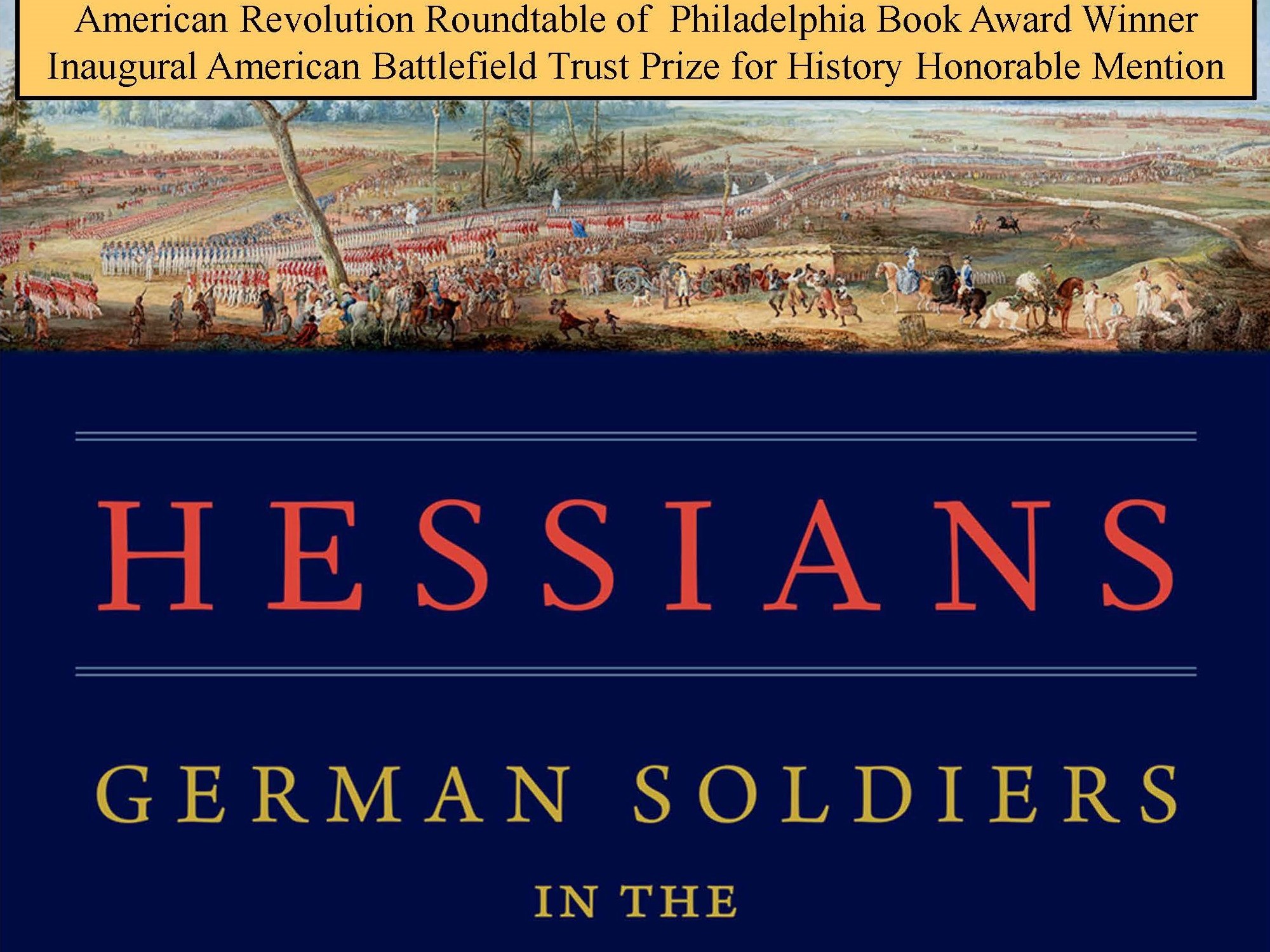
***The paperback of Hessians is available for pre-order!***
My book, Hessians: German Soldiers in the American Revolutionary War, was published by Oxford University Press in May 2022: https://tinyurl.com/yms9zbjw
Winner of the 2023 Society of the Cincinnati Prize.
The prize recognizes the author of an outstanding book that advances understanding of the American Revolution and its legacy. The award letter describes Hessians as “a landmark work that expands and enriches our understanding of this fascinating and important aspect of the American Revolution.”
Winner of the American Revolution Roundtable of Philadelphia Book of the Year Award.
The annual award recognizes the best book on the American Revolution Era published that year.
Honorable Mention for the Inaugural American Battlefield Trust Prize for History.
The award recognizes an outstanding published work focused on military history or biography central to the nation’s formative conflicts – the Revolutionary War, the War of 1812, and the Civil War. A selection committee of expert judges (Dr. James McPherson, professor emeritus at Princeton University, Dr. James Kirby Martin, professor emeritus at University of Houston and Dr. Joan Waugh, professor emeritus at UCLA) winnowed the list of nominees from nearly 100 from 24 different publishers to 11 finalists before selecting a winner and two honorable mentions.
Hessians: German Soldiers in the American Revolutionary War is available wherever books are sold, including http://amazon.com. I encourage you to purchase this and other early American history books from The Fort Plain Museum Bookstore, a 501(c)3 nonprofit organization. Proceeds from your purchase go to historic preservation, artifact acquisition, exhibit building and educational programming.

Reviews
“Rarely does any one book completely obviate the need for any other, effectively replacing all previous works on the subject. Hessians is just such a book. It is not just an addition to a good library on the American Revolution, it may actually free up some space by making a few other books unnecessary. Books like that are rare, and welcome.” — Reviews in American History
_____________________
“[Hessians is a book that is] superbly grounded in primary sources that is also readable. … In crisp, lively prose, this book brings to life the story of nearly thirty thousand soldiers from the German states who fought for Great Britain in the War of American Independence. … From the start, therefore, this work examines the experiences of all such soldiers, not just from a particular kingdom or duchy. This is an ambitious goal, and Baer achieved it with aplomb. … Plumbing a breathtaking amount of previously unresearched German archival sources along with better-known published primary accounts, Baer easily dispels the old canard that these men were all forced to go … A solid hybrid of social and military history … a very fine work of history.” —The Journal of American History
_____________________
“Hessians … is an excellent book. Beyond simply filling a historiographical need, it is well-written, without the jargon that limits the audience for many academic books, making it widely accessible to any reader wanting to learn about German auxiliaries in the Revolutionary War. It is also exceptionally thorough, with Baer seemingly having explored every archive and addressed every conceivable topic relating to German soldiers. It is a worthwhile purchase for anyone interested in the American Revolution.” — Journal of Military History
_____________________
“Hessians is a deftly written, richly detailed study and appraisal of a complex and vital component in Revolutionary War history. … Baer’s mastery of source material—twenty-six pages of bibliography, six of manuscript collections, mostly German—is reflected in her skillful weaving of first-hand accounts into her overall narrative. She states in the introduction that the German soldiers ‘vantage point is unlike that of any other group of people that participated in the war. In this book I have tried to let them tell their stories.’ She has succeeded. Hessians is a superb work of scholarship and is an essential volume for any student of Revolutionary War history.” — Journal of the American Revolution (https://allthingsliberty.com/2022/08/hessians-german-soldiers-of-the-american-revolution/)
____________________
“Baer has written an extremely gripping account of the adventures of German auxiliaries during the American Revolution. She has thoroughly documented her sources, with considerable use of manuscript collections at archives in the United States, France, and Germany in addition to published diaries and order books written by Hessian troops in America and their family members. By using the writings of the Hessians themselves, … Baer has personalized their experiences and crafted a volume that is a must read for anyone interested in the history of the American Revolution.” — Pennsylvania History: A Journal of Mid-Atlantic Studies
____________________
“Fortunately for students and scholars alike, … Baer … has written an excellent study of these German-speaking soldiers in what her publisher aptly describes as “the first comprehensive study of the German auxiliary forces from all six territories over the course of the entire war published in more than a century.” Her scope goes beyond the state of Hesse-Kassel to include six German territories in the Holy Roman Empire. … Baer’s new study is a superbly written, well-organized look at a class of (to Americans) enemy soldiers that made up a significant part of King George III’s regiments sent to put down the rebellious colonists.” — H-Net Reviews (https://www.h-net.org/reviews/showrev.php?id=58172)
____________________
“In Hessians … Baer offers a thorough and critical analysis of the German experience in the American Revolution. Relying on a variety of international sources, Baer reveals how German soldiers perceived the conflict, and how their contributions affected the outcome of the war. […] Baer’s efforts to shed light on these often-overlooked sources has helped to fill a critical gap in modern Revolutionary scholarship, making Hessians an essential read. […] Utilizing strong research, excellent organization, and precise language, Baer has shed a much-needed light on these critical players of the American Revolution.” — Journal of the Early Republic
_____________________
“In this terrific book, Baer … displays her comprehensive research in both the extant literature and numerous archives in Great Britain, France, the US, and all six German states that fought in the American Revolutionary War. The result is a truly definitive account of the 30,000 German auxiliaries, ranging from the six treaties they signed to the individual contingents’ experiences and perspectives.” — Choice
_____________________
“Baer has given many interesting details that flesh out German Auxiliary military service in America or Canada that personalizes the conflict, adding a fresh and new perspective.” … “A welcome authoritative study of German service in the American War for Independence.” — The Hessians: Journal of the Johannes Schwalm Historical Association
From the Back Cover
“We have long wanted a reliable and comprehensive study of the 30,000 Hessian soldiers who fought on behalf of the British in the American Revolutionary War. Friederike Baer, a very talented historian, has given us that much desired book, especially enriched by the use of hitherto unexploited German archives. A superb contribution to our understanding of the Revolution.” — Gordon S. Wood, Way University Professor and Professor of History Emeritus, Brown University
“This study offers fascinating insights into the experiences of German troops during the Revolutionary War; as newcomers, they saw the American conflict with fresh eyes. A marvel of archival research, it reveals an eighteenth-century civil war from the perspective of outsiders. Baer’s sharp observations give a vivid sense of the Germans’ wartime experiences and real sense of pride, frustration, and tragedy. The author successfully gets beyond the Hessians’ unfairly fearsome reputation and illuminates the soldiers’ own distinct impressions of the people, places, and combat they found in America. This richly textured account includes plenty of startling new revelations about the Revolutionary War.” — Benjamin L. Carp, Professor and Daniel M. Lyons Chair of History, Brooklyn College
“Friederike Baer’s extraordinary Hessians brilliantly analyzes the predicaments of thousands of German fighting men contracted into Britain’s American War from 1775 to 1783. Through exhaustive research on both sides of the Atlantic, Baer recovers the neglected perspective of these soldiers and their families, deployed to far off lands, to wage war against a variegated insurgency, on behalf of a nation not their own. That is achievement enough, but Hessians does more. Destined to be the authoritative work on its subject for a generation to come, Hessians challenges us to think anew about the landscapes, peoples, and ambitions of the new United States.” — Jane Kamensky, Trumbull Professor of American History, Harvard University


I’m delighted to have this very detailed, comprehensive, many say definitive, study of the German soldiers who served as auxiliaries to the British.
I am of Hessian descent, the third generation born in America. While my
genealogy doesn’t match with HETRINA, my family lived in towns from which soldiers in
Regiment Prinz Carl were enlisted. I have
relatives there in Kreis Bad Hersfeld-Rotenburg.
This book and Prof. Baer’s help has made it possible to expand my knowledge. I’m very thankful.
LikeLike
My name is Kenneth Artlip. I live in New Berlin, Wisconsin.
My 5th Great Grandfather was Christian (maybe) Orleb, or Ortlip. We have no idea what his real surname was. He was a German soldier who may have served in Regiment of Hesse Hanan. For sure he was in New York in 1777. He deserted most probably during Saratoga Campaign. He was captured by American Rangers under Capt. John Ryley and was tried while using the name Christian Ortlip, before the Commissioners for Detecting Conspiracies and Crimes in Albany NY on 29 June 1778 (Vol 1, 1778-9 p 159). He was given a pass and told to “to go at large in this country”.
He married a Dutch lady named Eva Ostrander in 1787 in Brunswick, Rensselaer Co. New York. As a result of the 1790 Federal Census in Hoosick NY, Ortlip became Artlip.
Eventually, Christian and Eva Artlip had 10 children.
My wife Lois and I loved the presentation and, of course, the presenter.
I have tried, without much luck, to verify Christian’s home place in Germany his real surname and Regiment, but have had very little luck in doing so.
Thank You
LikeLike
Thank you for your message! I am glad you enjoyed my presentation at Fraunces Tavern & Museum. As you point out, the corruption/changing of names can pose a real challenge when researching these soldiers. I noticed that your ancestor was picked up by Captain Ryley along with another deserter. His name is given as Hemligh Streligh, which is definitely not how he would have spelled it! Thank you for sharing the reference to the Commissioners for Detecting Conspiracies and Crimes. Looks like Ryley picked up a few Hessian deserters in the woods around Albany.
LikeLike
Ken Artlip here. Thank you so much for answering. All these years I thought no one cared. Thank you for caring and doing all the research.
We Really don’t know what Christian was doing from 1778 until 1787 when he married my grandmother a Dutch lady named Eva Ostrander. The Ostranders were Loyalists. Eva’s dad Antonius was KIA at Bennington. The only thing that saved his family was that his wife , Elisabeth Proper, had been a friend of Mr Livingston since childhood and after Antonius was killed she fled with her children to the Livingston Estate and he gave her shelter and protected her from the authorities
I read something very neat. When the British were camped around Saratoga, the Dutch girls would go out at night and sweet talk the German sentries.
“Why do you want to kill us ? Come and live here in this wonderful country with us. We have no quarrel with you.” And so on . IT worked . Some just walked away and made the Dutch girls happy. I think that’s really neat.
Thank You.
kartlip@gmail.com
LikeLike
Hello Mr. Artlip, i am a German Men from Hessen-Hanau (Hanau Town) and I have many Interestings of the America Independence War. My English is very Bad, i know this, Sorry! The Name of your 5th Greatfather, a Hessian Soldier, is writing maybe “ORTLIEB”. This Name is a Hessian Name. In my Birth-Town, Steinheim on the Main-River near Hanau, it gives 4 or 6 Familiys named ORTLIEB. One of them had in the 1950 to 1980 years a Guesthouse in Steinheim. My Name is Rudolf-Friedrich Mueller an I am 79 years Old. In my Family from my Mothers side gives on young Men, was Served in America by Regiments of Ansbach-Bayreuth. Her Name was David Zilch (or Silch) a Jaeger. After the War he not go back to Germany, was small wounded and stay forever in America. He married a American Wife and Founded in 1783 a Pail-Factory. Thats all my Informations!
Many Greetings from Germany // Merry Christmas and a Happy New Year!
Rudolf-Friedrich Mueller
LikeLike
Cool!! Congratulations!
LikeLiked by 1 person
Herzlichen Glückwunsch! Ein gelungenes Cover, sieht sehr gut aus. Ich freue mich auf das Buch
LikeLiked by 1 person