
In the spring of 1778, General Henry Clinton replaced General William Howe as the British commander-in-chief of North America. His headquarters were in New York. From there, Clinton oversaw the Southern Campaign. In the fall of 1781, he was aware of General Charles Cornwallis’ critical situation in Virginia. However, it was not until October that he finally decided to send aid to the beleaguered army. It turned out to be too late.

On October 19, a fleet comprised of 29 men-of-war, six frigates, and four fire ships departed from New York for Virginia. The troops on board included Hessian grenadiers, the Leib and Prince Carl regiments, and a contingent of Jäger. On October 28, the first vessels reached the Chesapeake, which was guarded by several French ships. The corps learned that day that Cornwallis had surrendered to a Franco-American force more than a week earlier. The next morning, the fleet set out on its return voyage to New York. Clinton’s failure to provide timely assistance to Cornwallis contributed to his resignation as commander-in-chief later that year.
The German troops that were part of the failed rescue operation included five officers from Hanau and ten from Braunschweig. General Wilhelm von Kyphausen had requested that officers from these two territories accompany the Hessians on the expedition south because so many of their officers were unable to go due to sickness.
The items featured in this post include the list (in English translation only) of the ten Braunschweig officers who were selected to join the Hessian troops on the expedition south. They include eight lieutenants and two ensigns. Major Otto von Mengen sent the list to the Duke of Braunschweig in November 1781.
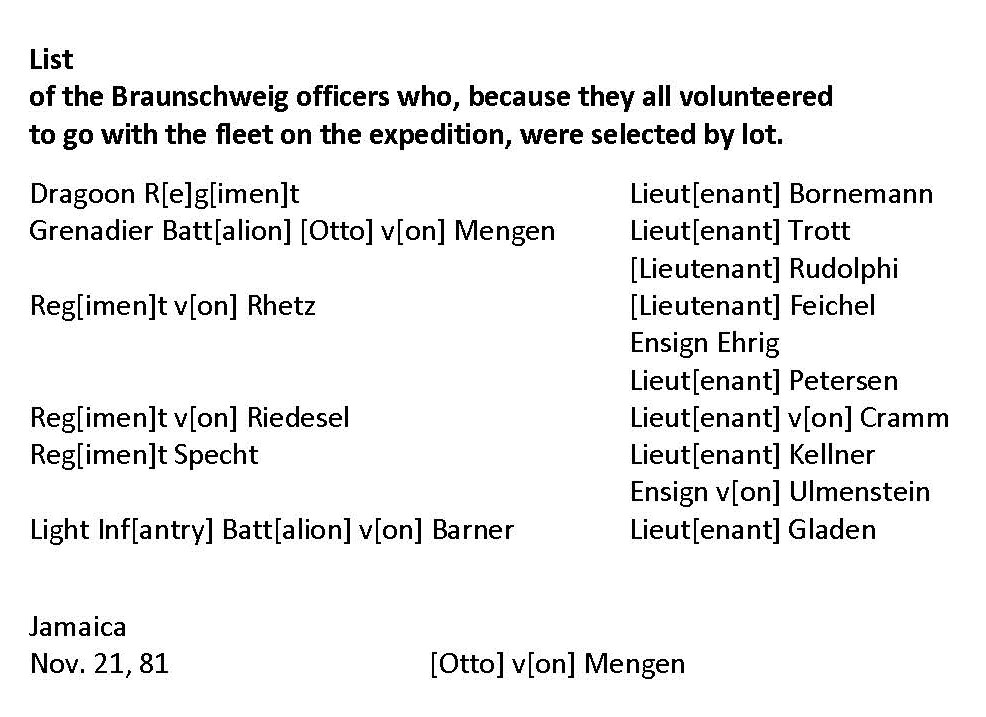
Also included is an excerpt from a letter by Major von Mengen in which he explains that many more officers had clamored to join the campaign. He thought that a selection by lot would be the best way to determine who would be included. In addition, Mengen notes in the letter that he had shared with Sir Harry Clinton over dinner his own desire to view a naval battle at least once during his military career. He may have been angling for an invitation to join the expedition. However, to his astonishment, Clinton responded that he would not see a naval battle if he went with them (Mengen recorded Clinton’s answer in English). The remark left the Braunschweig officer without words. Did the commander-in-chief already suspect that it would be pointless to send a fleet to Cornwallis’ aid? Was this merely a half-hearted gesture to show support for the army at Yorktown? Had he already decided not to engage the French in a sea battle? Mengen (and the other German officers) clearly expected this to be a major expedition. Clinton’s response suggested otherwise.

Excerpt from a letter by Otto von Mengen to the Duke of Braunschweig, Jamaica, Long Island, 2[3?] November 1781
ENGLISH TRANSLATION
… In my first humble letter from N[ew] York, I reported to Your Serene Highness that Lieutenant General von Knyphausen had requested a few subaltern officers to accompany the Hessian troops with the fleet. The voluntary offers by officers to go, and to satisfy everyone’s wishes, left me no other way than to conduct a lottery. With deference, I include the list of the ones that were lucky. Because I myself was not intended for what they were intended, I mentioned during dinner with Sir Harry Clinton that I would consider myself particularly fortunate if I could see a naval battle during my military career: You would not see a naval battle if you go with us replied the Commander-in-Chief, bringing me to astonishment and thoughtful silence. …
TRANSCRIPTION
… Durchlaucht hatte ich in meinem erstern unterthänigsten Schreiben von N[ew] York gemeldet, es wären einige Subaltern Officier von General Lieutenant v Knyphausen verlangt auf der Flotte mit hessischen Trupen mitzugehen. Freiwilliges Erbieten der Officier dazu liess mir keine andere Art, als das Loos übrig, um jedes Verlangen zu befriedigen. Ich schliesse denen es glücklich gefallen unthertähnigst hier an. Wozu die bestimmt waren, nicht selbst bestimmt, liess ich mich an der Tafel gegen Sir Harry Clinton merken, ich würde mich besonders glücklich schäzen, in meiner Kriegslaufbahn auch ein See Treffen zu sehn: You would not see a naval battle if you go with us erwiederte der Commandeur en Chef und brachte mich zur Verwunderung und nachdenkenden Stille. …
Citation: The two documents are in “Berichte des Oberstleutnants Otto Karl Anton v. Mengen sowie einige Briefe des Generals v Riedesel, des Leutnents Friedrich Karl Reinking and Herzog Karl Wilhelm Ferdinand bzw. das Fürstl. Kriegs- Collegium und darauf ergangege Antwortschreiben des Herzogs Karl, 1781 – 1782,” WO 38b alt Nr. 257, ff. 74, 80, Lower Saxony State Archives Wolfenbüttel.
Featured Image: Théodore Gudin, “Combat naval devant la Chesapeake, 3 September 1781” (Public domain, via Wikimedia Commons).
 Hessians - German Soldiers in the American Revolutionary War