
In 1940, the author Klaus Mann (1906–1949) completed a book manuscript titled Distinguished Visitors. Mann was a German writer who was able to escape the Nazi regime; in 1936, he had settled in the United States. His book featured profiles of prominent Germans who had spent time in North America or who had imagined that place in their creative work; they include individuals like Sandra Bernhardt, Peter Tschaikowski, Karl May, and Franz Kafka. The very first essay focuses on an unusual witness to the American Revolutionary War. Klaus Mann titled it: “A War Correspondent. Madame von Riedesel.”
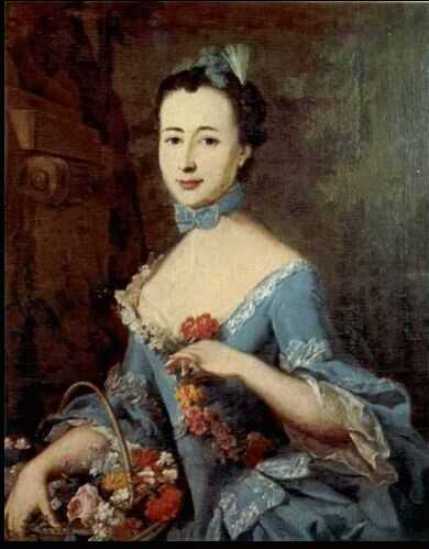
Most students of the American Revolutionary War have heard of Friederike Riedesel (1746–1808). If you are not familiar with her: she was the wife of Major General Friedrich Adolph Riedesel, the commander of the Braunschweig corps that served in the American war. In May 1776, she departed from their hometown of Wolfenbüttel to follow her husband to North America. She was accompanied on this momentous journey by her three young daughters, aged four years, two years, and ten weeks, at least two maids, including possibly a Mrs. Curssingen, and the Jäger Joh. Rockell. After an unanticipated delay in England, the group arrived in Canada in the summer of 1777. Friederike Riedesel spent the remainder of the war in North America, including several years as a member of the Convention Army, the army under General John Burgoyne that entered American captivity as a result of the surrender at Saratoga.
More than a decade after her return to Germany, Riedesel published an account of her experiences from her departure from Germany in 1776 to her return in 1783. These memoirs were originally issued in Germany as a private edition in 1800 with the title Auszüge aus den Briefen und Papieren des Generals Freyherrn von Riedesel und seiner Gemahlinn, geborenen von Massow. Ihre beyderseitige Reise nach America und ihren dortigen Aufenthalt betreffend. Zusammengetragen und geordnet von ihrem Schwiegersohne Heinrich dem XLIV. Grafen Reuss (Excerpts from the letters and papers of General Baron von Riedesel and his wife, née von Massow. Concerning both of their journeys to America and their stay there. Collected and arranged by their son in law Heinrich XLIV Graf von Reuss). The title makes it appear as though the book includes primarily the writings by the general. This is not the case; although the book includes a series of letters by him to his wife, around three quarters of the volume are made up of her memoirs.
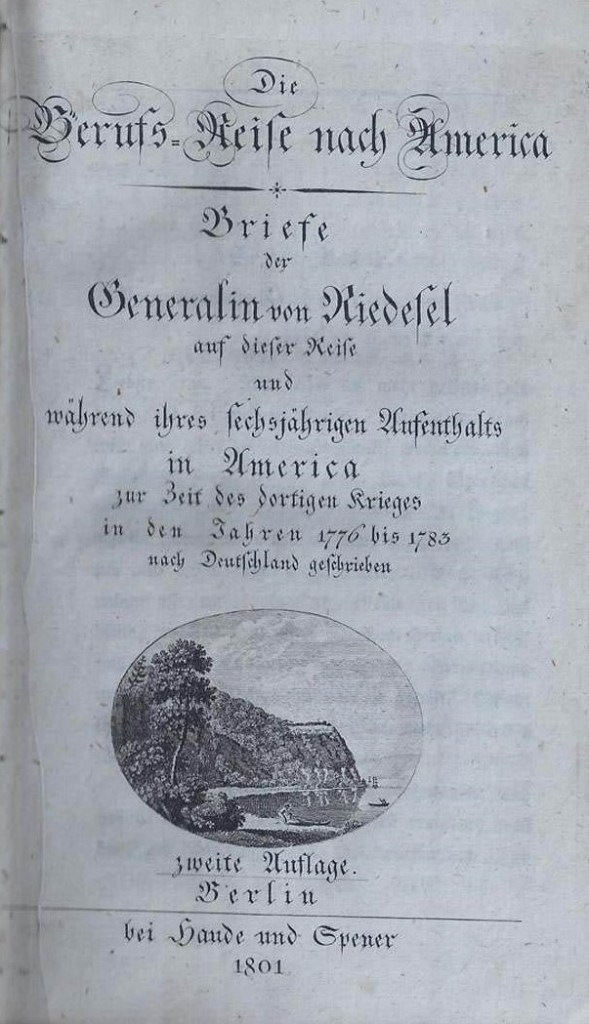
Public editions followed in 1800 and 1801, with a more appropriate title that emphasizes her contributions: Die Berufs-Reise nach America. Briefe der Generalin von Riedesel auf dieser Reise und während ihres sechsjährigen Aufenthalts in America zur Zeit des dortigen Krieges in den Jahren 1776 bis 1783 nach Deutschland geschrieben (The Tour of Duty to America. Letters of the wife of general von Riedesel, written during her journey and six year stay in America at the time of the war there in the years 1776 to 1783). A Dutch translation was published in 1802, and by the 1810s, excerpts in English translation were appearing regularly in American accounts of the Revolutionary War, including popular publication like James Wilkinson, Memoirs of his Own Time (1816), Benjamin Silliman, Remarks, Made, on a short tour. Between Hartford and Quebec. In the Autumn of 1819 (1820), Thatcher’s Military Journal (1823), Farmer’s Cabinet (April 1825), Ladies’ Magazine (February 1828), The North American Review (1828), and the North American Magazine (1833). The first English translation of the (almost entire) memoirs appeared in 1827 with the title Letters and Memoirs Relating to the War of American Independence, and the Capture of the German Troops at Saratoga. By Madame de Riedesel. Unfortunately, the version omitted sections the translator deemed to be “vulgar.” Four decades later, William Leete Stone published a much improved and complete English translation, titled Letters and Memoirs Relating to the War of American Independence, and the Capture of the German Troops at Saratoga. In the words of one reviewer, “Mr. Stone is free from the silly squeamishness of his predecessor, and has given the story of Madame Riedesel’s varied experiences as he finds it.” The most recent, and reliable, translation to date was published in 1965 (Marvin L. Brown, Jr. and Marta Huth, Baroness von Riedesel and the American Revolution: Journal and Correspondence of a Tour of Duty, 1776-1783). Her memoirs remains the only known account of a German woman who accompanied the German auxiliary forces to North America.
From its initial appearance as English editions, reviewers have been unanimous in their assessment of the book as a major contribution to American history and Americans’ understanding of it. For example, in 1828, the North American Review described the memoirs as “a spirited description of some of the most important scenes of our revolutionary war, written by a person who narrates what came under her own observation, and in a style at once animated and perspicuous, it has more than common claims to the notice of American readers.” The review concluded that “Madame Riedesel’s memoirs are a genuine appendix to American history.” […] “They trace national events, and delineate the state of society, in this country, at one of its most momentous epochs.” A review of the 1867 translation noted that “[e]very student of American history knows the interest which clusters around the Letters of Madame Riedesel, the heroic wife of the Baron who commanded the German troops in the Northern Campaign of 1777; and how much service they afford to every one who seeks a knowledge of that eventful period.” By making the volume accessible to American readers, Stone had “done a substantial service to American History.”
To this day, Friederike Riedesel continues to make regular appearances in both scholarly and popular writings about the American Revolutionary War. However, despite the general agreement that her written account is unique and important, knowledge about her life and role in the war typically does not extend much beyond her description of the events that transpired at Saratoga in the fall of 1777. Moreover, references to her person and family often include and repeat errors pertaining to basic information, such as her name, the number and names of her children, and identity of her parents and siblings. (To be sure, the nature of relevant archival records can make it challenging to locate reliable information.) Here are the basics about her background:
Friederike Charlotte Louise [in the records, her first names appear in various sequences] von Massow was born July 11, 1746, in Brandenburg, a city located roughly sixty-five miles northwest of Berlin, Germany. As a child she was known as Fritze, which suggests that she preferred Friederike as her given name. Her father was Valentin von Massow (1712–1775), a high-ranking official in the Prussian government. During the Seven Years War, his roles included president of war in Minden-Ravensbrück, and by the time of the American Revolutionary War, he served as a Prussian minister of war. (Her father is often erroneously identified as a general.) Friederike’s mother was Johanna Friederike, Baroness von Crausen (1726–1803). In addition to two half-siblings from her father’s first marriage (Valentin Georg Anton and Anna Dorothea Juliane), Friederike had two brothers (Friedrich Ewald Ernst and Valentin) and one sister (Elisabeth Henriette). Some time in the late 1750s or 1760, the family relocated to the city of Minden, the headquarters of the allied forces during the Seven Years’ War.
It was there that Friederike von Massow met her future husband Friedrich Adolph Riedesel, Freiherr zu Eisenbach (1738–1800). (In her letters, his mother addressed him as Fritz, which indicates that he went by Friedrich as his first name.) At the time, she was around thirteen years old and he was a young officer in Hessian service. He eventually joined the military of Braunschweig and, due to his talents and Duke Ferdinand’s friendship and patronage, he advanced rapidly in his career. (Duke Ferdinand was the reigning duke’s brother.) The couple married in 1762 and established a home in the city of Wolfenbüttel, not far from Braunschweig.
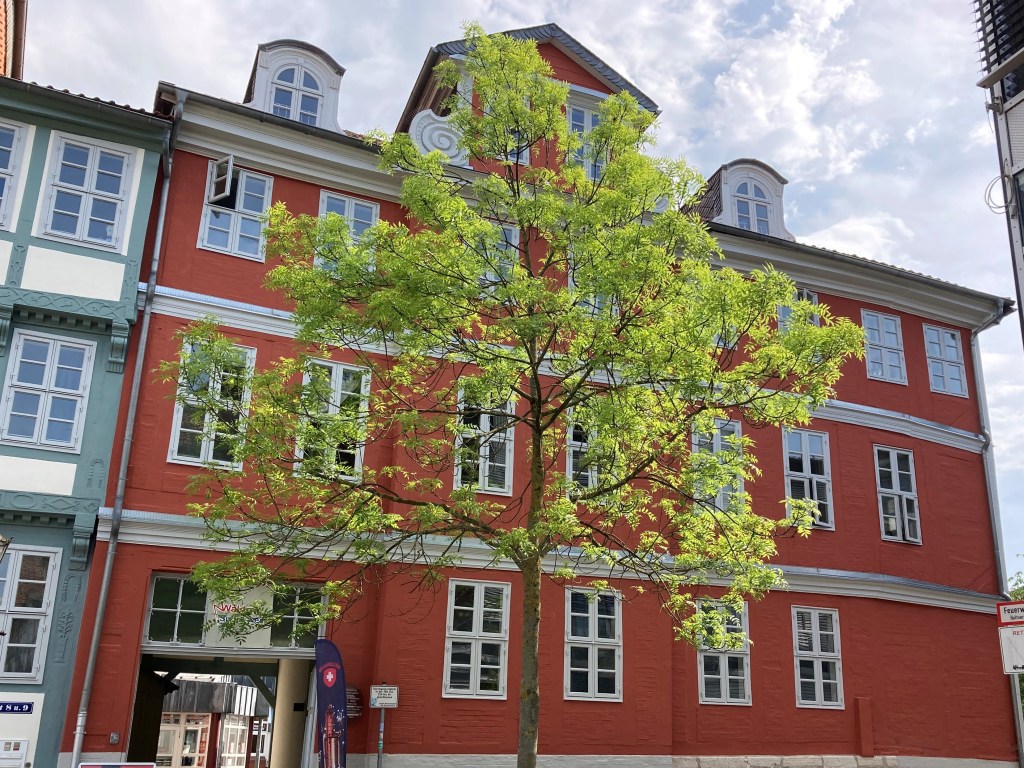
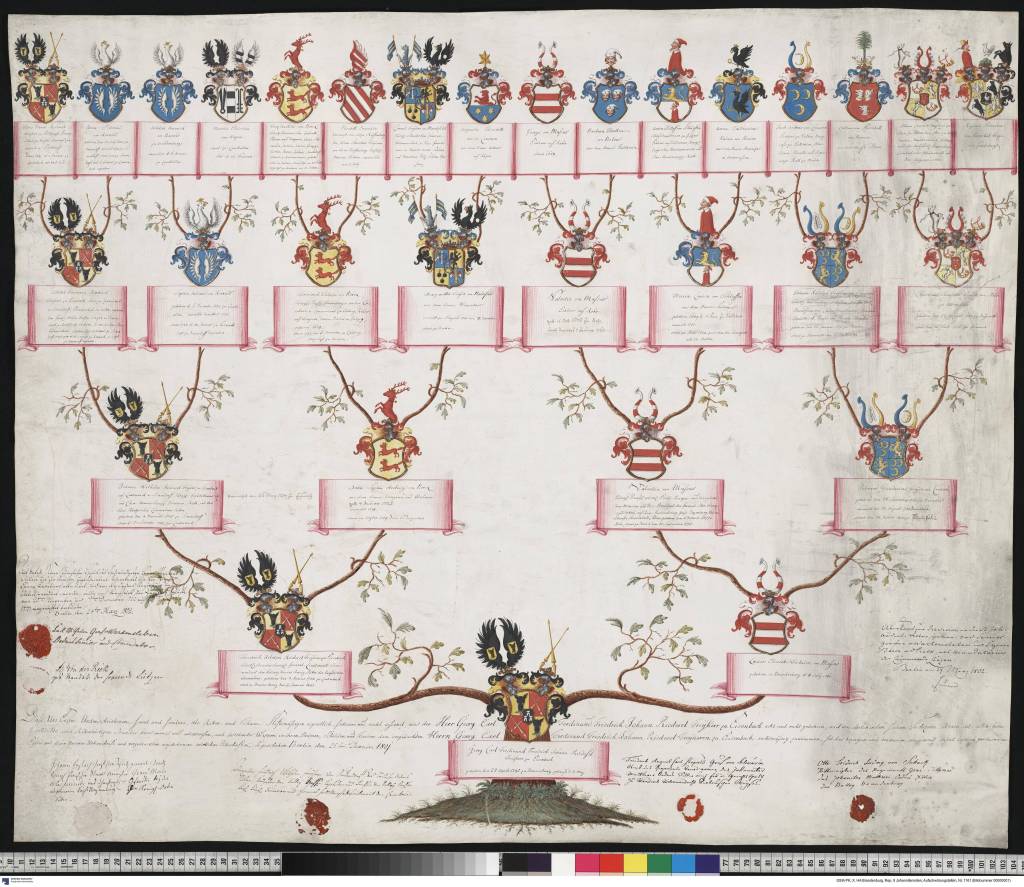
Their first two children, a son born in 1766 and a daughter born in 1770, did not survive infancy. Seven more children followed, six of whom lived into adulthood: Three daughters were born before the war and accompanied their parents to North America: Auguste Amalie Leopoldine (1771–1805), Johanne Juliane Friederike (1774–1854), and Caroline (1776–1861). Two additional daughters were born during the war; Henriette Louise Wilhelmine Amerika (1780–1856) was born in New York, and Canada (1782–1783) was born (and died) in Quebec. The last two children, Georg Karl Ferdinand Friedrich Johann (1785–1854) and Charlotte Hedwig (1788–1848), were born in Germany after the war. After the death of her husband in 1800, Friederike moved to Berlin, where she resided with her daughter Auguste and son in law Heinrich XLIV Reuss-Köstritz. She died there in 1808, and, like the general, she is buried in Lauterbach in the family vault of the church. A family tree in the collections of the Prussian archives documents the noble ancestry of son Georg going back four generations.
It is commonly assumed that Friederike’s decision to follow her husband to North America was nothing unusual at the time. She supposedly simply did what was expected of a soldier’s wife. This was not the case at all. Although the presence of women and children in military camps was common, it was highly unusual for a woman of her status to follow her husband into war. Contemporary records confirm that her friends and family did not approve of her decision to undertake this risky journey, especially since she was determined to go with her young children. There is no doubt that Friederike Riedesel was a very unusual woman. She followed her husband despite the strong reservations of people around her. She was among the first German women who traveled to North America for reasons other than emigration, and she was the first German woman and among a very small cohort of European women who published narratives about their travels outside of Europe.
The records included with this post are representative of some of the reservations about her plans that were shared by individuals in her family and in her social circles. They are excerpts from two letters (written in French) by Duchess Philippine Charlotte of Braunschweig. They are dated February 15 and April 17, 1776, and addressed to her brother, Prince Ferdinand of Prussia.
ENGLISH TRANSLATION
February 15, 1776
The poor wife of Riedesel is in a state of affliction which is truly pitiful; she is serious, , but even so, I’m afraid it won’t come to a good end. She persists in wanting to follow her husband, which is not practicable since he himself does not know the destination where or how he will be assigned. Between us, it is a true Hottentot war, where many innocent people will suffer and be sacrificed, and that is all.
FRENCH ORIGINAL
La pauvre femme de Riedesel est sand un état d’affliction qui fait véritablement pitié; elle est grave, avec cela je crains que cela ne prendra pas une bonne fin. Elle persiste de vouloir suivre son mari, ce qui n’est pas practicable puisque lui même ne sait pas la destination où ou comment il sera place. Entre nous soit dit, c’est une vraie guerre de Hottentots, où beacaup de personnes innocents souffriront er seront sacrifiées et voilà tout.
ENGLISH TRANSLATION
April 17, 1776
The question you put to me on the chapter of the subject, what makes Madame Riedesel intend to follow her husband to America, is otherwise known to me only by what she says, that it is out of affection that she wishes to follow him. She has not given up on it until now, she is so stubborn about this idea that no one dares to thwart her; so despite all the advice given to her to withdraw, she is making all the preparations to leave any day now. This is the first task to be done, the biggest still remains to reach Canada on the St. Lawrence River. If you look at the map of America, you will see what a terrible journey that is.
FRENCH ORIGINAL
La question que vous me faites sur le chapitre du sujet, qui fait intentionner Madame Riedesel de suivre son mari en Amérique, ne m’est autrement connu que par ce qu’elle dit, que c’est par amitié qu’elle veut le suivre. Elle ne s’en désiste point jusqu’a present est elle si opiniâtre sur cette idée que personne ne l’ose contrarier; ainsi malgré tous les conseils, qu’on lui a donnés pour l’en désister, elle fait tous les préparatifs, pour partir au premier jour. C’est la première besogne faite, la plus grande reste encore pour arriver au Canada sur le fleuve de St. Laurent. Si vous regardez la carte d’Amérique, vous verrez, quell terrible voyage cela fait.
Featured Image: Engraving by John Chester Buttre, after painting by Johann Heinrich Wilhelm Tischbein, Indiana University Bloomington Image Collections Online.
Citations: Klaus Mann, Distinguished Visitors: Der amerikanische Traum (Munich: Edition Spangenberg, 1992).
The excerpts from the letters by Duchess Philippine Charlotte are included in Hans Droysen, “Die Braunschweigischen Truppen im Nordamerikanischen Unabhänigigkeitskriege: aus Briefen der Herzogin Charlotte von Braunschweig, mitgeteilt vom Professor Dr. Hans Droysen in Berlin Friedenau,” Jahrbuch des Geschichtsvereins für das Herzogtum Braunschweig XIII (1914): 148-149, 150. The originals are in the Geheimes Staatsarchiv Preussischer Kulturbesitz Berlin. A manuscript typescript of Hans Droysen’s compilation of letters, including unpublished portions, is in the Lower Saxony State Archives at Wolfenbüttel (call number NLA WO 299 N Nr. 58).


One thought on “Friederike Riedesel, War Correspondent, 1776 to 1783”
Comments are closed.