
In the summer of 1776, the surgeon Julius Friedrich Wasmus was one of several thousand troops from Braunschweig who arrived in Quebec, Canada. He was attached to the Braunschweig Dragoner Regiment (regiment of dragoons). It was part of General John Burgoyne’s army that was moving south from Quebec in the summer of 1777. In mid-August, Burgoyne sent a detachment of around 800 men under Lieutenant Colonel Friedrich Baum to Bennington to collect horses, draft animals, and provisions for the army. Unbeknownst to them, an estimated 1,500 American troops under General John Stark had been assembling at that place. The ensuing battle ended in disaster for Baum and his forces. An estimated 200 men were killed; Baum was mortally wounded. Around 700 soldiers became American prisoners of war. Wasmus was one of them.

After residing for around a year with a family in Brimfield, Wasmus and other captives were first sent to Westminster and then to Rutland, Massachusetts. According to his journal, Wasmus expected to go with the Convention Army (the troops that became American captives as a result of Burgoyne’s surrender at Saratoga in October 1777) to Virginia in the winter of 1778; however, he was instead ordered to remain in Rutland to provide medical care for German officers, including members of the Convention Army. It is worth noting that Wasmus was not a regimental or company surgeon. Rather, his position in the army was the equivalent of a surgeon’s mate. The dragoons’ surgeon was Vorbrodt, who is mentioned in the document included with this post. Wasmus was the only military surgeon at Rutland during this time.
The document below is a letter written by Wasmus when he was at Rutland. It is addressed to the commander of the Braunschweig troops, Major General Friedrich Adolph Riedesel. At that time, Wasmus had been a prisoner for almost three years. He expresses pride in his ability to provide effective medical care to both Hessians (by which he meant, Hessen-Hanau soldiers) and British captives. He writes that he “cured” a fractured leg — at a time when these kinds of injuries frequently resulted in amputation — in addition to venereal diseases and other dangerous ailments. However, he complains about accumulating debts due to advancing the cost for medicine used by the British, his insufficient wages, and the loss of his baggage. He can’t wait to be exchanged. He is pleading with Riedesel to keep him in mind should there be an opening for a surgeon in another unit.
Wasmus wrote a number of letters to his general. They indicate that, by the beginning of 1781, he was growing increasingly frustrated that his role as surgeon had so far prevented his exchange. Despite his pleas and the efforts by several Braunschweig officers to arrange his exchange as a corporal, the Americans insisted that he had to be exchanged for an American surgeon. So, while other captives were being exchanged or paroled, Wasmus was left behind in Rutland.
Although he missed his friends, he gradually established an active medical practice serving several towns in the area. When he finally learned of his imminent exchange for an American surgeon in the summer of 1781, he was somewhat ambivalent about leaving. However, later that summer, he sailed from Boston to Quebec, where he rejoined his regiment.
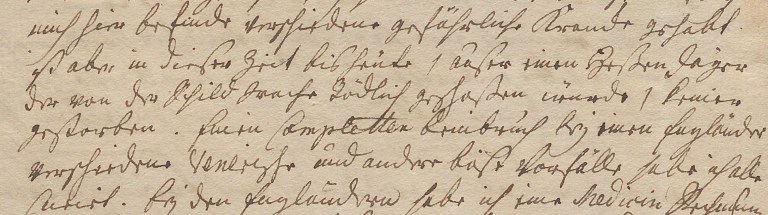
ENGLISH TRANSLATION
Rutland, June 5, 1780
Honorable [lit. high well-born] Baron, Gracious General Major,
I humbly wish to report to Your Honor that the prisoners in the barracks here are currently in good health. I also have the English and Hessians under my care, should they require any medicine. During the 16 months I have been here, I have had various dangerously ill people, but during this time until now (except for one Hessian Jäger who was fatally shot by the sentry) no one has died. I have cured a complete leg fracture in one Englishman, as well as various venereal and other serious conditions. I have a bill for medicine for 16 pounds for the English, which I advanced, and I wish that I could be reimbursed for it, as I have fallen into debt because of this, and my salary scarcely suffices to support me here. I have endured much trouble and burden with the English and have only included the cost of the medicine in my bill. I hope that I may eventually be exchanged [word(s) illegible due to damage] as was customary in the previous war in Germany [Word(s) illegible due to damage].
I have been so unfortunate to have received none of my baggage, including a trunk that I left in Trois Rivières and a portmanteau that I left behind at Fort Edward. I believe the regimental surgeon Vorbrod [Vorbrodt] took my trunk for himself. My losses at Bennington amounted to 12 pounds in cash, instruments, and baggage. Since I have now lost everything, I am poor and, especially due to the lack of clothing items, particularly shirts, I am in the most wretched condition. If only we might be exchanged one day!
Should a regimental field surgeon position ever become vacant, I most humbly beseech Your Honor to graciously consider me for it. Your Honor could graciously improve my fortune and elevate my position, in which I would joyfully sacrifice myself.
With the most humble respect and reverence, I remain, Your Most Honorable Baron, my gracious General Major,
Your humble servant
J.F. Wasmus

TRANSCRIPTION
Rutland den 5. Jun. 1780
Hochwohlgebohrner Freyherr gnädiger Herr General Major
Erw. Hochwohlgebohren habe unterthänig melden wollen daß die Gefangenen in den Barraks allhier sich anjetzt in guten gesundheits Umständen befinden. Ich habe auch die Engländer und Heßen unter meiner Vorsorge, wenn selbige an Medicin etwas benötiget sind, ich habe in den 16 Monathen daß ich mich hier befinde verschiedene gefährliche Kranke gehabt ist aber in dieser Zeit bis heute (auser einen Heßen Jäger der von der Schildwache tödlich geschoßen wurde) keiner gestorben. Einen Completten Beinbruch bey einen Engländer verschiedene Venerische und ander böse Vorfälle habe ich aber curirt. Bey den Engländern habe ich eine Medicin Rechnung von 16 lb, die ich vorgeschoßen, zu fordern und wünsche daß ich selbige bezahlt bekommen könte, weil ich dadurch in Schulden gerathen bin und meine Gage kaum hinreicht mich hier zuerhalten, ich habe bey den Engländern viel Mühe und Last gehabt und nichts als den Werth der Medicin in meiner Rechnung angesetzt, aber ich hoffe das ich dereinst [Wörter unleserlich] ausgewechselt werden, von mein [Wörter unleserlich] es im vorigen Krieg in Teutschland [Wörter unleserlich] üblich war.
Ich bin so unglücklich gewesen, daß ich von meiner Bagage als einen Coffre, den ich in Trois rivieres und einen Mantelsack den ich zu Fort Eduart zurückgelaßen, nichts erhalten habe. Meinen Coffre, glaube ich, hat der Regiments Feldscher Vorbrod [Vorbrodt] zu sich genommen –, mein Verlust zu Bennington war 12 lb an baaren gelde Instrumenten und Bagage. Da ich aber nun alles verlohren habe so bin ich arm und der Kleidungs Stücken besonders Hemder halber, in der elendsten Situation. Möchten wir doch einmahl aus gewechselt werden!
Solte einmahl eine Regiments Feldscher Stelle offen sein, so bitte unterthänigst, Erw. Hochwohlgebohren wollen gnadig auf mir reflectiren. Hochdieselben können mein Glück gnädig verbessern und meinen Stand verändern, als in welchen ich mich freudigst Sacrificieren würde.
Der ich mit unterthänigsten Respect und Ehrfurcht beharre Hochwollgebohrener Freyherr meines gnädigen Herrn Generall Majors
Unterthäniger Knecht
J.F. Wasmus
Citation: Schriftwechsel des Generalmajors Friedrich Adolf, Freiherrn von Riedesel, NLA WO 237N Nr. 84, f. 58, Lower Saxony State Archives Wolfenbüttel.
Note: Julius Friedrich Wasmus’ diary covers the time from his arrival in Quebec in the summer of 1776 to his return to Germany in 1783. It has been published in English. The original is in the Lower Saxony State Archives Wolfenbüttel (NLA WO VI Hs 11 Nr. 248/2).
Featured Image: Plate from John Aitken, Essays on several important subjects in surgery: chiefly on the nature and cure of fractures of the long bones of the extremities. Particularly those of the thigh and leg, whether simple of compound : for which a new method of retention is proposed. The whole illustrated with cooper-plates (London, 1771). Accessed at the Wellcome Collection.
 Hessians - German Soldiers in the American Revolutionary War
One thought on “I Have the English and Hessians under my Care. Massachusetts, 1780.”