George Washington famously described subordination and discipline as “the Life and Soul of an Army.” He reiterated this conviction on multiple occasions over the course of the Revolutionary War. In January 1778, for example, General Orders included the reminder that “exact discipline and the strictest obedience to orders is the soul of an Army and foundation of success, whilst the contrary may be productive of the most fatal consequences.” The enforcement of discipline and obedience was strict, and punishment for infractions could be harsh. However, the Americans were supposed to treat its soldiers more leniently than its enemy army treated its troops. As Horatio Gates put it in a letter to Washington, “a Soldiery, composed of Freemen, armed in the Defence of their natural Rights, should not be treated with that cruel Severity, so often, and so wantonly practiced in Royal Armies.”
How did German regiments address crimes and other forms of misconduct in the ranks? Naturally, punishments varied depending on the nature of the offense. They could be quite harsh. German-authored records related to disciplinary cases, including court-martials, regularly mention penalties such as confinement for a period of time, dishonorable discharge from the regiment, and demotion (for corporals). However, by far the most frequent sentence for soldiers was some sort of corporal punishment, such as lashings and beatings. It was also very common for soldiers to be condemned to running the gauntlet, a form of punishment in which the man was forced to run multiple times between two long rows of soldiers who struck him with sticks and similar implements. This was a humiliating and painful experience that was intended not only to punish the offender but also to deter others from committing similar offenses.
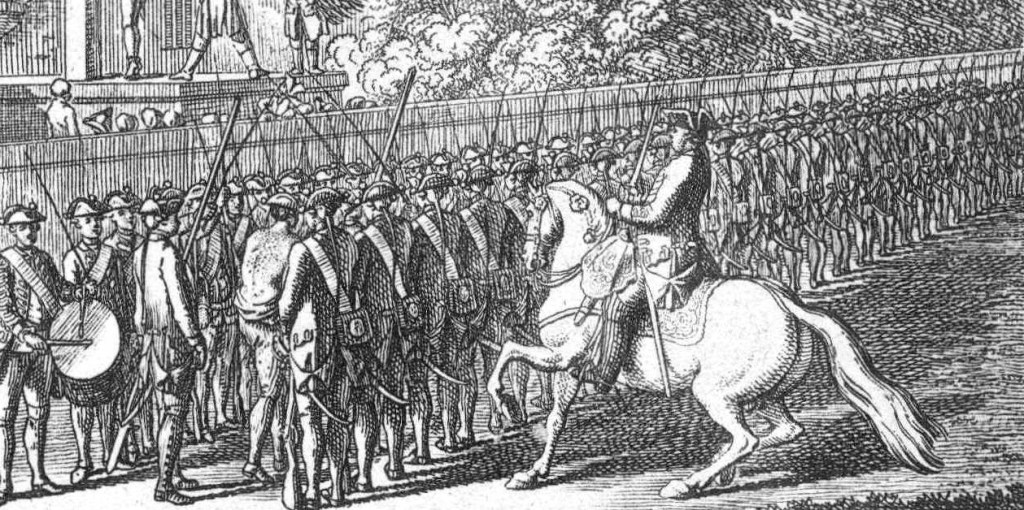
Illustration [detail] in J. B. Basedows Elementarwerk mit den Kupfertafeln Chodowieckis … Tafel 34.
The punishment for particularly egregious offenses was death. Desertion was one of these capital crimes. However, while it was not unusual for deserters to be sentenced to die, it was extremely rare for it to be actually carried out. Only a handful of such cases are known to have occurred within the German corps over the course of the seven years that Germans served in North America. In fact, execution as punishment was so rare that many soldiers in Canada thought it was not permitted there. This, at least, is what the commander of the Braunschweig corps, Major General Friedrich Adolph Riedesel, believed when he was dealing with incidents of serious disorder within his ranks.
This post features a letter by Riedesel to his ruler, the duke of Braunschweig. Written in Sorel, Quebec, in the summer of 1782, it includes information about the court-martials for four of his soldiers. Each had been found guilty of committing a number of crimes over a period of time. They included theft from comrades and locals and repeated attempts to desert and persuade others to join them. Despite having been punished with confinement, loss of certain privileges, and severe beatings, these repeat offenders remained undeterred. Even “severe corrections” had failed to have the desired effect. Frustrated with his inability to curb the “vices” of thievery and desertion, Riedesel resolved to make an example of the four men.
Riedesel did not think that they all needed to die to achieve this objective. Instead, he resorted to a practice that was derived from the Roman punishment of decimation. In this ancient form of military discipline, a tenth of a group of soldiers collectively guilty of a serious offense, such as cowardice, desertion or mutiny, were selected by lot. These men would then be killed by their comrades, regardless of their actual individual behavior.
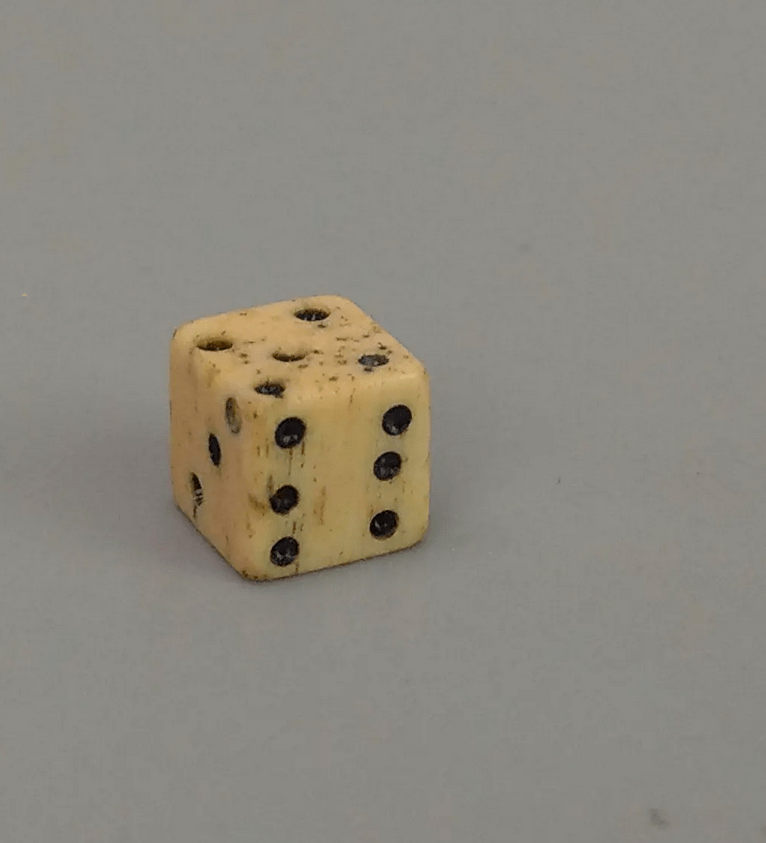
In the case discussed in this post, all four men had been found guilty and condemned to die. Typically, after enduring the terror of fear of death, they would have been pardoned and be subjected to another form of punishment. However, they had the bad luck of being selected to serve as a warning to others. They would throw dice for their lives, and the two men with the lowest score would be executed. In other words, luck determined whether they would live or die.
I have not encountered another case of soldiers drawing lots or throwing dice for their lives in the Braunschweig or any of the other German corps. This may have been an isolated case. Riedesel certainly did not make this decision lightly. In his letter to his ruler, he explains what happened.
A note regarding one of the offenders: Christoph Müller became an American prisoner of war as a result of Burgoyne’s surrender at Saratoga in October 1777. He belonged to this captive army, known as the Convention Army, when he deserted for the first time from their barracks at Winter Hill, near Cambridge, Massachusetts. After being returned to captivity, he deserted again and enlisted in the Loyalist provincial corps led by Frederick Diemar. This troop, known as the Black Hussars due to the color of their distinctive uniform jackets, enlisted a number of German prisoners of war, including Braunschweig soldiers. Unsurprisingly, Braunschweig officers were not pleased with these activities and sought to reclaim their men whenever possible. Müller was one of the men who was discovered and returned to Canada.

ENGLISH TRANSLATION
Sorel, 3 July 1782
General Major v. Riedesel, concerning the capital crimes committed by the 3 musketeers and [1] baggage servant named within, and their punishment.
The musketeer Christoph Müller, belonging to Colonel [Johann Friedrich] Specht’s regiment and company, 36 years old, a native of Osterwiek [Osterwieck], of the Protestant religion, served for 6 years, and capitulated for 4 years, deserted from the Convention [Army] for the first time at Winter Hill, but was brought back to the corps by loyal subjects of His British Majesty, and punished with two months’ arrest and the loss of his capitulation. He then stole a silver spoon belonging to Lieutenant [Johann Ludolf] von Unger. Since the spoon was recovered, he was punished for this with a beating with a cane. He nevertheless deserted again, went to the enemy provinces, and, without saying that he belonged to the Braunschweig Corps, joined Diemar’s Hussars in New York. There he was recognized by Brigadier [Ernst Ludwig Wilhelm] von Speth, reclaimed, and taken to Canada.
From there he deserted in 1780 from the camp at Berthier in a complot [conspiracy] of ten men, of which he was one of the leaders, and he himself seduced one of his accomplices named Johann Lüttmann and several others [to desert]. He was condemned to run the gauntlet 24 times through 200 men but was spared 4 [of these runs].
He repeated the desertion in September 1781 with one of his comrades named Johann Müller, whom he had enticed to do this, and promised to lead him to New York, because he knew the way very well. However, he was once again caught.
The musketeer Johann Schulze of the regiment of Captain [Julius Ludewig August] von Poellnitz Company that had been graciously entrusted to me, 33 years old, born in Baruth in Saxony, Protestant religion, by profession a blacksmith, since 1777 in military service here. In the night from the 23rd to the 24th of July of last year, he stole from the former but since demoted Corporal Bensen [Bense] of my regiment, by means of breaking the window and entering the room in which Bense was sleeping, a sum of money of various pieces of gold, which according to the currency here amounts to £ 39, 1 shilling, 2 pence. He then deserted together with two of his accomplices, named Roeshing and Schnellbach from the guard at Berthier, whom he had allowed to take part in the theft, and at the same time he left his post. However, all three were caught again, and although some of the money was recovered during the search, around £18, 2 shilling, 3 pence, remained unrecovered.
The baggage servant Ernst Friedrich Schott from Captain v. Schieck Vacant Grenadier Company of the regiment of Colonel Specht, 30 years old, born in Karlsruhe, Protestant religion, a watchmaker by profession, 4 years in service here, capitulated for 6 years, deserted in a complot of 4 men from Riviere de Loup in 1779, and thievingly took 3 silver watches with him, which had been brought to him by Habitants for repair. When the complot was caught, the watches were taken from them and returned to the owners. Schott, however, was punished with running the gauntlet 8 times through 200 men. On July 4th of last year, he deserted for the second time with a Canadian named Querie from Montreal. However, he was immediately caught again. During the investigation it was discovered that, in addition to many other gross, hostile and dangerous frauds, he had kept a number of gold, silver and tombac watches, some of which had been given to him to sell, some for repair, and he had actually sold them and kept the money and defrauded the owners. He also took a gold watch belonging to the merchant Dumoulin with him when he deserted, and he defrauded the merchant Mersé of a silver watch, which, in spite of all the care and coercive means employed, could not be recovered, as he insisted that he had left the gold watch in the woods but had sold the silver one to a man who had gone to Michilimakinack [Michilimackinac]. Because it is more than 200 miles from here, further investigation was made impossible. The theft itself, including the goods which were given to him in good faith and care, and which he willingly and dangerously embezzled, according to a moderate estimate, amounts to more than £ 57 in local currency. Based on the circumstances, the Inquesit [accused] was granted a defensor [defender], and during the impartial military court all the arguments presented in the defense statement have been closely examined.
The musketeer Johann Wehr of my regiment and the vacant company, 22 years old, born in the Eichs Feldischen [Eichsfelde], Catholic religion, served for 6 years, deserted for the first time in August 1780 from the camp at Quebec in a large complot, and at that time seduced the musketeer Julius Cassel to desert. He went away with his complete uniform, also his musket and weapons, and, along with his accomplices, he resisted with his musket a detachment of the Anhalt-Zerbst regiment, which had been sent after the deserters. He was punished for this crime this time with running the gauntlet 18 times through 200 men. It occurred to him a second time to form a complot, and on April 18, he went with musketeer Adam Hutlinger, whom he induced to desert after he had shortly before taken ½ Guinea from one of his comrades.
All 4 inquisitors [accused] have not been able to present even a minimal substantial, honest and lawful cause to justify their repeated crimes, rather they confess, testantibus actis [as the records show], that they have no cause to complain about anything, and that they have received everything they could possibly rightfully demand.
The court martial held for these 4 inquisitors was impartially combined out of various regiments belonging to the Braunschweig Corps. After taking into account all of the circumstances mentioned in the actis [record] which could possibly be favorable to the offenders, and in view of their gross crimes, which have been repeated so many times, it unanimously condemned them to die by hanging. As His Honorable Ducal Highness can discern from the general extract and tabular record of judicial proceedings, which the general staff auditor prepared and submitted on his arrival here, these vices have taken hold within the corps for some time now to such an extent that it can hardly been stopped. On the contrary, the people have continued these punishable unlawful acts completely unabashedly, and the severe corrections given up to now have remained fruitless. The idea that no death penalties could be carried out here has become general and has been noted in the votes cast in court-martials. Therefore, I have been put under the sad necessity of confirming the votes given at the court-martial for these 4 inquisitors, with the permission of the governor of the province, General Haldimand. However, in order to merely set an example and to instill in the corps a revulsion against the two above-mentioned gross vices, I have changed the judgment to the effect that the two deserters in the complot and complot makers, Christoph Müller and Johann Wehr, and the two dangerous, clandestine and methodical thieves, Johann Schultze and Ernst Schott, must play for their lives in reatu asquales [reatu agnates = related to the crime].
As it turned out, the inquisitors Wehr and Schultze were sentenced to die because they threw the lowest numbers [with dice]. On June 11, the death sentence was therefore carried out on both of them, but instead of the punishment of hanging, by means of the arquebusade [firing squad].
The two remaining men, Christoph Müller and Friedrich Schott, on the other hand, who had the fortune to be freed from the death penalty imposed on them by throwing the highest numbers, have not been punished physically after having endured the fear of death. However, they have been removed from the regiment and corps as evil members unworthy of the company of honest soldiers, and so that they may no longer be able to do damage to the public, have been delivered to warships to work in the service of His Majesty the King of Great Britain.
According to the present and reported circumstances, I most humbly hope that Your Most Serene Highness will most graciously approve this procedure, which the service and the greatest necessity compelled me to take, and I remain in the deepest devotion
Most Serene Highness most obedient servant Riedesel

TRANSCRIPTION
Sorel, d. 3ten Jul. 1782.
General Major v. Riedesel, die von intus benahmten 3 Mousquetier und [1] Packknecht begangenen Capital Verbrechen, und deren Bestrafung betreffend.
Der Musquetier Christoph Müller, von des Obristen [Johann Friedrich] Specht Reg und deßen Compagnie, 36 Jahr alt, aus Osterwiek [Osterwieck] gebürtig, Evangelischer Religion, 6 Jahr gedient, und auf 4 Jahr capitulirt, desertirte das erste mal zu Winter Hill aus der Convention, wurde aber von den königlich gesinnten Unterthanen Sr Großbritt Majestaet wieder zum Corps gebracht, und mit 2 monalichen Arrest nebst den Verlust seiner Capitulation bestraft. Er stohl darauf einen dem Lieut: v. Unger zu gehörigen silbernen Löffel, wofür er, da der Löffel restituiret wurde, mit bloßen Stock Prügeln in der damaligen Lage abgestraft. Er desertirte aber dennoch wieder, ging in die feindlichen Provinzen, und sistirte sich, doch ohne zu sagen, daß er zum Braunschw. Corps gehöre, in New York unter die Diemarschen Husaren, von daher er bei Anwesenheit des Brigad: [Ernst Ludwig Wilhelm] v. Speth erkannt, reclamiert, und mit nach Canada genommen wurde.
Von da desertierte er 1780 aus dem Lager von Berthier in einem Complot von 10 Mann, wovon er einer der Anführer war, und einen seiner complicen Namens Johann Lüttmann selbst, und noch mehrere zu bereden verführt. Er wurde das mal zu 24 maligen Gaßen=führen durch 200 Mann condemniret, ihm aber 4 mal davon geschenckt.
Er wiederholte die Desertion im Sept: 1781 mit einem seinen Cammeradten, Namens Johann Müller, den er dazu verleitete, und versprach ihn nach New-York zu führen, weil er den Weg sehr gut wiße, wurde aber auch wieder attrapirt.
Der Musquetier Johann Schulze von den mir Gnädigst anvertrauten Regiment des Capit: [Julius Ludewig August] v. Poellnitz Comp., 33 Jahr alt, von Baruth im Sächsischen gebürtig Evangel. Religion, von Profeßion ein Schmidt, seit 1777 in hiesigen Kriegsdiensten, stahl dem ehemaligen nunmehro aber degradirten Corporal Bensen von meinem Regiment, in der Nacht von 23ten auf den 24ten Jul. v. J. mittelst Erbrechung der Fensterlade und Einsteigung ins Cabinet worin Bense gschlafen, eine Summa Geldes von verschiedenen Piecen in Golde, welche nach der hier coursirenden Müntze auf £ 39 1 Sch[illing] 2d [Pence] beträgt. Er desertirte darauf nebst zweyen seinen complicen, Namens Roeshing und Schnellbach denen er an den Diebstaehl teilnehmen laßen, von der Wache zu Berthier, verließ zugleich seinen Posten. Alle drey wurden aber wieder ertappet, und ob man gleich bey der Visitation einen Theil des Geldes wieder fand, so sind doch an die 18 £. 2 S[hilling]. 3d. [Pence] unrestituiret geblieben.
Der Packknecht Ernst Friedrich Schott vom Regiment des Obristen Specht des Capit: v. Schieck Vacanten Grenadier Comp. 30 Jahr alt, aus Carls Ruhe gebürtig, Evangel. Religion ein Uhrmacher von Profession, 4 Jahr in hiesigen Diensten auf 6 Jahr capitulirt, desertirte in ao 1779 in einem Complott von 4 Mann von Riviere de Loup aus, und nahm diebischerweise 3 silberne Uhren mit, die ihm von Habitants zur Reparatur gebracht waren; die Uhren wurden, da das Complott attrapirt ward abgenommen, und denen Eigenthümern restituiret, Schott hingegen mit 8maligen Gaßen=führen durch 200 Mann bestraft. Am 4ten Jul v. J. desertirte derselbe zum 2ten mahle mit einem Canadier namens Querie aus Montreal, wurde aber gleichfals wieder ertapt. Bey der Untersuchung entdeckte sich, daß er außer vielen andern groben, feindlichen, und gefährlichen Betrügereien, inmaßen er eine Partey goldene, silberen und Tombachene Uhren, die ihm Theils zum Verkauff eingesezt, theils zur Reparatur gebracht, zurück gehalten, würcklich verkauft, das Geld depensirt und die Eigenthümern darum betrogen, auch eine goldene Uhr, welche dem Kauffmann Dumoulin gehört, bey seiner Desertion mit genommen, und den Kauffmann Mersé um eine silberne Uhr betrogen; die aller angewandten Vorsicht und Zwangs Mittel ohngeachtet, nicht wieder herbey zu bringen gewesen, indem er beständig dabey verblieben, daß er die goldene Uhr im Holze liegen laßen, die silberne aber an einen Mann verkauft, welcher nach Michilimakinack [Michilimackinac] gegangen, und über 200 Meilen von hier entfernt, welches eine weitere Nachforschung unmöglich gemacht. Der Diebstahl selbst beträgt, mit Inbegriff derer Güter, die ihm in guten Glauben und Verwahrung gegeben worden, und er williger und gefaehrlicher weise veruntreuet, nach einen nur mässigen Überschlage mehr denn £ 57 allhie coursierende Münze. Dem Inquesit [Beschuldigten]ist vorkommenden Umständen nach ex officio ein Defensor [Verteidiger] zugegeben, und bey abgehaltenen unpartheyschen Kriegs=Rechte auf alle in der eingegebenen Defensions=Schrift vorgekommenen Argumente genau reflectiret.
Der Musquetier Johann Wehr von meinem Regt und der vacanten Comp., 22 Jahr alt, aus den Eichs Feldischen [Eichsfelde] gebürtig, Catolischer Religion ins 6te Jahre gedient, desertirte zum ersten male im Aug. 1780 aus dem Lager zu Quebec in einem starken complott, und verführte dermalen den Musquet. Julius Cassel zur Desertion. Er ging mit völliger Mondirung, auch Gewehr und Waffen fort, wiedersetzte sich nebst seinen Complicen thätlich mit Gewehr gegen eine Commando von dem Regt Anhalt Zerbst, welches denen Deserteurs nachgesetzt wurde. Er ward für dieses Verbrechen dasmal mit 18maligen Gaßenführen durch 200 Mann bestraft. Es fiel demselben zum 2ten mahle ein, ein Complott zu machen, und ging am 18ten April a.c. mit dem Musquet. Adam Hutlinger fort, den er zur Desertion verleitete, nachdem er kurz zuvor einen seiner Cameraden ½ Guinée untergeschlagen.
Sämtliche 4 Inquisiten haben nicht die allergeringste erhebliche redliche und gesetzmäßige Ursache anzuführen vermogt, um damit ihre reiterirte Verbrechen zu justificiren, vielmehr gestehen sie, testantibus Actis [as the records show], daß sie über nichts zu klagen Ursach, und sie alles erhalten haben, was sie nur irgend mit Recht fordern können.
Das über diese 4 Inquisiten gehaltene unpartheyische von verschiedenen Regimentern des Braunsch. Corps combinirte Kriegs Recht, hat selbige mit Erwegung alles in actis [record] erwehnten und denen Deliquenten etwa zu gute kommenden Umstände, in Rücksicht ihrer groben so mannigfaltig wiederholten Verbrechen unanimiter zum Strange condemniret. Da beyde Laster, sowohl die Desertion als Dieberey wir Ehrw. Herzogl Durchl aus den eingesandten General Extract und tabbelarischen Verzeichniß von den vorgefallenen Gerichtlichen Handlungen, welches der Genl Staabs Auditeur aus denen verhandelten Actis, bey seiner Ankunft hier verfertiget, und eingereichet hat, in mehrern zu ersehen, gnädigst geruhen werden, bey dem Corps seit einiger Zeit so sehr eingrißen, daß demselben kaum Einhalt gethan werden können, die Leute vielmehr diese strafbare gesetzwiedrige Handlungen ganz ohngescheuet fortgesezt, und die bis lang gegebene, so harte Corrections fruchtlos geblieben: Die Idee, daß keine Lebens=Strafen hier verhängt werden könten allgemein geworden und bey abgegebenen Votis in Kriegs Rechte bemerket worden: So bin ich in die traurige Notwendigkeit gesetzt worden, die über diese 4 Inquisiten [Beschuldigten] abgehaltene Kriegs Rechte, unter Genehmigung des Gouverneurs der Provinz, General Haldimand zu confimiren. Um jedoch nur lediglich ein Exempel zu statuiren, und dem Corps eine Abscheu gegen die beyden oberwehnten groben Laster einzuflößen, habe ich das Erkenntniß dahin geändert, daß die beyden Deserteurs im Complott und Complott-Macher, Christoph Müller und Johann Wehr, die beyden gefährlichen heimlichen und geflissentlichen Diebe, Johann Schultze und Ernst Schott in reatu asquales [reatu agnates = im Zusammenhang mit dem Verbrechen] um ihr Leben spielen müßen.
Da es sich denn gefügt, dass dem Inquisit Wehr und Schultze durch Wurfung der niedrigsten Augen das Loos betroffen zu sterben. Das Todes Urtheil ist also an diesen beyden, jedoch statt der Strafe des Stranges, mittels der Arquebusade [durch Erschießen] am 11ten Juny a.c. vollstreckt.
Die beyden übrigen Christo. Müller und Friedr. Schott hingegen, welche das Glück durch Wurffung der mehresten Augen von der gegen sie erkannten Todes Strafe befreyet, sind zwar nach ausgestandener Todes Angst mit keiner Leibes Strafe belegt, jedoch als böse und der Gesellschaft ehrlicher Soldaten, unwürdige Mitglieder, vom Regiment und Corps geschaffet, und damit solche dem Publico ferner zu Schaden außer Stand gesezt werden, zur Arbeit in Sr. Majestaet des Königs von Groß Brittanien Diensten, auf Krieges=Schiffe abgeliefert.
Ich darf vorliegenden und einberichteten Umständen nach unterthänigst hoffen, dass Erw. Herzogl. Durchl. dieses Verfahren, wozu mich der Dienst und die höchste Nothwendigkeit gezwungen, gnädigst approbiren werden, und beharre in tiefster Devotion
Erw. Herzogl. Durchl. Unterthäniger Knecht Riedesel
Citation: The letter is included in the folder: Berichte des Oberstleutnants Otto Karl Anton v. Mengen sowie einige Briefe des Generals v Riedesel, des Leutnents Friedrich Karl Reinking and Herzog Karl Wilhelm Ferdinand bzw. das Fürstl. Kriegs- Collegium und darauf ergangege Antwortschreiben des Herzogs Karl, 1781-1782, WO 38b alt Nr. 257, f. 183, Lower Saxony State Archives Wolfenbüttel.
 Hessians - German Soldiers in the American Revolutionary War
One thought on “They Threw Dice For Their Lives. Canada, 1782.”