
A few years ago, the Braunschweig Prinz Friedrich Regiment was described as “one of the worst regular infantry units in Revolutionary era North America.” Indeed, it seems to have had a poor reputation in terms of discipline, at least when compared to other Braunschweig regiments that served in North America. Shortly after the regiment’s arrival in Quebec in the summer of 1776, the commander of the Braunschweig corps Major General Riedesel voiced serious concerns about its condition; specifically, he found the men to be exceptionally poorly drilled. Because he did not have much confidence in the regiment’s commander Lieutenant Colonel Christian Julius Praetorius to remedy the situation, he placed Lieutenant Colonel Friedrich Baum in charge of drilling the individual companies before bringing them back together for exercising them as a regiment. The Prinz Friedrich Regiment ended up joining General John Burgoyne’s expedition the following summer. However, after the conquest of Fort Ticonderoga, it was left to guard the fort as the main army marched on toward Albany (and, as it turned out, into American captivity.) After Burgoyne’s defeat at Saratoga in October 1777, the regiment returned to Canada where it remained until the end of the war and its return to Germany.

Over the course of the war, Riedesel regularly dispatched reports and updates regarding the corps to his ruler in Braunschweig. These packets frequently included letters by other officers or soldiers addressed to him or the duke directly. Praetorius authored several of these letters. And in some of them, he eagerly sought to highlight his regiment’s fine appearance, commendable behavior, and overall good reputation.
The letter included with this post dates to the spring of 1782, when the regiment was garrisoned in Quebec. It had been six years since Riedesel’s devastating assessment of his regiment, and almost five years since it had been relegated to garrison duty. Evidently, their drilling remained wanting; in late March, another officer, Johann August von Loos wrote to his close friend Riedesel from Quebec that “Praetorius must drill diligently.” To make matters worse, though through no fault of Praetorius, the soldiers had been wearing the same uniforms for several years. They no longer looked good.
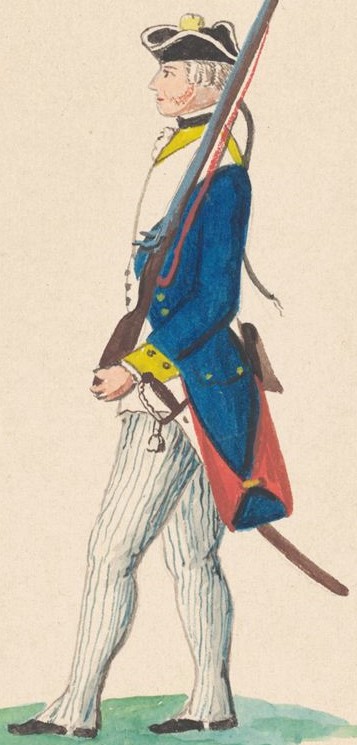
German regiments wore uniforms that were distinguished by the colors of the coat, including collar, lapels, and cuffs. After five years of wear and tear in harsh climate and rough terrain, the Prinz Regiment uniforms were in terrible shape. This was obviously a problem. For one, they were unsuitable for Canada’s long, cold winters. The men required warmer outfits. However, Praetorius appears to have been more concerned with the shabby appearance of his regiment compared to the British regiment that served at the same location (this was the 31st). And he was even more embarrassed by the poor appearance of the regiment in the eyes of the British commander-in-chief, General Thomas Clarke. It was shameful that his men were clad in ragged uniforms. Their appearance was not just humiliating for him and the men; it also reflected poorly on the duchy and the entire corps.
To address the situation, Praetorius devised an ingenious plan to provide his men with winter outfits and to make their shabby uniforms presentable. This was the subject of his letter in the spring of 1782. With obvious delight, Praetorius reported to the duke that his initiative and creativity had resulted in success. In time for winter, the regiment had been outfitted with “nice winter habits” that should last them for a long time. More importantly, Praetorius had managed to transform the ragged outfits, turned inside out, repaired and patched, into presentable uniforms. He was pleased to report that the regiment’s appearance had earned the highest praise from Clarke. Even Riedesel could not deny that. That’s because Praetorius knew, he informed the duke, that Clarke had expressed his approval in a letter to Riedesel. In fact, he had reportedly even held up the Prinz Friedrich Regiment as a model of appearance to one of his own officers. Praetorius’ pride in his resourcefulness and the generals’ response is obvious.
But that was not all. He had not only managed to make his regiment look sharp. Praetorius concluded the letter with an even more flattering observation about his men. The Prinz Friedrich regiment, the British general had reportedly said, was the only German regiment he had ever encountered that could get along with his British regiment. In fact, his men had such a good reputation, Praetorius explained, that the people of Quebec had given them the name “bon enfants,” or good children.
Praetorius’s letter reached the duchy in August 1782. The duke retroactively approved his actions but hoped that the expenses had not exceeded the regiment’s financial means. While this was not the enthusiastic praise he may have hoped for, Praetorius must nevertheless have been pleased with the response. At least his ruler and superior officer had not reprimanded him for taking unconventional (and unauthorized) steps to make his regiment look good. They seemed to have been satified with his performance.
ENGLISH TRANSLATION
Christian Julius Praetorius to the Duke of Braunschweig, Headquarters, Quebec, May 30, 1782
[…] I had mentioned in my most recent reports to his Grace, dated October 14 and November 15, that I have been stationed with the regiment of His Serene Highness Prinz Friedrich in the garrison at Quebec this past winter. […] Before leaving the encampment, I had all the uniforms [“Mondirungen”] of the companies repaired so well that it received the approval of Major General von Riedesel, who arrived here from captivity before I moved into the garrison. However, despite all the repairs, the uniforms were too old and worn out to last through the entire winter, which is very long here, had it not been for a convenient opportunity that provided me with the means to address this concern.
This opportunity came from the [fire]wood, which is provided weekly to the garrison and is very expensive here. I saved enough of this [fire]wood to have made a nice winter outfit [“Winter habit”] made of brown cloth for each of the non-commissioned officers, drummers, and soldiers of the entire regiment, which will serve well through the entire coming winter. Major General Riedesel, who visited us from Sorel last January and had each company drill individually before him at the local barracks, was very pleased with this nice winter outfit, because he found it even better than the English uniforms of the 31st Regiment.
Since said Major General von Riedesel did not bring any new uniforms for the regiment upon his arrival in Canada, only forty-two complete uniforms could be distributed to each company. I was again in a most difficult situation, needing to find a solution for the remaining, greater part [of the regiment]. I had to consult with all of the company chefs, and we agreed to buy the best old uniforms from the soldiers, turn them inside out, and replace the worst parts with new cloth, so that the regiment would appear entirely new at Major General Clarke’s review. That I have fully achieved my goal in this regard, Major General von Riedesel will not get around to notifying you in his most humble report, since I know Major General Clarke praised the regiment highly in a letter to him, and at dinner, he presented the proper appearance of the Regiment Prinz Friedrich as a model to his own major.
The cost for the winter outfits amounted to around 1,000 Spanish dollars. As for the repair of the uniforms for this spring, I have some hope from Major General von Riedesel that these expenses will be reimbursed with cash, because even though they could be somewhat high, it was my duty, given that I must here serve alongside the English and under the eyes of the commanding general, to exert all my efforts, for the honor of the Ducal House of Braunschweig and the entire corps, to ensure that we are not inferior to the English in either exercise or appearance. Since this is based in truth, I must also remark that Major General Clarke is astonished to have encountered a German regiment that gets along with his regiment, a fortune he says he has not experienced before. To date, there has not been a single complaint about a soldier from the regiment. Whenever thefts occurred in the garrison last winter, the investigation always revealed that they were committed by the English, which has earned the [Prinz Friedrich] regiment such a reputation that the city’s residents are calling them Bon Enfants [P. wrote “Bon Enfent”, meaning good children]. […]
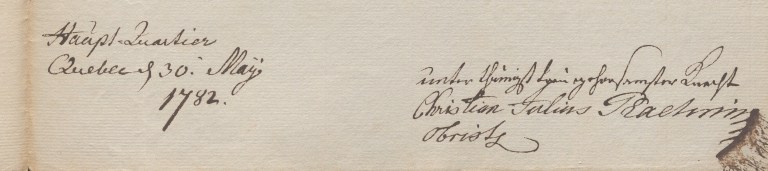
TRANSCRIPTION
Christian Julius Praetorius an den Herzog von Braunschweig Haupt=Quartier, Quebec, d. 30. May 1782.
Daß ich mit dem mir gnädigst anverTrauten Regiment Sr. Durchl. Prinz Friedrichs in der Garnison zu Quebec diesen vergangenen Winter zu liegen gekommen, habe Seiner Herzogl: Durchl in meinen letzteren unterthänigsten Bericht vom 14 Octobr: und 15. Nov: […] zu melden die Gnade gehabt. Ehe ich das Laager verlies hatte ich die sämtlichen Mondirungen bey allen Compagnien so gut aus bessern lassen, daß es den Beyfall des Genr: Major von Riedesel erhielt, der noch ehe ich in die Garnison rückte alhier aus der Gefangenschaft ankahm, erhielte. Jedoch war die Mondierung zu alt und abgenutzt, als das sie aller ausflickung ohn erachtet, auf den ganzen Winter, der hier sehr lang ist, hätte aus dauren können, wenn nicht eine bequäme Gelegenheit mir die Mittel verschafft hätte, diese Besorgnis zu heben. Diese Gelegenheit nun bestand darin, daß ich von dem Holz, welches der Garnison Wöchentlich gereichet wird, und hier sehr theuer ist, so viel über spahrte, daß ich denen gesamten unter=officiers Tambours und Soldaten vom ganzen Regt: einen schönen Winter habit von braunen Tuche machen lassen konte, welcher noch den ganzen künftigen Winter seine Dienste thun kann. Der General Major von Riedesel welcher uns im vergangenen Januaris von Sorell aus hier besuchte, und jede Compagnie auf den hiesigen Baraquen hatte vor sich einzeln exerciren ließ, war über diesen schönen Winter habit sehr erfreut, weil er ihn noch besser fand, als der Engellender ihren vom 31 Regiment.
Da nun mehr gedachter Genr. Major von Riedesel bei seiner anhero Kunft in Canada nicht mehr Mondierunen für daß Regt: mit gebracht hat, als daß p. Compagnie nur 42 Stück Complet aus gegeben werden können, so war ich wieder in äuserster Verlägenheit, für den übrigen grösten Theils noch rath zu schaffen, und hier mußte ich mich mit sämtlichen Comp Chefs besprächen, und kahmen dahin mit ein ander überein, daß wir die besten alten Mondierungen denen Leuthen ab kauften, und um wenden, und die schlächtesten Stellen durch Neues Tuch wolten ersetzen lassen, damit daß Regt: bey der Revue des General Major Clarcke als ganz neu in die Augen fiele. Daß ich nun meinen Zweck in diesen Stück völlig erreicht habe, davon wird der Genr. Major von Riedesel in seinem unterthänigsten Rapport die anzeige zu thun nicht um hin kommen, weil ich gewiß weis, daß der General Major Clarcke in einen Schreiben an ihm, das Regt mit den grösten Lobsprüchen belegt, und selbst bei Tisch seinen eigenen Major die properté des Regts Pr. Friedrich zum Muster vor geworfen hat.
Die Kosten für den Winter habit belaufen sich mehren theils auf 1000 Spanische Thaler, was die reparatour der uniformen für dieses Früh-Jahr an betrifft, so habe ich einige Hoffnung von dem General=Major von Riedesel, daß solche mit bahren gehlde erstattet werden wird, denn ob sie gleich etwas hoch zu stehen könnet, so erforderte es doch meine Pflicht, weil ich mit den propone Engelländern alhier Dienste thun muß, und unter den Augen des Commandirenden General en Chef mich befinde, zur Ehre des Durchl. Hauses Brschw und des ganzen Corps, alle meine Kräfte an zu strängen, um den Engl: weder in der Exercise noch properté etwas nach zu geben. Weil es in der Wahrheit gegründet ist, so kann nicht um hin zu mercken, daß der Genr. Major Clarcke erstaunend ist, ein Teutsches Regt. an getrofen zu haben, daß sich mit seinen Regt vertragen kann, welches glück ihm wie Er sagt, noch nicht wieder fahren ist. Den bis jetzt ist noch nicht die geringeste Klage über einen Burschen vom Regt gehöret worden, denn wenn immer im vergangenen Winter Diebereyen in der Guarnison vor fielen, so fand sich bey der untersuchung alle mahl, daß sie von den Engl. aus geübet worden, welches dem Regt. die reputation zu gezogen, daß sie von den Einwohnern der Stadt Bon Enfent genannt werden. […]
Citation: Berichte des Oberstleutnants Otto Karl Anton v. Mengen sowie einige Briefe des Generals v Riedesel, des Leutnents Friedrich Karl Reinking and Herzog Karl Wilhelm Ferdinand bzw. das Fürstl. Kriegs- Collegium und darauf ergangege Antwortschreiben des Herzogs Karl, 1781 – 1782, WO 38b alt Nr 257, ff. 134-135, Lower Saxony State Archives Wolfenbüttel.
An English translation of Loos’ letter with the reference to Praetorius’ diligent drilling (dated March 28, 1782) is in William L. Stone, transl., Memoirs, Letters, and Journals of Major General Riedesel (repr. New York, 1969), 2:224.
For an excellent collection of essays related to warfare from 1648 to 1789, including discussions of primary sources and historiography that deal with the American Revolutionary War (including the critical assessment of the Prinz Friedrich Regiment), readers are encouraged to check out Dr. Alexander S. Burns’ Blog Kabinettskriege.
Featured Image: [Detail] F. X. Habermann, Vuë de la Rue des Recolets de Quebeck. Prospect der Strasse gegen der Kirche der Recolecten in der obern Stadt zu Québec [177-]. Accessed at Library of Congress.
Image of Soldier: “Braunschw. Regt Prinz. Friedrich 1778,” in the collection of Friederich von Germann drawings, New York Public Library Digital Collections.
 Hessians - German Soldiers in the American Revolutionary War
Charles Lefferts in his book on uniforms of the American Revolution writes this for the troops with Burgoyne. ” For service in America they were equipped with the “American overall,” a loose fitting high waisted garment that strapped under the instep and buttoned snugly at the ankle with 4 or 5 buttons.* This garment was supplied by the British from salvaged tentage and sails, and from surplus naval stores of seamen’s trousers made of blue and white or red and white striped”tiken”. *
Tiken or ticking is a cloth used to hold straw in mattresses and is almost always striped blue and white or red an white.
Brunswick soldiers of various regiments wore this. It can be seen in drawings. watercolors by von Germann, Knoetel, Schirmer, and Larter.
Robert Moeller
On Mon, Aug 19, 2024 at 5:08 PM Hessians – German Soldiers in the American
LikeLike