
It does not require any special insight or explanation that war and warfare affect individuals and communities in a wide variety of ways. Many people experience suffering and hardship while others fare quite well and still others seem to go about their daily lives as usual. The document included with this post illustrates some of the ways in which the war between Britain and the Americans disrupted the life of a young man who arrived in Boston in early 1778. The young man was a native of Prussia named Moses Abraham Wallach. He was not a member of the German corps; however, for a brief period of time, he was associated with, and perhaps even lived among, soldiers belonging to the corps from Braunschweig and Hessen-Hanau. The document is a letter written by him to the Braunschweig general Adolph Riedesel, dated June 1778. It is preserved in the papers of General Riedesel. The two men happened to be in the Boston area at the same time but for very different reasons.
Riedesel was there as a prisoner of war. He was a member of the Convention Army, the army numbering around 6,000 British and German soldiers that had become American captives as a result of General John Burgoyne’s surrender at Saratoga in October 1777. Riedesel commanded the German corps, which included 1,800 Braunschweigers and 600 men from Hessen-Hanau, plus an estimated 82 women and unknown number of children. Under the Articles of Convention (the terms of surrender that were signed by Burgoyne and the American General Horatio Gates), the Convention troops were supposed to march to Boston, from where they would be taken back to Europe. However, neither Britain nor the Americans formally ratified the Articles. As a result, the troops did not sail for Europe. Instead, they remained in the Boston area until the following winter, when they set out for the long march to Charlottesville, Virginia.
In November 1777, the British troops moved into barracks at Prospect Hill while the German troops settled into barracks at Winter Hill, both outside of Boston. For more than a year, this large army needed to be supplied with provisions and other necessities.
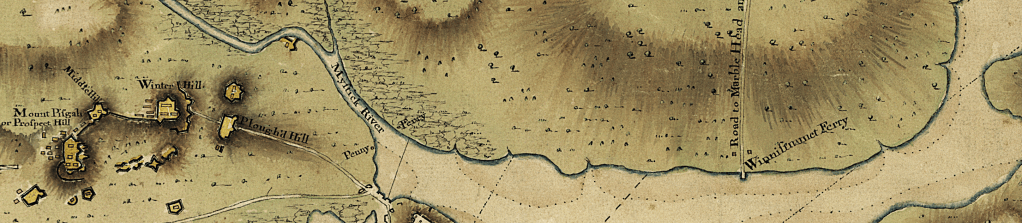
In the summer of 1778, Moses Abraham Wallach was in Boston for business purposes (as he claimed in his letter). He was born around 1756 in Königsberg, Prussia. In the fall of 1776, he emigrated via Amsterdam to the Dutch colony of Suriname, located on the northern coast of South America. In the late eighteenth century, Suriname’s Jewish population numbered around 1,500 individuals, making it the largest Jewish community in the Americas. According to his letter, Wallach resided there with a brother. In late 1777 or early 1778, the young man evidently set out for the voyage from Suriname to Boston; the letter indicates that he arrived in the city in February 1778. He must have been surprised to discover that Boston happened to be the temporary home of a sizeable German community of men, women, and children. For the next few months, he supplied this community with “manufactured” goods. Wallach also claimed to have been instrumental in efforts to discourage desertions, apparently through the clandestine dissemination of information among the troops. His German background, including language fluency, undoubtedly gave him an advantage in business dealings and social interactions with members of the German corps. The fact that Wallach identifies Winter Hill as his location in the letter indicates that he spent considerable time at the German barracks; perhaps he even resided there.
However, Wallach had not intended to remain in Boston. Unfortunately, a sea voyage to South America was very dangerous on account of hostile vessels. Although the ocean was swarming with privateers, the greatest threat to a Dutch merchant vessel would have been the British navy. In fact, meeting minutes of Boston’s St. Andrew’s Lodge indicate that the vessel on which Wallach had been traveling in late 1777 or early 1778 had been captured by the British. It is possible that its intended destination had not been Boston. However, that’s where Wallach found himself in the beginning of 1778. Stripped of his belongings, he turned to the local Masonic lodge for help.
On February 12, “Brother Morton” presented a petition to the lodge for assistance of “Brother Moses Abraham Wallach,” noting that he had been “taken by one of Tyrant Georges Frigates & had everything taken from him even to his Certificate.” The lodge held a collection for Wallach and appointed a committee to find him “suitable Lodgings and a passage to some Dutch Island in the W. Indies” and “present him a Certificate from this Lodge.” (No other than Paul Revere was the Lodge Master when the petition on behalf of Wallach was submitted.) When Wallach learned in the summer of 1778 that a vessel was scheduled to depart for the West Indies, he decided to take advantage of the opportunity. He turned to the German commander General Riedesel for assistance.
The letter essentially consists of a desperate plea for a pass that would protect him (and a chest with his belongings) from seizure and harassment should his vessel fall into British hands. He was worried that he would be treated as though he was a rebel unless he was able to present evidence for his faithful service to the German corps and loyalty to the British king. Twice, Wallach mentions that he is Jewish. He hoped that Riedesel would extend his “renowned grace and compassion even to [him], as a Jew.”
Riedesel’s reply, if there was one, does not appear to have survived. Moreover, it is unclear whether Wallach attempted the voyage and, if so, whether he made it back to Suriname. Whatever transpired after his request to General Riedesel, it appears that things worked out for him. In December, he expressed his appreciation to the Lodge with a gift of “a number of elegant Brass Sconces.” It is possible that he continued to furnish the German Convention troops with supplies until their departure for Virginia in late 1778. In any case, Wallach eventually settled in Boston, where he died in 1836. He was survived by his wife Mary (Robbins) and several children.
Note: I would like to thank Edith Steblecki, Assistant Director and Curator at the Paul Revere House, for sharing her research notes related to references to Moses Abraham Wallach in the St. Andrew’s Lodge minutes.
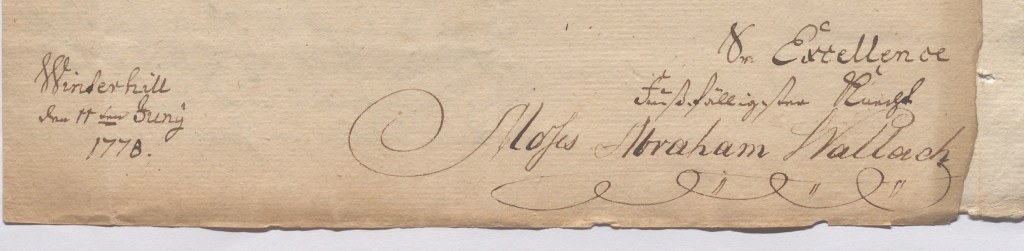
ENGLISH TRANSLATION
To His Excellency General Major von Riedesel
Most submissive memorial
To his Excellency, I humbly present to you, as I am confident that it is not unknown to Your Excellency, that, since the arrival of the German troops at Winter Hill and especially with the Infantry Regiment of Your Excellency, in regards to the items that were requested and supplied by me, as well as my discreet dissemination [of information?] against desertion in the German corps, which I believe were effective, I have conducted myself as is expected of an honest person. If required, this will also be strongly attested by all officers with whom I have associated and who are familiar with me. As long as my circumstances allow and I find myself safe in Boston, I will endeavor to demonstrate through further proof the compliments that have already been given to me.
However, as Your Excellency can gather himself, these days one is living in Boston in a state of fear and hope, as one rumor follows another about the arrival of Howe’s fleet in this city. It is expected that within 3 or 4 weeks a ship will depart from here to the West Indies, and I have a brother residing there, namely in Suriname. I have previously stayed with him and only about 4 ½ months ago I arrived in Boston from there by ship for business purposes. Since that time, I have almost daily been with the German Corps and have not failed to serve them as requested, and moreover without significant personal gain. Now, I desire nothing more than to spend my current troubled days in peace with my brother until God has restored peace, and to depart from here with the aforementioned ship. However, this journey is not without risk, as I am certain that the ship bound for the West Indies will not pass through safely without being attacked by our gracious king’s fleet stationed here. In that case, I would be treated like another rebel.
Therefore, as a person in utmost distress, I throw myself imploringly at Your Excellency’s feet and plead for the gracious consideration of my urgent request. May Your Excellency deign to extend his renowned grace and compassion even to me, as a Jew, and not cast away his servant who lies prostate at his feet. Instead, according to your innate grace and compassion, please give the order that a pass be issued to me, as a Jew who faithfully served the German corps and was deemed a loyal subject of the king, for my person as well as a chest for my safe journey to Suriname. I do not doubt the assistance of my most humble request and submit in deepest humility.
Your Excellency’s Most Humble Servant, Moses Abraham Wallach
Winter Hill, June 11, 1778
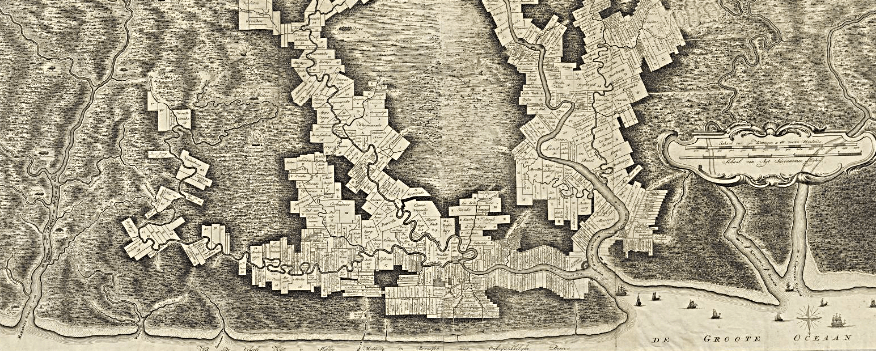
Algemeene kaart van de Colonie of Provintie van Suriname met de rivieren, districten, ontdekkingen door militaire togten […], (1758), Leiden University Libraries.
TRANSCRIPTION
An Sr: Excellence des Herrn General Major von Riedesel
Fußfälligstes Pro Memoria
Sr: Excell: unterwinde mich Fußfälligst vorzutragen, wie ich mich versichert halte, daß es Sr. Excell: nicht unbekand sey, wie ich mich beynahe seit den hierseyn der Teutschen Trouppen auf Winterhill und besonders bey Sr. Excell: Infanterie Regiment, in Betracht der dabey verlangten und von mir gelieferten Manufakturen, nicht weniger in Ansehung wider die Desertion durch mir incognito nach meiner Einsicht gutgeachteten Ausstreuungen im Teutschen Corps, mich so betragen, wie es von einem rechtschaffenen Menschen nur gefordert werden kan, welches mir den auch erforderlichen fals, sämtliche Herren Officiers mit welchen ich Umgang genoßen und Käntniß von mich haben, aufs beste Attestieren werden, ich werde nicht ermangeln so lange es meine Umstände erlauben, und ich mich in Boston sicher finde, dahin trachten, denen mir zwar vor das erste selbst beygelegten Lob durch mehrere proben an den Tag zu legen;
Da man nun aber, wir Sr. Excell: nach dero hohen Einsichten selbst erachten können, unter Furcht und Hoffnung seine Tage zu Boston an jetzt zu bringen hat, indem ein Geschrey dem andern, von der Ankunft der Howeschen Flotte auf hiesiger Stadt sich begleitet, und der Fall eintreten wird, daß binnen 3. oder 4. Wochen von hierher ein Schiff nach West=Indien abgeht, und ich alda, und zwar zu Surinam einen Bruder wohnhaft habe, bey welchen ich mich auch vorbeständig aufgehalten, und nur seit etwa vor 4 ½ Monath von dahero in Ansehung der Handelung, mit einem Schiffe zu Boston angelanget, diese Zeit her ich den auch bey nahe alltäglich mich bey den Teutschen Corps befunden, auch nicht ermangelt, denenselben, mit denen von mir geforderten, und zwar ohne großen eigennutz Dienstfertig zu sein, so wünschte den nun auch nichts mehr als meine jetzt widrigen Tage, bis zu dem durch Gott dereinst hergestellten Frieden, bey solchen meinen Bruder fernerhin in Ruhe zu zubringen, und mit Vorgedachten Schiffe dahin abzugehen: Da nun aber diese Fahrt nicht der sichersten eine sein wird, und gewiß vermuthe, daß das nach Westindien bestimmte Schiff ohne vor unseres Gnädigsten Königs hierbefindlichen Flotte Attaquiert zu werden nicht durchkommen wird, und ich alsden gleich einen anderen Rebellen behandelt werden würde.
Ich daher als ein in Höchster Noth sich befindender Mensch werfe mich Er: Excell: hierdurch flehendlich zu dero Füßen, und bitte um gnädige Erhörung meines dringenden Gesuchs, Höchst dieselben wollen Dero weltberedte Gnade und Menschen Liebe, auch mir als einen Juden gnädigst angedeyen laßen, und denen zu Dero Füßen hingelegten Knecht, nicht hülflos von sich stoßen, sondern vielmehr nach der angebornen Gnade und Menschenliebe, Dero Befehl dahin ergehen zu laßen, daß mir als einen dem Teutschen Corps gedienten und Treu Befundenen Juden und Unterthanen des Königs, ein Paß auf meine Person mit inbegriff eines Coffers zu meiner sichern Reise auf Surinam gereicht würde: ich zweifele nicht an der Hülfe meines Füßfälligsten Gesuchs und ersterbe in tiefster erniedrigung.
Sr: Excellence Fußfälligsten Knecht Moses Abraham Wallach
Winterhill, den 11ten Juny 1778
Citation: Moses Abraham Wallach to Riedesel, in “Schriftwechsel des Generalmajors Friedrich Adolf, Freiherrn von Riedesel …,” 237N Nr. 84, fols. 18-19, Lower Saxony State Archives Wolfenbüttel.
Featured Image: [Detail] John Montrésor, A draught of the towns of Boston and Charles Town and the circumjacent country shewing the works thrown up by His Majesty’s troops, and also those by the rebels, during the campaign [1775]. Library of Congress Geography and Map Division.
For references to Moses Abraham Wallach, see Robert Cohen, Jews in Another Environment: Surinam in the Second Half of the Eighteenth Century (1991), p. 33; and Lee M. Friedman, “Early Jewish Residents in Massachusetts,” Publications of the American Jewish Historical Society 23 (1915), pp. 86-87.
 Hessians - German Soldiers in the American Revolutionary War
I am a descendant of Moses Abraham Wallach, and had previously obtained the referenced letter. I have a few questions.
LikeLike
Thank you for your comment! The letter is dated June 11, 1778. Wallach writes that he supplied the troops with “Manufakturen.” This term can include any manufactured goods (as opposed to raw materials and food items, like firewood, bread, etc.). I am doubtful that this referred to “armor articles.” It seems more likely that he furnished the captive troops with metal tools and other household items they needed to turn the barracks into decent quarters. It is also possible that he supplied them with goods that were manufactured by others. It is interesting that he subsequently fought for the colonists considering his claim in the letter that he had been “deemed a loyal subject to the king.” When did he enlist and where did he fight?
LikeLike
I am not sure when he first joined the militia or where he fought, but I have a copy of his appointment to Major signed by John Hancock.
It’s still a mystery how he could have been supplying the trooos at Winter Hill if they took everything from him when his ship was seized. Why did he need money from the Lodge?
LikeLike
I am not a German language reader, and had the letter translated by an older German person. I’ll take your word for the meaning of “Manufakturen”. Perhaps I had told the translator that Wallach became an armorer. Regarding his service in the Militia, I don’t know when he joined or what battles he fought in, but I have a partial copy of his commission as a Lieutenant in the militia of the Commonwealth of Massachusetts, Suffolk County, signed by John Hancock. He eventually became a Major. It is still a mystery how he could have supplied anything to the troops at Winter Hill if all his possessions were seized on the ship from Suriname. For what it is worth, I have not found any record that the ship he left Suriname on “The Sukey” was seized, and there are extensive records of seizures on both sides. I have been writing the family history, and would welcome your thoughts on this question.
LikeLike
Do you have documentation that shows that he left Suriname on the Sukey? And if so, when was that?
LikeLike
I have secondary documentation which consists of a register of ships traveling through Suriname with some passengers listed. The nameof the ship was Sukuy, not Sukey, and it left Suriname October 12, 1777. If you are interested, I can send you my write-up on M A Wallach. who is my 3rd great-grandfather.
LikeLike
Hi! I am also a descendant of Moses through his daughter Olivia Price. I am very interested in ancestry and would love copies of everything you’ve found.
LikeLike
Elizabeth. You must be a Goldthwaite. I recently met a Steven Goldthwaite in Nova Scotia who must be a relative of yours. I have a lot on Moses and many of his descendants. I have written several chapters on the family, but not your line. I come down through Richard, brother of Olivia Price. How can we communicate without going through this website?
LikeLike
If you both emailed me through the contact form I would be happy to connect you.
LikeLike