Personal correspondence by members of the German corps typically touches on a variety of topics. The authors obviously wanted to cover a lot of ground. For example, letters may include descriptions of the American land, people and cultural customs, personal experiences on and off the battlefield, updates regarding mutual friends and acquaintances, and news or rumors pertaining to the war. They were supposed to be both informative and entertaining. In fact, quite a few letters include passages that are funny. It is evident that the authors possessed a keen sense of humor.
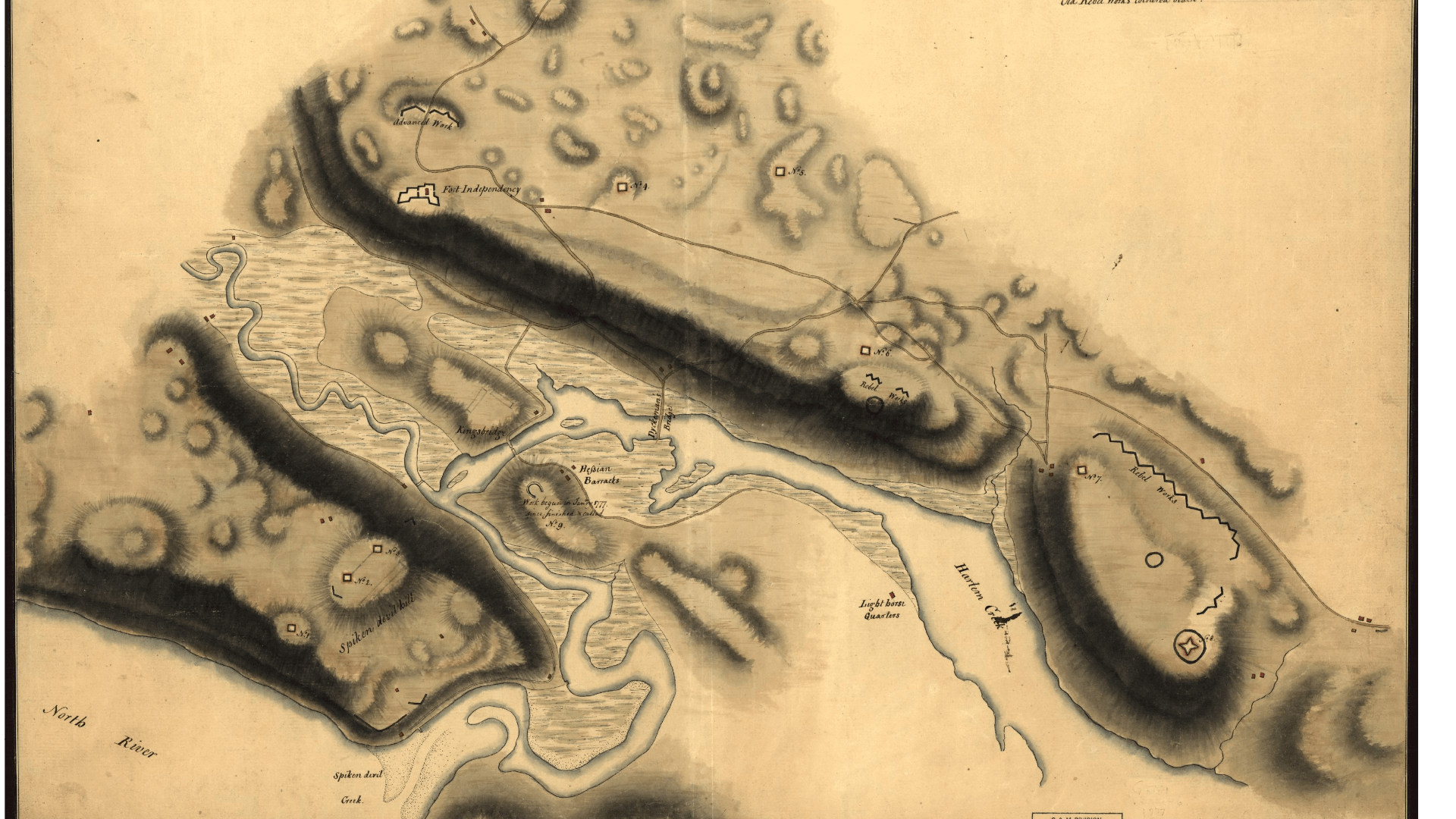
Featured with this post is a letter from Lieutenant Johann Heinrich Henckelmann (c. 1749-?) of the von Stein Garrison Regiment (1778 Seitz, after 1783 von Porbeck Regiment). It was addressed to Pastor Eichenberg in Kassel. (This was probably Heinrich Wilhelm Eichenberg, at the time pastor in Phillipsthal, Hessen). Henckelmann wrote the letter at Fort Knyphausen in June 1777. The fort had been known as Fort Washington until November 16, 1776, when a British-Hessian force defeated the American defenders and renamed it in honor of General Wilhelm von Knyphausen, the commander of the Hessian troops.
Henckelmann describes the contents of the letter as “mishmash.” This is a fair assessment. The topics include a description of Fort Knyphausen, an embarrassing incident at Kingsbridge involving a “Rebels-Lady,” the richness of the province of New York, the death of Colonel Rall at Trenton in December 1776, and Henckelmann’s role at the Battle of Fort Washington. In addition, Henckelmann mentions that he has been somewhat frustrated with his appointment and lack of access to information about military matters.
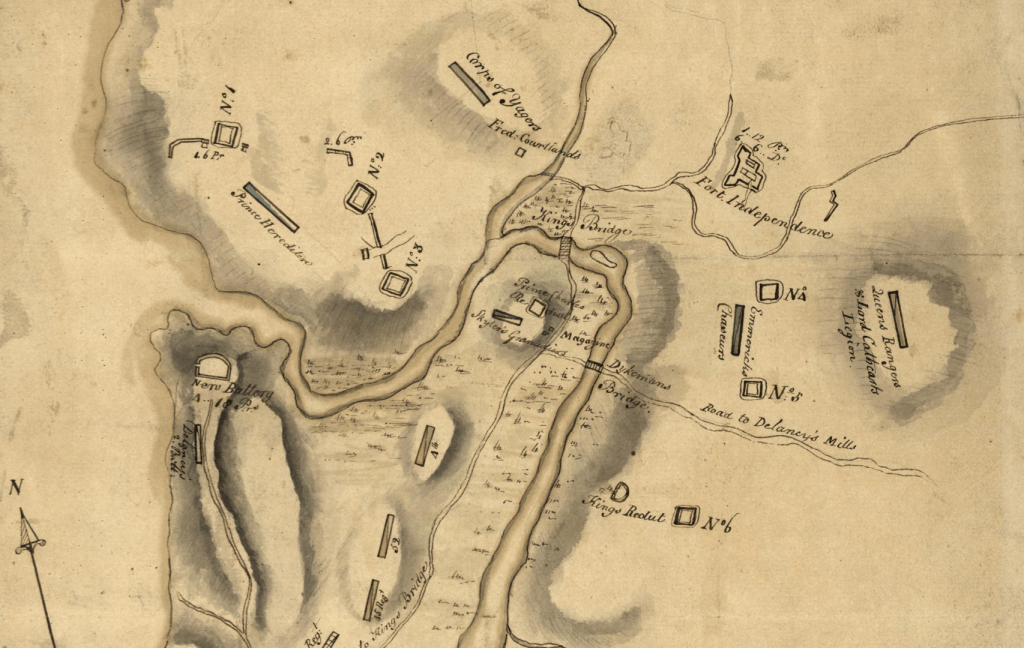
The incident with the “Rebels-Lady” occurred at a social gathering that had taken place in May or June 1777 at Kingsbridge. The post at Kingsbridge guarded the bridge across the Spuyten Duyvel Creek, a narrow waterway that separated the island of Manhattan from the mainland. The Hessian barracks were located near the bridge. Evidently, Henckelmann was a talented vocalist, and he regularly entertained fellow officers and prominent locals with concerts. (In the letter, he compares himself to Giuseppe Morelli, at the time the soprano in the choir of the court chapel at Kassel.)
Regular attendance by a number of prominent Americans at his performances at Kingsbridge soon compelled Henckelmann to call in the Hessian hautboists (oboe players) to accompany his singing. Although not all of the Americans in attendance can be identified with certainty, it is clear that they belonged to very prominent local families: the Cortlands and the Philipses. The Hessian officer mentions several of them in his letter:
Colonel Cortland most likely refers to James Van Cortlandt (1727-1781). He was married to Elizabeth Cuyler (1731–1815). By the time of the American Revolution, he had inherited his father’s house, which was located only a couple of miles from Kingsbridge. (The Van Cortland House is now a historic house museum in the Bronx ).
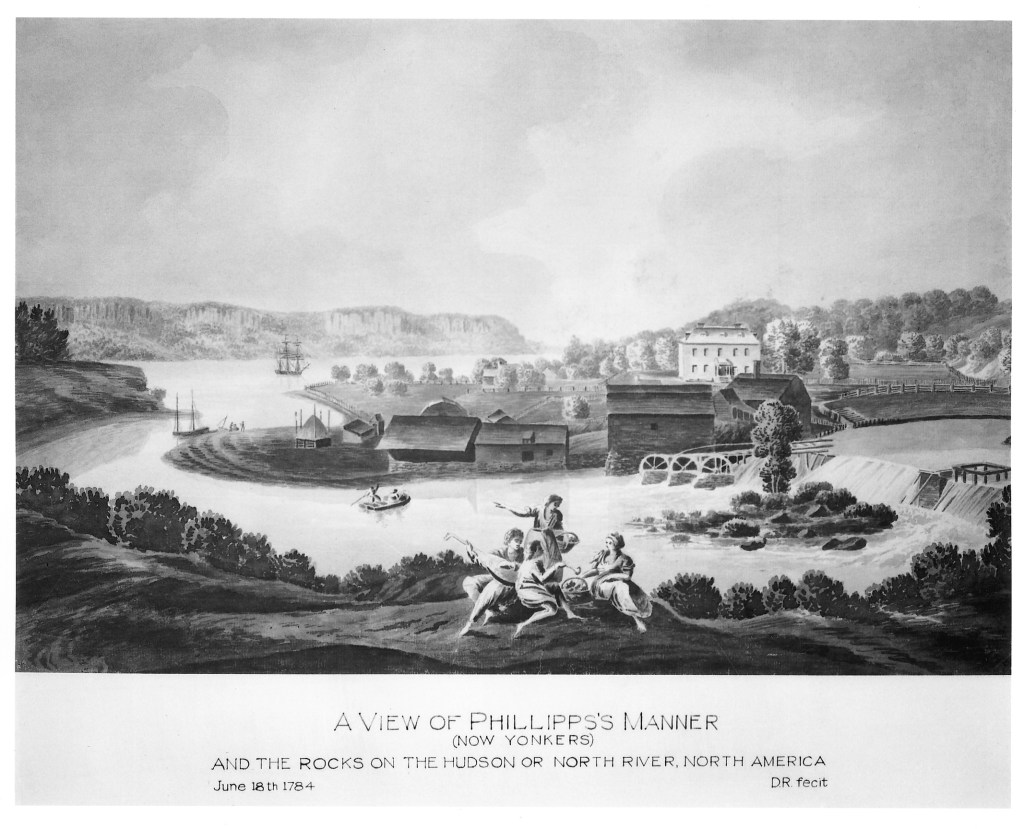
The wealthy resident of New York mentioned in the letter is Frederick Philipse (1720-1785). His wife was Elizabeth Williams Rutgers Philipse (c.1732-1817). She was the daughter of Charles Williams, naval officer for the port of New York. The person identified in the letter as “Miss Williams” may have been her sister, Sarah Williams. The “Venus” in Henckelmann’s letter refers to Maria Eliza Philipse (c. 1756-1838), eldest daughter of Frederick and Elizabeth Philipse. Maria Eliza was 21 years old when Henckelmann made her acquaintance. He jokes that he would be tempted to marry a “Rebels-Lady” if she was this particular “Venus.” He was impressed with her in part because of her father’s wealth. Indeed, Frederick Philipse was one of the largest landholders in New York. He was the third (and last proprietor) of Philipsburgh Manor, which covered about two hundred square miles between the Hudson and Bronx rivers in western Westchester County, extending north from Spuyten Duyvil Creek to the mouth of the Croton River.
In addition to several officers, Henckelmann also mentions Friedrich Wilhelm von Kyau (1654-1733), a baron and lieutenant general well known for his wit and funny pranks. Secret. Strieder refers to Friedrich Wilhelm Strieder (1739-1815), a librarian, historian, and lexicographer based in Kassel. Henckelmann’s letter is included in a file labeled “Privatbriefe aus dem amerikanischen Krieg, überwiegend an Friedrich Wilhelm Strieder [Private Letters from the American War, primarily to Friedrich Wilhelm Strieder].”
Note: I would like to thank Sarah Wassberg Johnson, programs and education manager, and Michael Lord, site manager, both at Philipse Manor Hall State Historic Site, for their assistance in identifying some of the American individuals mentioned in the letter.
ENGLISH TRANSLATION
Lieut. Henckelmann to Pastor Eichenberg in Philipsthal, Fort Knyphausen, 18 June 1777
Do you see now how I am keeping my word? Here now is a letter from America, as I promised you. Although you will not find a lot of interesting things in it, a letter from North America that does not include more than that I am healthy and alive as well as the wish that you and your esteemed family are enjoying the same fortune: this must be dearer to you and more valuable than a lament by Itha.
Where am I writing these haughty thoughts? Near Fort Knyphausen, where we were in barracks this past winter and where we are now in camp. Ensign Trott, who arrived last week from Hessen along with the recruits, told me that Pastor Lotzen believes that Fort Knyphausen was an old castle located at the sea. May I ask you to inform the pastor, with many regards, that the fort, which was built only last year by the rebels, is nothing more than a 5-cornered irregular redoubt equipped with 34 cannon and a magazine in the middle. All around it are lying large oak trees instead of chevaux-de-frise. On the north side at around a rifle shot distance, the North River flows by, on the other side of which New Jersey is presenting itself admirably. If it were to be attacked, 1000 men would have to go inside not counting artillerymen. Of these, 600 could fire constantly and 400 men would have to remain in reserve. In the same way, Fort Independence near Kingsbridge, which is 2 miles from here, and Fort Lee in [New] Jersey, which is opposite Fort Washington, would be demolished. It would be too far-reaching to name all of the batteries and earthworks surrounding the fort. In case I do not marry an American lady and instead return to Hessen, I will bring a plan of the fort and everything that belongs to it that I recorded in my journal.
Whether I am serious about marrying a rebel lady? Most certainly, if it was the one that visited me six weeks ago at Kingsbridge, where I was on command. A girl like Venus, whose father is an English colonel and inhabitant of this province. He owns a piece of land of 22 miles on which 1,000 families are living as his subjects. His annual revenue amounts to 36,000 Liv. Sterl. [pound sterling]. It was his daughter who paid a visit to Kingsbridge in the company of Colonel Cortland (also a local citizen), his wife, and a Miss Williams, with the intention of hearing me sing and give a concert. I do not know whether you know that I was on a par in singing with Mr. Morelli in Kassel. Because they were attending regularly, the oboe players were summoned. Have you ever heard of an opera piece that starts with “Msgr. voies mes larmes”? I trilled this piece for the company to so much acclaim that they were left speechless. But the ending was not all that nice. I was standing, out of respect for the ladies, before Lady Philyps [Philipse] – that was her name – holding a tray with four glasses filled with red wine, and I asked her to drink to the health of the king. Because she did not see me right away due to an ugly hat she was wearing, and because she was flirting with Colonel Cortland, she got under the glasses with her head and spilled one of them on her snow-white dress. I did as Kyau advises and assumed responsibility and at the same time asked for her permission to present her with a new dress, which was fortunately turned down. I knew that ahead of time, or else I would not have been so generous.
Would it not be possible for me to marry a lady here, now that the most beautiful and wealthiest in the province of New York has visited me? It is possible, but I don’t think so. When I think back to my friends and my fatherland, where I will appear in new splendor and as a very important person upon my return, I am losing the desire to remain among the rebels. Although I have to confess that nowhere in the world can there be a more blessed and fertile ground as here. The province of New York is said to be one of the worst, and yet I am amazed by its beauty. The fields, which are basically just turned over without being fertilized, bear the most beautiful fruit. Although all the fruits known to us grow here, the inhabitants mostly grow corn [literally, “Turkish wheat”]. It is wonderful that the small spring leeks are growing in the country like a meadow and then gradually disappear again. The vines are standing around in the woods and hedges and they are slowly becoming astonishingly full of grapes. The fruit trees that every gentleman has standing around his house are countless. There are so many wild laurel trees in the forest that it is impossible to get through. I had an arbor made of it in front of my tent.
How big New York is, how many churches, houses, etc. are in it, I have written to Secretary Strieder but I haven’t received a reply yet. I don’t write much about the war because you can get this news better than I know it. If I were Adjutant General, which I would like to be in order to see more than I actually see, I could give you news that others might not think of. However, as it is, I can’t tell you anything. I no longer wanted to be a regimental adjutant because I wasn’t rewarded for my work. Little things without reward are not my thing, I do big things.
You will be familiar with the affair with Rall. He died on the bed of honor. I pity him. He used to be my enemy. He didn’t think I was brave enough because I didn’t want to violate any laws and break the neck of a mad person. But luckily for me, he was wrong. During the conquest of Fort Knyphausen, I was in command of a battery, from which the rebels were constantly being fired on, and I was quite confident about this. Maybe they didn’t fire back? Yes, yes, that happened too. When carrying out my duties, I am not afraid of any danger.
Whether our operations are still in progress? Yes: General Howe is on Washington’s right side, Cornwallis on the left, and Heister in front on the Jersey side. Maybe we will soon hear something of importance. Generals Knyphausen, Schmidt, Tryon and Jones are our commanders. Fort Knyphausen is on the road that leads to Boston. That’s why there is a corps of about 5,000 men under the command of General Knyphausen. Now I think that I have to stop entertaining you with my mishmash. Farewell etc.
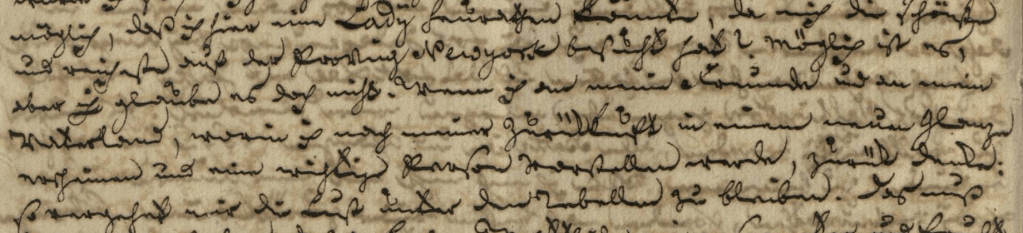
TRANSCRIPTION
Lieut. Henckelmann an Pfarrer Eichenberg zu Philipsthal, Fort Knyphausen, 18 Junii 1777
Sehen sie nun wie ich meine Wort halte? Hier ist ein Brief aus America, wie ich ihnen versprochen habe. Sie werden zwar nicht viel merkwürdiges darin finden, allein ein Brief aus Nordamerika, wenn auch weiter nichts darin stünde, als daß ich gesund bin und lebe, und der Wunsch, daß Du und Ihr hochgeschätzes Hauß eben diese Glückseeligkeit geniessen mögen: so muß es Ihnen doch lieber und schäzbarer seyn, als ein Klaglied von Itha. Wo ich Ihnen diese stolzen Gedanken herschreibe? Nahe aus dem Fort Knyphausen weg, wo wir diesen vergangenen Winter in barraquen cantonirt, und nunmehr im Lager stehen. Der Fähndrich Trott, welcher vorige Woche nebst den Recrouten aus Hessen hier angekommen ist, sagte mir, der H. Pfarrer Lotzen glaubte, daß Fort Knyphausen wäre ein altes Schloß, und läge an der See. Darf ich also bitten. H. Pfarrer nebst vielen Empfehlungen unbeschwert wissen zu lassen, daß das Fort erst im vorigen Jahre von den Rebellen angelegt, nichts anders als eine 5 eckige irregulaire Schanze mit 34 Canonen besetzt und in der Mitte mit einem Magazin versehen wäre. Um dasselbst herum lägen grosse Eichbäume an statt der Spanischen Reiter. An der Nordseite flösse der Nord-River ungefähr einen Büchsenschuß davon vorbey, auf dessen andern Seite sich New-Yersey vortreflich prasentirte. Es müßten 1000 Mann ohne die Artilleristen hinein, im Fall es sollte angegriffen werden. Hiervon könnten 600 beständig feuern und 400 Mann müßten in Reserve bleiben. – So wäre auch das Fort Independence bey Kingsbridge 2 Engl. Meilen von hier beschaffen und das Fort Lee auf Jersey, welches dem Fort Washington gegen über gelegen, wäre demolirt. Es würde zu weitläufig warden, alle Batterien und Schanzen, so sich um das Fort befinden, zu benennen. Sollte ich mich nicht mit einer Amerikanischen Lady verheurathen, sondern nach Hessen wieder zurückkommen: So bringe ich meinen Plan, der in mein Journal eingetragen ist, von dem fort und allem was dazu gehört, mit.
Ob das mein Ernst wäre, eine Rebels-Lady zu heurathen? Ganz gewiß, wenn es nämlich die wäre, so mich zu Kingsbridge, wo ich eben auf Commando war, vor 6 Wochen besuchte. Ein Mädgen, wie Venus, deren vater Engl. Obrester, und ein Einwohner dieser Provintz ist. Er besitzet einen Strich Landes von 22 Meilen, hat 1000 Familien Unterthanen darauf wohnen. Seine jährl. Revenues erstrecken sich auf 36000 Liv. Sterl. [pound sterling]. Dessen Tochter nun ware es, die nebst dem Obresten Cortland (auch ein hiesiger Bürger) seiner Frau Ehelibste, und einer Miss Williams war zu Kingsbridge die visite machten, und zwar in der Absicht, mich singen und ein Concert zu hören. Ich weiß nicht, ob Ihnen bekannt ist, daß ich mich mit H[errn] Morelli zu Cassel um den Sang streite. Weil sie sich regelmässig melden liessen, so wurden die Hautbois herbey geholt. Haben Sie wohl jemahls von einem Stück aus der Oper gehört, das sich – Msgr. voies mes larmes – anfängt? Dieses trillerte ich meiner Gesellschaft mit so vielem Beifall vor, daß ihnen die Sprache verging. Der Ausgang war aber eben nicht so gar schön. Ich stehend, aus Respekt gegen die Dames, mit einem Teller, worauf ich 4 Gläser mit rothem Wein hatte, vor dieser Lady Philyps [Philipse] – so heißt sie – und bat sie, des Königs Gesundheit zu trincken. Da sie mich nun vor einen abscheulichen Sturmhute, den sie auf dem Kopfe hatte, nicht gleich sahe, und mit dem Oberst Cortland schäkerte, kam sie mir mit dem Kopfe unter die Gläser und schüttete eines davon auf ihr schneeweisses Kleid. Ich machte es, wie des Kyau bedeuten, und nahm die Schuld auf mich, bat zugleich um Erlaubniß, daß ich ihr ein Geschenk mit einem anderen Kleid machen durfte, welches aber zu meinem Glück ausgeschlagen wurde. Das wußte ich vorher, sonst würde ich so freygebig nicht gewesen seyn.
Wäre es nun wohl nicht möglich, daß ich hier eine Lady heurathen könnte, da mich die schönste und reichste auß der Provintz New York besucht hat? Möglich ist es, aber ich glaube es doch nicht. Wenn ich an meine Freunde und an mein Vaterland, worin ich nach meiner Zurückkunft in einem neuen Glanze erscheinen und eine wichtige Person vorstellen werde, zurück denke, so vergeht mir die Lust unter den Rebellen zu bleiben. Das much ich zwar gestehen, das in keinem Weltheil ein gesegnter und fruchtbarer Boden seyn kann, als hier. Die Prov. New-Yorck soll eine der schlechtesten sein, und gleichwohl erstaune ich über ihre Schönheit. Das Feld wird ohne gedüngt zu werde, schlechtweg herum gerissen, und trägt die schönsten Früchte. Obgleich alle bey uns bekannte Früchte hier wachsen: so halten sich die Einwohner doch mehrentheils mit türkischen Weizen auf. Wunderbar ist es, daß der kleine Lauch das Frühjahrs hier auf den Ländern wie eine Wiese stehet und sich nach und nach wieder verliehrt. Die Weinstöcke stehen in den Wäldern und Hecken herum und langsam erstaunend voll Trauben. Die Obstbäume, welche ein jeder Gentlemann um sein Haus hat, sind unzählig. Zu dem Walde stehen wilde Lorbeerbäume, daß man nicht durchkommen kann. Ich habe davon eine Laube vor mein Gezelt machen lassen.
Wie groß Newyorck sey, wie viel Kirchen, Häußer etc. darin seyen, habe ich an den Secret. Strieder geschreiben, aber noch keine Antwort erhalten. Mit Fleiß schreibe ich nichts vom Kriege, weil Sie diese Nachrichten besser haben können, als ich sie weis. Wäre ich General-Adjutant, das ich aus dem Grunde seyn möchte, um mehr zu sehen als ich würklich sehe: So könnte ich Ihnen Nachrichten geben, wovon andere vielleicht nicht denken; so aber kann ich Ihnen nichts sagen. Regts-Adjut. wollte ich nicht länger seyn, weil ich für meine Arbeit nicht belohnt wurde. Kleinigkeiten ohne Belohnung sind meine Sache nicht, ich handele ins Grosse.
Die Rallische Affaire wird Ihnen bekannt seyn. Er ist auf dem Bette der Ehre gestorben. Ich bedaure ihn. Ehemals war er mein Feind. Er hielt mich nicht tapfer genug, weil ich die Gesetze nicht übertreten und einem wahnsinnigen Menschen den Hals brechen wollte. Aber zu meinem Glück hat er sich geirrt. Ich habe bey Eroberung des Forts Knyphausen in einer batterie auf Commando gestanden, voraus unaufhörig auf die Rebellen gefeuert wurde, und bin ganz getrost dabey gewesen. Vielleicht wurde nicht wieder herrüber gefeuert? Ja, ja, des geschahe auch. Bey Ausübung meiner Pflichten scheue ich keener Gefahr. Ob unsere Operationen noch nichts im Schusse sind? Ja: H. Gen. Howe stehet dem Washinghton rechts, Cornwallis links und Heister vor der Seitte auf Jersey. Vielleicht hört man nächstens so etwas von Wichtigkeit. Hr. Gen. Knyph., Schmidt, Tryon und Jones sind unsere Befehlshaber. Das Fort Knyphausen lieget an der Strasse, die nach Boston gehet, darum steht hier ein Corps von ungefähr 5000 M. unter der Orde H. Gen. Knyph. Nun sehe ich, daß ich aufhören muß, Sie mit meinem Mischmasch zu unterhalten. Leben Sie wohl etc.
Citation: The letter is included in the folder “Privatbriefe aus dem amerikanischen Krieg, überwiegend an Friedrich Wilhelm Strieder, 1776-1779,” HStAM Fonds 4 h No 3787, fols. 10-13, Hessian State Archives Marburg.
Featured Image: Sketch of the Heights of Kingsbridge , with the proposed redoubts coloured orange. Old rebel works coloured black [1777], Library of Congress Geography and Map Division.
 Hessians - German Soldiers in the American Revolutionary War
One thought on “Fort Knyphausen, a Rebels-Lady, Rall, and other Mishmash. New York, 1777.”