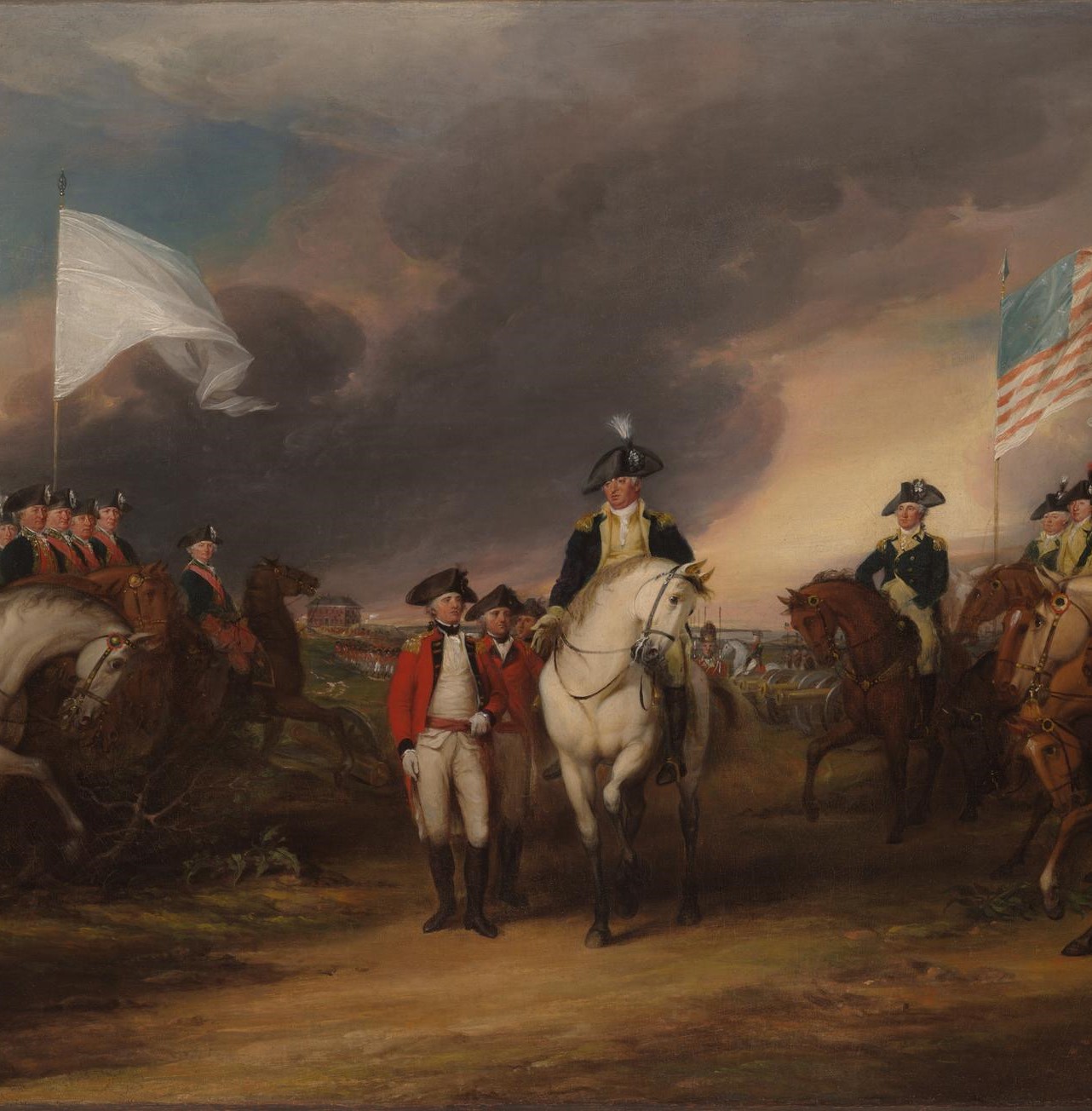
General Cornwallis’ defeat at Yorktown, Virginia, in October 1781 was a shocking development. Although it did not end the war, it turned out to be its last major battle. For some members of the German corps, it also marked the beginning of a period of reflection about the progress of the war, what had gone wrong, and who was to blame for Britain’s failure to defeat the rebels. A particularly impassioned assessment comes from the pen of the Braunschweig Lieutenant Colonel Otto Karl Anton von Mengen.
Lieutenant Colonel von Mengen had been a major in the Regiment von Riedesel until October 1777, when he assumed command of the Grenadier Battalion Breymann after its commander, Lieutenant Colonel Heinrich von Breymann, was killed at the battle of Bemis Heights on October 7, 1777. He belonged to the army commanded by General John Burgoyne when it surrendered at Saratoga, New York, merely ten days later. Under the terms of surrender, agreed upon by General Horatio Gates and Burgoyne, the estimated 3,500 British and 2,400 German (Braunschweig and Hessen-Hanau) troops that were part of Burgoyne’s army were supposed to be sent back to Europe. In anticipation of the departure, they were marched to Boston, Massachusetts. However, both the American Congress and the British government refused to formally recognize the treaty. As a result, the Convention Army, as the captured troops became known, did not depart for Europe.
Although many of the German troops remained in captivity until the end of the war, a number of them were exchanged or released on parole over the next few years. This included Lieutenant Colonel von Mengen. He was on Long Island when he learned of Cornwallis’ defeat at Yorktown on October 19, 1781.
In early November, Mengen poured out his heart about Cornwallis’ defeat — this “very sad catastrophe” — in a letter to his ruler, the Duke of Braunschweig. He was deeply ashamed and humiliated that the army had been defeated by an enemy that was made up of “mostly miserable, half-naked villains.” Mengen’s description of the Americans is particularly disdainful; after five years of war, most Germans had gained some respect for the rebels as enemies. His view of the Americans as inept villains amplified the significance of the failure of mighty Britain to defeat them. Indeed, he had nothing but contempt for the British. It was their selfish and foolish actions that had brought about the collapse of a “powerful and flourishing” nation. Mengen was livid. He thought that “Heaven would not want this to become the history of England.”
ENGLISH TRANSLATION
Jamaica on Long Island, 2 November 1781
Your Serene Highness have already been informed of another sad catastrophe, if you deigned to read my most humble letter. A very sad catastrophe once again fell on a Corps d’Armée in America. Shame and resentment fill the soul of every soldier who derives his honor from more glorious war events in which he was present. And what is most terrible, what humiliates, what is so demeaning: it is neither the skill of warfare nor the bravery of the enemy that wins. Oh! No matter in what exaggerated form it may appear in distant countries, it is mostly miserable, half-naked villains, forced to be soldiers due to want or dissoluteness, and rough militia out of fear of their tyrants, who are credited with this glory. However, it is one’s own mistakes, hesitation, negligence, lavish living, the consequences of declining military discipline, chatter by old and young fools, drowned in lust, treacherous grasps to enrich themselves, and their jealousies, [which] in certain respects [are] more punishable then the ones that ruined the most flourishing armies, more than a confluence of unavoidable accidents. This picture has its origin in history and not in a hypochondriacal phantasy. Lots of screaming, bickering among the parties, at times […], frequently unfair and vulgar, always of use to someone, filled the council meetings, and the nation, as powerful and flourishing as it was, collapsed. Heaven would not want this to become the history of England. Your Serene Highness will forgive me this outpouring of the heart; it revolted against the idea of a dishonored soldier under such circumstances. …

TRANSCRIPTION
Jamaica auf Long Island, 2 November 1781
Ihre Herzogl. Durchlaucht sind bereits von einerten traurigen Catastrophe unterrichtet, wenn Höchst dieselben mein unterthänigstes Schreiben zu lesen geruhe; sehr trauerns volle Catastrophe abermahls über ein Corps d’Armée in America verhängt. Schaam und Unmuth erfüllet die Seele jedes Soldaten, der seine Ehre von mehr glorreichen Kriegs Begebenheiten hergeleitet, wobei er gegenwärtig gewesen. Und was das schrecklichste, was demüthigt, so sehr erniedrigt: es ist nicht Kriegs Geschicklichkeit, nicht Tapferheit des Feindes der sieget: o! in was vergrösserter Gestalt es in entfernten Ländern auch erscheint, es sind mehrentlichs elende halb nackende Lotterbuben, gezwungen zu Soldaten, aus Mangel oder Liederlichkeit, und rohe Miliz aus Furcht ihrer Tirannen, auf welche dieser Ruhm komt; aber es sind eigene Fehler, Zaudern, Nachlässigkeit, üppiges Leben, Folgen nachgelassener Krieges Zucht, Schwetzereien alter und junger Thoren, ertruncken in Wollüsten, betrügerische Griffe um sich zu bereichern, und deren Eifersucht, in gewissen Betracht mehr strafbar, welche die blühendsten Heere zu Grund gerichtet, mehr als ein Zusammenhang unvermeidlicher Unfälle. Dieses Gemälde hat in der Geschichte sein Urbild, nicht in einer milzsüchtigen Phantasie. Lauter Schreien, Gezänke der Partheien, zuweilen […], oft ungerecht und pöbelhaft, alzeit einen nützig, erfüllte denen die Raths Versammlungen, und der Staat so mächtig er war, und so blühend, verfiel. Der Himmel wolle nicht daβ dieses schon die Geschichte von England wurde; und Ehr: Herzogl. Durchlaucht halten mir diese Ergiessungs des Herzen zu Gnaden; es empörte sich gegen die Idee eines entehrten Kriegesmannes unter solchen Umständen. …
Citation: Briefe des Oberstleutnants Otto Karl Anton v. Mengen, sowie einige Briefe des Generals v. Riedesel …, 1781-1782, WO 38 b alt Nr. 257, fols. 73-73v, Lower Saxony State Archives Wolfenbüttel.
Featured Image: John Trumbull, “The Surrender of Lord Cornwallis at Yorktown, October 19, 1781” (1787 – ca. 1828), Yale University Art Gallery.
 Hessians - German Soldiers in the American Revolutionary War
The writer, a noble, did not understand the cause the American colonists were fighting for. Americans to this day do not fully understand allegiance to a noble family. Our loyalty is to the Constitution. That was a very new, even revolutionary, idea at the time of the American War of Independence, as the British call it, and the American Revolutionary War as US citizens know it.
The Germans who stayed in America after the war were predominantly commoners. Opportunities beckoned.
My ancestors left the Prussian province of Hessen-Nassau in 1875 and 1885, not long after the German states were unified by Prussia. They didn’t want to serve in the military and economic conditions in the Bad Hersfeld area were not good.
Thankfully, today Germany has a democratic government.
LikeLike