
In both private and official writings, members of the German corps regularly expressed frustration with a lack of information about the war and an inability to grasp the “big picture.” Not surprisingly, many of these complaints show up in records penned by soldiers in rural regions or remote locations far from the main theaters of war, including Quebec and West Florida. However, a sense of confusion was not unusual even in places where information should have been more readily available. A letter written by the commander of the Third Waldeck Regiment shortly after its arrival in New York reflects these sentiments.
Waldeck was the smallest of the six German territories that concluded subsidy treaties with Britain during the American Revolutionary War. In April 1776, Prince Friedrich Karl August agreed to yield “to his Britannick Majesty a Corps of Infantry of six hundred and seventy men, which shall be at the entire disposition of the King of Great Britain, to be employed in his service on the same footing as the other German Troops, both in Europe and in North-America.” The treaty was signed by the prince’s representative, Friedrich Louis Wiepert von Zerbst and the British representative, William Faucitt. In all, Waldeck provided Britain with about 1,225 troops over the course of the war.
This corps became known as the Third Waldeck Regiment. Its commanding officer was Johann Ludwig Wilhelm von Hanxleden (c. 1736 – 1781). Along with the second division of the troops from Hessen-Kassel, the regiment landed in New York in October 1776. In addition to the 670 soldiers, the transports carried the general staff and fourteen members of the artillery. Also on board were thirty-two women and nineteen children. At least one child was born during the transatlantic crossing (a boy, Benjamin, named after the vessel on which his mother was a passenger).
In his role as commander, Hanxleden regularly dispatched reports to a Waldeck government official, secret secretary (Geheimsekretär) Georg August Frensdorff (1740 – 1819). Included with this post is the very first letter Hanxleden wrote from New York. Although dated October 19, its contents suggests that he composed it over several days.
In the letter, Hanxleden informs Frensdorff that the regiment had little time to recover from the transatlantic voyage. The men were almost constantly on the move with little understanding of rationales behind orders. “One moment I am an Englishman and the next a Hessian,” this Waldeck officer writes with exasperation. He also complains about the limited access to information and general ignorance about larger developments in the war. Under the circumstances, it is perhaps not surprising that he asks Frensdorff not to send any additional women to America.
Hanxleden includes an inquiry regarding the handling of dead soldiers’ belongings and debts. In America, he explains, the captain inherits both from men who do not leave behind a wife or children. To illustrate what can happen in such cases, he mentions two men by name: soldier Stinmeyer and Captain von Leliwa. Hanxleden might be referring to Philipp Steinmeyer, a Waldecker who died of wounds suffered at Westchester on October 22, 1776 (see HETRINA). While I have not been able to identify a Waldeck officer named von Leliwa who served in America, there was a captain von Leliwa who belonged to the Hessian Regiment von Bose. It is also possible that Hanxleden recalled an incident that involved Captain E. P. C. von Leliwa who served in the Second Waldeck Regiment that was in Dutch service. Perhaps Stinmeyer died when both men were serving in Holland.
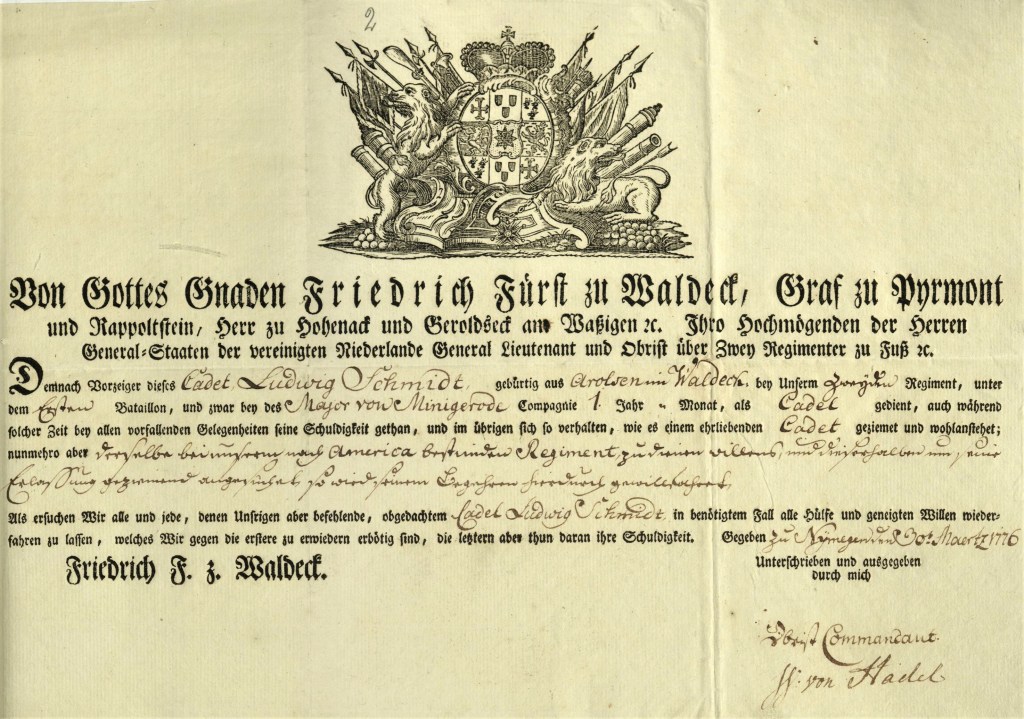
Here is a discharge certificate for a soldier belonging to the Second Regiment in Dutch service who planned to enlist in the Third Regiment destined for America:
Despite his initial frustrations, Hanxleden is confident that the Americans – or as he puts it, the “rabble” [“Lumpengesindel”] – would easily be defeated if the army met them on the “plaine.” Indeed, at the time, General William Howe was preparing for an attack on the Americans at White Plains. The battle, which took place on October 28, resulted in a British victory. The Waldeck Regiment did not take part in the assault. However, on November 16, it participated in the successful attack on Fort Washington, which was renamed Fort Knyphausen in honor of the commander of the Hessian forces. Around ten months later, it took part in the successful defense of Staten Island from an American raid under the command of Major General John Sullivan.
The Third Waldeck Regiment remained in the New York region until late 1778, when it was sent to West Florida. Hanxleden would become one of the many losses suffered by the regiment during its stay in that province. He was killed in early January 1781 during an attack on the Spanish fort near Mobile.
ENGLISH TRANSLATION
[in other hand] received February 4
Kingsbridge, October 19, 1776
I have received both of your letters, including the one from home and the one from London, the latter of which I received two days ago at Fort Independence. A few days ago, General [William] Howe issued me a warrant for 1,000 pounds sterling; the exchange is done by the banker Mr. Barrow in New York, and the payment is done by Mr. Apthrop [Apthorp?] as paymaster in New York. The extracts and bills will soon show the needs of the regiment. My receipts will show what I am receiving. Everything will be put in order once we move into winter quarters. Dearest friend, don’t hold it against me that I will close this letter very soon. I just received the warning from headquarters that a ship will be departing for London, and at the same time, I received orders to depart with the regiment. However, I do not yet know where we are going. I only know that we are going to the English army but I do not yet know under whose orders. Presently, we are with the corps under [Hessian General Wilhelm von] Knyphausen. Since our debarkation, the regiment has not remained in camp for three days at a time; one moment I am an Englishman and the next a Hessian. We are moving around like Israel’s children in Egypt.
In the letter to His Serene Highness, I forgot to ask how we should handle the bequest of deceased soldiers. Here the captain is the heir in cases where the man did not have a wife or children. If he is leaving debts, they fall to the captain. This happened to the major with [the soldier] Stinmeyer. He arrived at the company 9 or 10 pounds in debt, and Captain von Leliwa had to pay it. You will see from the rapport for the Serene Highness what the regiment needs. Should we get any recruits, do not send us any more women. On campaign, they are the most useless objects [literally, “furniture”] in the world. We are in greatest need of a few good free corporals. Be assured of many compliments to everyone in the fatherland. Farewell, I recommend myself always as your most obedient servant, J L W von Hanxleden
Do not expect any news from me. One hears less here than you may know in Europe, namely about the whole context of things. This winter one will find out more. If we had the rabble on the Plaine we would soon be done with them.
P.S. Do not be surprised if my letters and rapports are not always dispatched at the required time. It cannot happen until one receives orders about this from headquarters, and the warning that a ship is departing, and then everything has to be ready right away.
I conclude this letter in my present camp at Delancey’s Mills [“delancin mille”] and I am covering General Howe’s headquarters. I also hear that Fort Lee was taken over yesterday, and our back toward New York, which is around 16 English miles from here, is clear [of the enemy]. We will probably now turn around again and pay a visit to our enemies at White Plains [“Wittplains”]. They are positioned very advantageously on a mountain range, and they have gathered their entire force from the region. They have no other retreat [“Retirade”] than to Boston.
Ensure especially Colonel Kalms of my compliments. I started a letter to him but I was not able to finish it because I, along with all the regimental commanders, was just now ordered to headquarters, which is as far from my post as Arolson is to Hulsen [in Waldeck]. He is probably considering another expedition. I am writing so confused and mixing up one thing with the other because I am almost completely unable to write one sentence without receiving orders, implementing them, and issuing them in turn.
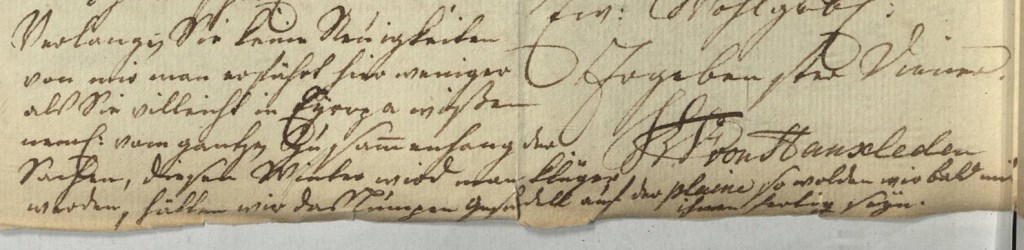
TRANSCRIPTION
[in anderer Hand] reçev le 4 fevr.
Kings Brücke, 19 Oct 1776
Ihr. Wohlgeb: beiden Briefe sowohl den aus dem Land als den letzten aus London, diesen habe aber noch Vorgestern in Ford Intepentence [Fort Independence] richtig erhalten. Vor einigen Tagen habe 1000 lb: Ster. auf einen Warrand vom General [William] Howe ausgestelt erhalten, die Wechsel giebt der Banquier Mr. Barrow in N[ew]: Yorck aus, die Zahlung thut Mr Apthrop [Apthorp?] in N[ew]: Yorck als Pay Master. Aus denen Extracten und Rechnungen wird demnächst ersichtl: seyn, was das Regiment haben muß, meine Quittungen warden zeigen was ich empfange, mithin wird sich solbald wir in die Winterquartiere rücken alles in Ordnung bringen laßen. Liebster Freund nehmen Sie nicht übell daß vor jetz so bald schlise so eben werde aus dem Hauptquartir avertiert daß ein Schiff nach London abgeht, und zu gleich erhalte ordre mit dem regiment auf zu brechen ich weiß aber noch nicht wohin zur Englischen Armee ist mir vorläufig bekannt unter weßen ordre ist mir noch ohnbekannt, gegenwärtig stand beym Knyphausischen Corps. Ich habe mit dem Regiment seid dem Debarquement Noch nicht 3 Tage in meinem Lager gestanden, bald bin ein Engelander bald ein Heße und wir ziehe hir rum wie die Kinder Israel in Egipten.
In dem Schreiben an Ihre Hochfüstl. Durchl: habe vergessen anzu fragen wie Höchst Die selben befehlen wie es mit der Verlaßenschaft dero abgehenden Leute gehalten warden soll, hier ist der Capitain der Erbe in Fall der Mann kein Frau und Kinder hinterläst, bleibt er schuldig so fäld es dem Capitain auch zur Last, dieses ist dem Major mit dem Stinmeyer schon geschen, den Er mit 9 oder 10 lb: Schuld zur Compag: bekam und Hr. Haupt: Leliwa zahlen muste. Aus dem Rapport an Ihre Hochfüstl. Durchl: werde Sie ersehen was dem Regiment gegenwärtig fehlt, solden wir mahl recruten bekommen, so schicken Sie uns nuhr keine Weiber mit, dieses ist das unnüzete Möbel von der Weld in Campagne, einige guthe Frey Corporals thun uns am nöthigsten. Alles versichert mit mir in unserm Vatterland unser vielfältiger Compliments. Leben Sie wohl, ich befehle ohnaufhörl: Erw: Wohlgeb: Ergebenster Diener J L W von Hanxleden
Verlangen Sie keine Neuigkeiten von mir man erfährt hier weniger als Sie villeicht in Eyropa wißen neml: vom gantzen Zusammenhang der Sachen, diesen Winter wird man klüger werden, hätten wir das Lumpengesindell auf der plaine so wolden wir bald mit ihnen fertig seyn.
P.S. Wundern Sie sich nicht wenn meine Briefe und Rapports nicht allemahl zur befohlenen Zeit abgeschickt werden, dieses kann nicht ehemden geschen biß man darzu aus dem Hauptquartir ordre erhält und avertirt wird das ein Schiff abgeht und dann muß sogleich alles fertig seyn.
Ich endige diesen Brief in meinem jetzigen Lager zu delancin mille [DeLancey’s Mills] und decke das Hauptquartir vom Generahl How [Howe], auch vernehme daß das Fort Lee gestern übergangen ist und haben wir den Rücken nach New=Yorck, welches ohngefehr 16 Engl: Meilen von hier entfernt ist, frey. Nun werden wir uns wohl wieder schwencken und unsere feinde zu Wittplains [White Plains] aufsuchen, in steht daselbst auf Gebürgen sehr vortheilhaft postirt, und haben ihre gantze Macht aus hiesige Gegend dorthin gezogen, sie haben keine andern Retirade als nach Boston.
Versichern Sie Hr. Oberst Kalms besonders meine Compliments, und ich hätte einen Brief an Ihn zwahr angefangen, aber nicht endigen können, weil soeben nebst allen Regiments Commandanten ins Hauptquartir, welches soweit wie Arolson von Hulsen vor meiner front liegt, beordert bin, dieser bedenckt vermutl: wieder eine Expedicion. Daß ich so confus schreibe und eins durcheinander mische ist schuld, daß fast nicht im Stande bin eine Zeile zu schreiben ohne daß order empfange, Sie bewürcken und wieder rum ausgeben muß.
Citation: The letter is in “Akten des Kabinetts enthaltend Berichte des Kommandantes des dritten englisch-waldeckischen Soldregiments in Amerika, Oberstleutnants (dann Obersten) v. Hanxleden an den Fürsten und an Frensdorff, 1776-1780,” HStAM 118a Nr. 974, vol. 1, ff. 47-48, Hessian State Archives Marburg.
Captain von Leliwa is mentioned in “Monatliche LIsten vom Grendadier Batallion Block, von Lengerke 1stes Grenadier Bat. 1780 to 1784,” HStAM 15 Nr. 267, f. 146, Hessian State Archives Marburg.
Featured Image: “Bataafsche Republiek. 1 en 2 Regiment Waldeck,” New York Public Library Digital Collections.
 Hessians - German Soldiers in the American Revolutionary War
Reading Daniel Krebs book,”A Generous and Merciful Enemy,” yes there were times when German POWs were treated better than British POWs, but here too Germans
we’re on a roller coaster. The revolutionaries didn’t always have the resources to care for POWs, allowing Germans to work helped solve that problem. The need to move POWs led to very long marches, medical care was difficult. Disease, lack of clothing and housing, and erratic provisions made the problem worse. The Convention Army, supposed to be sent back to Europe, gradually became POWs. Congress changed its approach to POW treatment as conditions changed. POWs were used to further their objectives. Sometimes even revolutionary POWs were left in captivity if it helped the revolution’s cause.
LikeLike
Having finished the book, the section that describes the Third Waldeckers in Florida makes me believe that they had some of the toughest, roughest time in America due to climate and disease. This letter makes a lot of sense based on their experience.
Overall the German troops in British auxiliary service had a very awkward roller coaster experience. As soldiers they did the best the could. There were a variety of problems from the very beginning and they lasted until they either made it home or died. Death came on long hot marches, from a variety of diseases, ship voyages, poor sanitation, provisions, and housing far more often than from combat, but that too was brutal and 18th century military medicine was very primitive.
Despite these tough, tough times there were moments where life was more pleasant, sometimes enjoyable. Enough so that a sizable number decided to stay.
LikeLike